
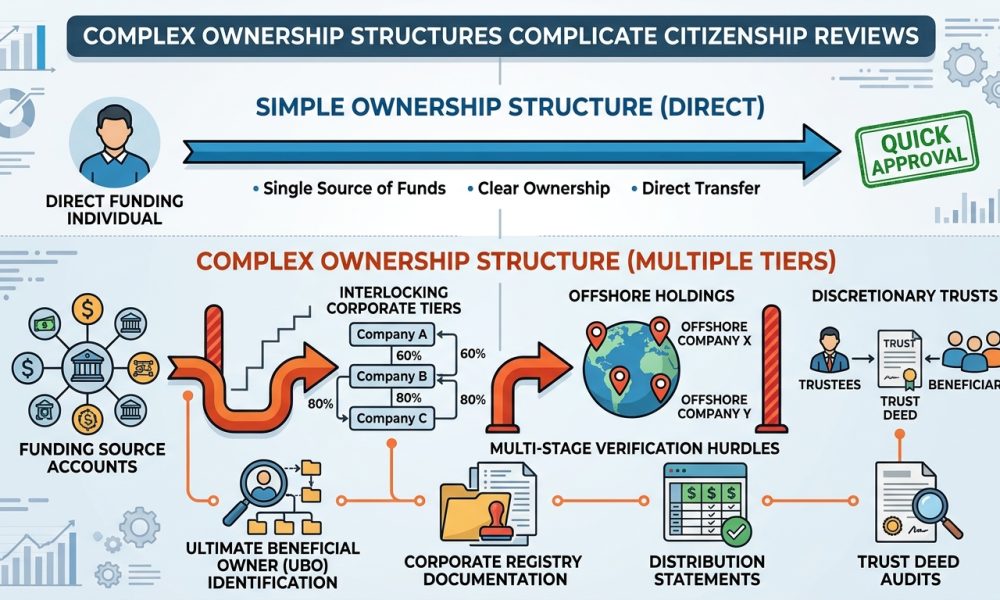
Second citizenship applicants with holding companies, family trusts, partnerships, and international investments may need to establish who controls assets, who benefits from them, and how legitimate funds reach the government.
WASHINGTON, DC, November 8, 2026 — Entrepreneurs pursuing citizenship by investment may encounter detailed financial questions when their wealth is held through companies, trusts, or investment vehicles rather than directly in a personal account under their own name.
Such arrangements can be lawful and commercially sensible. Still, they require investigators to distinguish registered ownership from ultimate control and to understand how a contribution becomes available to the individual seeking nationality, often across different jurisdictions.
As Caribbean citizenship authorities strengthen source-of-wealth and source-of-funds reviews, applicants with layered structures should prepare consistent ownership records, distribution histories, and explanations supported by documents that independent reviewers can verify across the different legal systems involved.
Complexity Is Not Automatically Evidence of Wrongdoing
A holding company may centralize several operating businesses. At the same time, a family trust may manage succession and investments, creating legitimate reasons for an applicant’s wealth to appear across multiple entities and accounts throughout their financial history.
The difficulty arises when the papers available to investigators do not clearly show who owns the economic interest, exercises decision-making authority, or has permission to transfer the proposed citizenship contribution, particularly where institutions maintain different records.
A persuasive application explains the business purpose of each important layer without treating ordinary confidentiality as permission to omit beneficial owners, trustees, or material transactions from official scrutiny. It should describe any limitations in the available evidence.
Legal Title and Beneficial Ownership May Differ
A company may appear as the legal owner of an investment account even though one or more individuals ultimately benefit from its assets or exercise authority through shares, voting agreements, or other arrangements.
Investigators may therefore examine ownership percentages, shareholder registers, voting rights, and control provisions rather than accepting a certificate of incorporation as a complete explanation of the company’s relationship to the applicant, especially where control is exercised indirectly.
This examination is especially relevant when the principal applicant owns only part of a business or when relatives and outside investors share economic benefits that should not be represented as personally available funds.
Government Guidance Recognizes Additional Verification Needs
Dominica’s Citizenship by Investment Unit expressly identifies complex corporate or business structures, missing financial records, and information involving several countries as circumstances that may require supplementary inquiries during application screening, including explanations of important transactions.
Its published guidance separates source of wealth, meaning how an applicant accumulated assets, from source of funds, meaning the origin of the specific money proposed for the qualifying government contribution, particularly when ownership is distributed among corporate entities.
Those distinctions allow a government to assess both the legitimacy of a long business career and the narrower question of whether the applicant lawfully controls money arriving at the receiving bank, sometimes using documents from several independent sources.
Company Groups Require a Clear Ownership Map
Entrepreneurs who own subsidiaries through one or more holding companies can prepare a dated organizational chart identifying legal entities, jurisdictions, direct shareholders, ultimate individual owners, and relationships between the businesses involved, rather than focusing only on balances immediately before payment.
The chart should be supported by authentic incorporation records, registers, and relevant agreements, because a neatly drawn diagram is an explanatory aid rather than independent evidence of ownership or decision-making power during the financial periods under examination.
Where ownership changed through acquisitions, inheritance, restructuring, or outside investment, a dated chronology can explain why historical bank records name different companies from those appearing on the current application, supported by appropriate corporate registry records.
Trust Arrangements Raise Questions About Control
Trust property is commonly administered by trustees for beneficiaries under governing instruments, making the identity of the settlor, trustees, beneficiaries, protectors, and people holding appointment or removal powers potentially important to financial review.
The exact legal analysis depends on the trust and jurisdiction, since a beneficiary’s economic interest does not necessarily provide unrestricted authority to withdraw assets or instruct the trustee to finance personal expenses without appropriate authorization.
A credible file may need relevant trust deed provisions, trustee resolutions, distribution statements, and banking records establishing why the applicant was entitled to receive a specific amount for the proposed contribution, especially when trust assets remain subject to trustee discretion.
U.S. Financial-Crime Guidance Offers a Useful Framework
The Financial Crimes Enforcement Network’s guidance on obtaining beneficial ownership information describes risk-based examination of legal entities and trusts, including efforts to understand who provides money and who exercises meaningful control over assets.
Although American banking guidance does not replace a Caribbean government’s nationality law, it illustrates why reviewers may request details beyond the names printed on company certificates or account statements, with particular attention to the power to authorize distributions.
Applicants should also avoid assuming every jurisdiction uses identical ownership thresholds or disclosure definitions, because an accurate application must satisfy the specific authority and financial institution reviewing it, even where regulatory definitions differ.
Distributions Must Be Distinguished From Business Revenue
A successful company can report substantial annual revenue without its founder having personal title to that income, particularly when operating expenses, company debt, minority investors, and retained earnings limit distributions under applicable corporate laws.
Where citizenship funds originate from dividends, authorities may seek audited accounts, shareholder approvals, dividend declarations, and bank records showing the amount legally distributed to the individual applicant before concluding that company revenues represent personally available assets.
For partners receiving profits through several entities, records should also explain each transfer between companies and when business assets became personally owned and available for investment, supported by corporate decisions and transaction records.
Shareholder Loans Create a Different Evidence Trail
Business owners sometimes receive money through formal shareholder loans rather than dividends, and the distinction affects whether a transfer represents income, debt, repayment, or funds held subject to contractual conditions requiring separate corporate authorization.
A reviewer may request the loan agreement, corporate authorization, repayment schedule, and account records, particularly when a large payment appears shortly before the citizenship application is filed and the shareholder and company have different obligations.
The explanation should describe the true legal arrangement rather than relabeling a loan as accumulated personal savings, because inaccurate characterization can undermine confidence in otherwise legitimate transactions, including repayment obligations that affect the applicant’s finances.
Business Sales Can Cross Several Ownership Layers
An entrepreneur selling an operating subsidiary may receive proceeds through a holding company before any distribution reaches a personal account, so you need evidence of both the commercial sale and the subsequent lawful payments before the contribution is made.
Acquisition agreements, closing statements, shareholder registers, company accounts, and transfer confirmations can help reconcile the advertised transaction value with the much smaller amount ultimately available to a particular owner after contractual deductions and distributions.
Where proceeds include installments, earnouts, or escrow balances, applicants should distinguish money already received from contingent entitlements and explain any timing differences that appear across the supporting records, documenting actual settlement dates and currencies.
Family Trust Payments Need Accurate Characterization
A trust distribution to a beneficiary may require different evidence from a loan made by the trust or a payment that a trustee makes directly on another person’s behalf under the relevant instrument.
Investigators may ask who authorized the transfer, which provision permits it, and whether the receiving person can lawfully use the amount to satisfy a citizenship contribution without further conditions, including any restrictions established by the trust.
Families should preserve trustee decisions and original statements rather than relying on an informal assertion that all trust assets belong to the principal applicant merely because relatives created the arrangement, under the governing provisions that apply to the trust.
International Accounts Can Complicate the Transfer Path
Funds may move from an overseas operating company to a regional holding entity, then to an investment account, and finally to the applicant’s personal bank before the citizenship contribution is paid, creating several points that require documentary verification.
Each movement can be legitimate, but unexplained changes in ownership, currency, amount, or account holder may require additional bank statements, transaction agreements, and evidence of the authority behind the transfer from the relevant financial institution.
Reviewers need not treat every intermediary account as suspicious. Yet, applicants benefit from presenting a continuous, verifiable transaction chain instead of disconnected screenshots showing only beginning and ending balances, with every material intermediary clearly identified.
Independent Screening Is Different From Agent Preparation
Dominica requires citizenship applications to go through government-authorized agents, who conduct preliminary checks and organize documents before the Citizenship by Investment Unit and independent investigators review them using relevant financial and identity records.
The receiving bank may also perform its own due diligence, meaning an agent’s acceptance of an organizational chart or funds explanation cannot guarantee that all subsequent reviewers will reach the same conclusion following independent reconciliation.
Applicants should respond to legitimate follow-up inquiries with authentic documents and clear explanations, recognizing that the government alone decides whether the complete record satisfies its nationality and financial-integrity requirements under the law governing applications.
Regulatory Scrutiny Makes Credible Records More Important
An October 29, 2026, Reuters report on European pressure over Caribbean investor citizenship described concerns about security and visa-free travel, alongside the financial importance of these programs to island governments and their public finances.
Such scrutiny does not mean entrepreneurs with trusts or international companies are presumptively ineligible. Still, it highlights why participating authorities must demonstrate that financial investigations are credible, independently supportable, and consistent with applicable regulations.
A program’s advertised processing speed should therefore be assessed alongside its capacity to examine complicated ownership, rather than assuming that rapid nationality issuance is always preferable to careful verification and reliable government decision-making.
Families and Financial Sponsors Add Another Layer
A principal applicant may fund citizenship for a spouse, children, and qualifying parents. At the same time, another relative or business partner actually supplies some or all of the required contribution through a separate account or authorized arrangement.
Disclose these arrangements according to program requirements because family relationships do not establish that the payer lawfully controls the funds or that a business entity has authorized the payment through appropriate governance procedures.
A complete explanation identifies contributors, legal ownership, relevant agreements, and the intended beneficiaries of the application without confusing eligibility for citizenship with entitlement to money held by others, even where businesses are otherwise fully documented.
Document Authentication Has a Narrower Role
A genuine biometric passport can help confirm electronically protected identity data. Still, technical authentication does not prove that a trust distribution was authorized or that the applicant disclosed every beneficial owner during the original government examination.
The Amicus International Consulting guide to passport NFC chip scanning and its results explains why electronic document checks must be distinguished from broader government decisions involving nationality, administrative status, and the lawful basis of issuance.
Applicants should keep original corporate, trust, and banking records separate from passport documents, since reviewers asking about financial ownership need evidence fundamentally different from a successful electronic chip reading and may request historical records.
Preparation Can Reduce Avoidable Delays
Entrepreneurs considering second passport planning through Amicus International Consulting should begin with an evidence inventory identifying entities, beneficial owners, trustees, significant distributions, and the exact account expected to finance the contribution under official program requirements.
Qualified lawyers and accountants can help reconcile genuine discrepancies and explain governing legal rights. Still, they should never invent past transactions, manufacture ownership records, or conceal material facts to simplify the file or avoid legitimate scrutiny.
Applications involving complex ownership structures can remain entirely legitimate, provided the applicant can demonstrate control, lawful financial transfers, and a coherent source-of-wealth history that the government can verify through independent records.
Transparency Supports a Defensible Citizenship Decision
A sophisticated ownership structure can offer commercial advantages, succession planning, and clear management responsibilities. Yet, those benefits do not remove the need for truthful disclosure during an investment citizenship application under the applicable nationality laws.
The strongest records distinguish personal assets from corporate property, beneficial interests from legal title, and authorized distributions from payments made without sufficient documented authority under the applicable corporate and trust arrangements governing the transaction.
Ultimately, complex ownership structures complicate citizenship reviews not because complexity itself is prohibited, but because officials need reliable evidence connecting the person seeking nationality to the legitimate funds supporting the application and any underlying business interests.




