
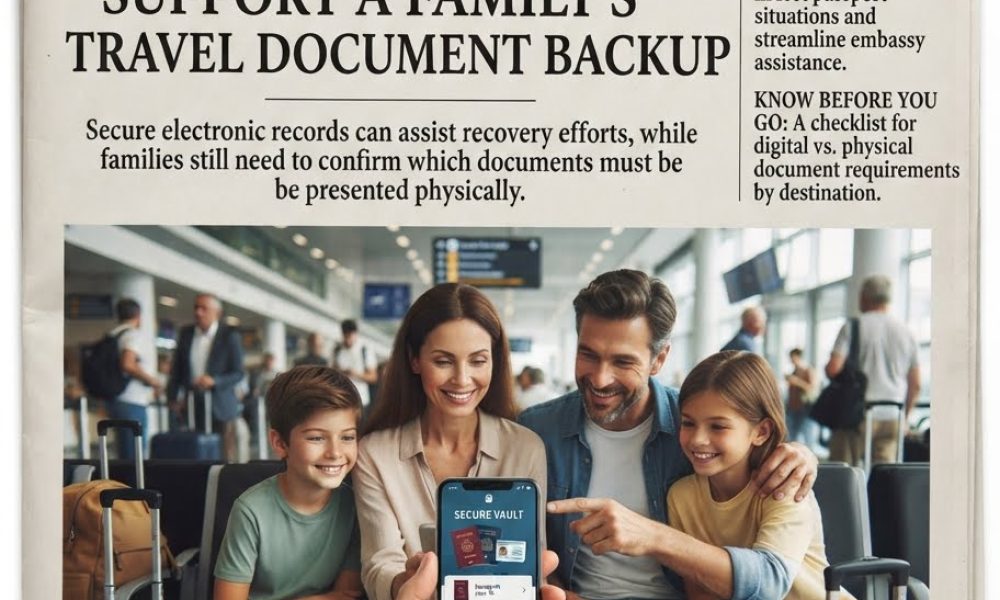
Secure electronic records can help families retrieve essential Information after documents disappear, become damaged, or are hard to find. However, families still need to confirm with authorities which originals, certified copies, and supporting records they require in person.
WASHINGTON, DC, October 16, 2026: Digital copies can strengthen a family’s travel document backup by preserving Information needed during an emergency, but their usefulness depends on secure storage, reliable access, and a clear understanding of what authorities will accept.
For parents managing several passports, consent letters, and supporting records, an organized electronic collection makes it easier to retrieve details when contacting a consulate, explaining a missing document, or preparing paperwork for a replacement.
However, a scanned passport page is not a replacement passport, and an Image of a signed document does not automatically satisfy an authority that requires an original, a specific certification, or another prescribed form of evidence.
The practical objective is to maintain accessible supporting Information alongside the documents required for the journey, with arrangements that continue working if a phone disappears, an account becomes inaccessible, or the family loses its main travel bag.
Start With the Documents Each Traveler Needs
Before creating electronic backups, families should identify the requirements for each traveler and each stage of the itinerary, including transit stops, because the needed documents can depend on nationality, age, family circumstances, and the route.
Canadian guidance on children’s travel documents identifies possible supporting records such as birth certificates, consent letters, custody arrangements, and a deceased parent’s death certificate. It directs families to check destination-specific requirements before leaving the country.
A useful preparation method is to record each document’s purpose, the person it concerns, and the format required by the receiving authority, giving parents a practical checklist instead of an undifferentiated folder containing everything they have ever scanned.
That checklist should distinguish documents needed for routine travel from records retained only for possible recovery, helping the family carry what authorities require while avoiding unnecessary circulation of sensitive Information that has no clear connection with the trip.
Understand What a Passport Copy Can Contribute
The U.S. State Department’s guidance on lost passports abroad lists a photocopy of the missing passport among the citizenship evidence travelers can bring when applying for a replacement, illustrating how a copy can support recovery without replacing the document itself.
The department directs travelers to contact the nearest embassy or consulate and apply in person, while explaining that consular staff will try to assist even when applicants cannot present every document listed in the replacement instructions.
An electronic Image may help a parent retrieve the passport number, spelling of the holder’s name, and other details. Still, the family should ask the assisting office how to submit that Information and whether printed copies are necessary.
Preparation can make assembling a replacement Application Easier. Still, it cannot guarantee issuance, eliminate identity checks, or ensure an emergency document will be accepted at every remaining destination on the family’s itinerary.
Check Consent Letters and Supporting Records Separately
Canada’s guidance on consent letters for children recommends carrying an original signed letter, noting that border officials may reject photocopies or digital versions and may be more likely to question their Authenticity.
The same guidance explains that Canada does not legally require a consent letter. Still, foreign immigration authorities, airline personnel, or Canadian officials may request one, so the requirements and expectations for a particular journey matter
Parents should avoid treating every supporting record as interchangeable, since a passport copy kept for recovery, a consent letter carried for inspection, and a court document establishing parental authority serve different purposes and face different acceptance requirements.
When an authority requests certification, notarization, or translation, the family should clarify exactly what it expects before departure, rather than assuming a clear scan or a document accepted on a previous trip will meet the new request.
Create Readable Copies Without Changing the Record
A useful backup should capture the full relevant page with readable text, visible edges, and enough detail to identify the document, so the family can consult the record without guessing at numbers hidden by glare, shadows, or careless cropping.
For multi-page documents, parents can check that the file includes the necessary attachments and signature pages, because an apparently complete first page may omit the provision, endorsement, or signature that explains the document’s practical significance.
The purpose is faithful preservation, so families should avoid modifying names, dates, photographs, signatures, or other substantive content, and should distinguish any personal explanatory note from the Image of the original record to prevent confusion during later use.
Before storing the collection, an adult can open each file at a readable size and compare it with the source, checking that the correct child’s records appear together and that no page belongs to an outdated version.
Keep the Collection Focused and Clearly Organized
A family backup doesn’t need to become a complete archive of everyone’s personal history, and a focused collection can make emergency retrieval easier while limiting how much sensitive Information is exposed if an account or device is compromised.
Parents might organize records by traveler and document category, using clear filenames and a separate inventory that identifies what each file contains without including full passport numbers or other unnecessary personal details in the filenames.
Records linked to a particular trip should clearly identify the relevant dates, especially where consent arrangements, accompanying adults, accommodation details, or travel plans differ from earlier journeys and could otherwise create uncertainty about which document remains applicable.
After a passport renewal or another important change, the family should replace the active backup and clearly separate any historical record it genuinely needs, reducing the chance that someone submits an expired document simply because it appears first.
Protect Storage Accounts and Devices
Canada’s Get Cyber Safe guidance recommends strong passwords and multifactor Authentication to protect backups, and encourages using more than one storage option to reduce dependence on a single location that could be lost or compromised.
For a family, those principles can translate into a protected document vault or restricted storage account, supported by secure devices and permissions that allow access only to the adults who have a legitimate need for the records.
Parents should understand whether their chosen service stores files locally, remotely, or both, because that affects whether documents remain available without an internet connection and whether deleting one copy also removes synchronized copies elsewhere.
Security settings deserve attention before departure, when you have time to review account recovery details, install updates, and confirm shared access works as intended, rather than trying unfamiliar changes while managing children and a disrupted itinerary.
Plan for Losing the Phone That Holds the Backup
A backup stored only on the same phone used for boarding passes, messaging, and account Authentication can become unavailable at the exact moment you need it, so it’s important to plan for that device being lost.
Families can test whether another authorized adult can retrieve the essential records from a separate device, without relying on access to the missing phone, while keeping recovery credentials protected and separate from the device they are intended to recover.
A limited offline copy may help when connectivity fails, provided the device and files are properly protected. However, an offline folder on a lost phone still requires another recovery route if it’s the family’s only accessible copy.
The most useful test is practical: before leaving home, responsible adults should show they can find the correct record through the backup arrangement, rather than assuming an unfamiliar app will work during an emergency.
Assign Access According to Actual Responsibility
When two parents or guardians travel together, both may need access to essential Information. Still, sharing should follow the family’s actual legal and practical arrangements rather than assuming that every relative or accompanying adult should receive the entire collection.
A trusted contact at home could hold selected recovery Information or help retrieve documents if requested, with clear instructions about who may receive them and how to verify an unexpected request before sending a child’s identity records.
For school trips or travel with relatives, families should decide which documents the accompanying adult needs and how the organizer will handle them, including who can access uploaded records and whether the organization keeps copies after the journey ends.
These arrangements should respect any applicable parenting orders or restrictions on disclosure, and people should resolve uncertainty about another person’s authority through appropriate advice rather than by broadly distributing documents in the hope of making travel easier.
Share Documents Carefully When Assistance Is Needed
Canadian passport-fraud guidance advises people to protect travel document Information and share copies only when they are confident in the recipient, recognizing that a photocopy or electronic Image can become sensitive material that requires careful handling.
If someone claims to represent a consulate, airline, or assistance provider and requests documents, parents can verify the organization through its official contact Information before uploading files, especially if the request arrives unexpectedly or pressures them to act immediately.
When a verified organization provides a designated submission process, following it can reduce confusion about where records should go, and sending only the requested material avoids exposing unrelated family Information in a larger document folder.
Families should also ask whether a temporary sharing link, restricted recipient access, or another available safeguard suits the situation, recognizing that turning off a link later does not necessarily delete a copy already downloaded by its recipient.
Use Backups Within the Official Recovery Process
If a passport disappears abroad, the first practical step is to contact the relevant issuing authority’s consular service and follow its instructions, using the backup to provide accurate Information rather than assuming that a copy authorizes continued travel.
For U.S. passports, the State Department explains that reporting a passport lost or stolen makes it invalid for international travel, so subsequently finding the booklet does not restore its usefulness as though the report had never occurred.
A child’s replacement may require additional evidence and parental participation, and families should obtain instructions specific to the child’s nationality and circumstances instead of assuming that an adult replacement checklist fully describes what the consular office needs.
The family may also need to discuss changed travel dates with its carrier and accommodation provider, preserve relevant correspondence and receipts, and check insurance terms, because document recovery can affect several arrangements beyond obtaining another passport.
Treat Children’s Records as a Distinct Part of Preparation
A child’s travel file may need to explain relationships as well as identity, particularly when surnames differ, one parent travels alone, or a guardian accompanies the child, making accurate organization valuable even when nobody loses a passport.
Amicus International Consulting’s coverage of parent photographs in Mexican children’s passports addresses a related aspect of family travel documentation, while the separate question of which supporting records a family must carry still requires confirmation for the particular journey.
Parents should avoid assuming that Information printed in a passport eliminates a destination’s consent or relationship-document requirements, because different records answer different questions, and the relevant authority determines what evidence it requires in the circumstances.
For children traveling separately during part of an itinerary, the backup arrangement should reflect who accompanies each child at each stage, ensuring that the responsible adult can obtain the relevant records without accessing unrelated Information about other family members.
Review Access and Records After the Journey
Once the family returns, an adult can review temporary sharing permissions, remove unnecessary downloads from devices, and ask service providers about records submitted during the trip, keeping any material still needed for unresolved applications, claims, or other legitimate purposes.
Deleting a file from one folder may leave copies in synchronized storage, email attachments, downloaded files, or a deleted-items area, so cleanup should follow the actual storage arrangements rather than assuming that one deletion removes every version.
The family can also record what worked during the journey, including whether offline access succeeded and whether an authority requested an unexpected format, using that experience to improve preparation without treating one official’s acceptance as a universal rule.
A dependable travel document backup gives families another route to essential Information when something goes wrong, while clear responsibilities, protected access, current records, and the required physical documents help turn that Information into practical support during recovery.




