
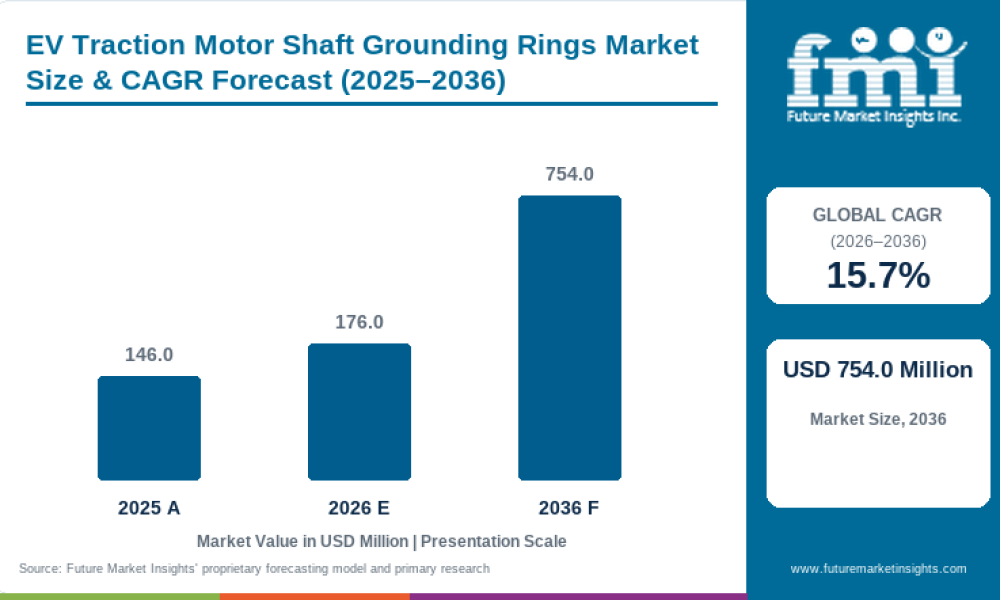
The global EV traction motor shaft grounding rings market is estimated at USD 176.0 million in 2026 and is projected to reach USD 754.0 million by 2036, expanding at a 15.7% CAGR from 2026 to 2036. The market was valued at USD 146.0 million in 2025. Growth is linked to electric vehicle production, traction motor design requirements, and the need to manage electrical currents that can damage motor bearings.
EV traction motor shaft grounding rings use conductive rings and brush assemblies to divert shaft current away from bearings. The market estimate includes original equipment manufacturer (OEM) fitment and service replacement. Insulated bearings, conductive grease, and general industrial motor rings sold outside road-vehicle traction systems are excluded.
Demand develops alongside the electric vehicle drive motor market because inverter-fed traction motors can generate high-frequency shaft voltage and bearing current. Grounding-ring adoption depends on the penetration of these components, the number of traction motors per vehicle, and the proportion of platforms that use alternative current-mitigation technologies.
What Are the Key Segments in the EV Traction Motor Shaft Grounding Rings Market?
Passenger cars are projected to account for 84.0% of demand in 2026, reflecting their substantial role in electric vehicle production and the associated requirement for reliable traction motor operation.
Carbon-fiber and brush rings are expected to hold 67.0% of grounding element design demand in 2026. These assemblies provide a conductive path intended to divert shaft current away from bearings, making contact performance and durability important considerations for motor manufacturers.
Battery electric vehicles (BEVs) are projected to represent 78.0% of EV architecture demand in 2026. Their full electric-propulsion configurations make shaft-voltage management an important consideration for traction motor and inverter engineering.
Single-motor vehicles are expected to account for 62.0% of motor configuration demand in 2026. Cost-focused EV platforms commonly use one primary traction unit, concentrating the grounding requirement around a single motor and rotor shaft.
OEM supply is projected to capture 88.5% of sales channel demand in 2026. Shaft diameter, bearing arrangement, housing geometry, and the grounding path are established during motor development, making protection requirements part of e-drive engineering and qualification.
The market is segmented by vehicle type, EV architecture, motor configuration, grounding element design, sales channel, and region. Vehicle categories include passenger cars, light commercial vehicles, medium and heavy trucks, and buses and coaches. Grounding element designs include carbon-fiber and brush rings, conductive lip and nonwoven contacts, and spring and metal contacts. Sales channels comprise OEM supply and service and aftermarket demand.
Get detailed market forecasts, competitive benchmarking, and pricing trends:
https://www.futuremarketinsights.com/reports/sample/rep-gb-35591
Which Countries Are Showing the Strongest Growth in the EV Traction Motor Shaft Grounding Rings Market?
Indonesia is projected to record the highest growth among the profiled countries, with a 24.0% CAGR through 2036. Its market outlook reflects the potential for expanding electric vehicle adoption and increased demand for traction motor components. Grounding-ring suppliers will need to align product specifications with local vehicle platforms and evolving motor designs.
India is expected to expand at a 23.0% CAGR. The country’s projected growth creates opportunities for suppliers serving electric passenger vehicles and other road-vehicle platforms. As motor and inverter systems develop, OEM qualification and reliable current-diversion performance will remain important considerations.
Brazil and Türkiye are each projected to grow at a 20.0% CAGR. In both markets, the outlook is linked to the development of electric mobility and the integration of traction motor components into vehicle platforms. Suppliers will need to address compatibility, durability, and manufacturing requirements as demand develops.
South Korea is expected to record a 17.0% CAGR, supported by its automotive and electric powertrain manufacturing base. Motor engineering, bearing protection, and integration with inverter-fed traction systems are relevant factors for grounding-ring suppliers targeting vehicle manufacturers.
Mexico is also projected to grow at a 17.0% CAGR. The country’s automotive manufacturing ecosystem creates potential opportunities for component suppliers working with OEMs and traction motor producers. Platform-specific qualification and production consistency will influence supplier selection.
The United Kingdom is projected to record a 16.0% CAGR, the lowest among the countries listed. Market development will depend on electric vehicle adoption and the extent to which traction motor manufacturers incorporate shaft-current mitigation into their designs.
How Is the Competitive Landscape Evolving?
Competition in the EV traction motor shaft grounding rings market centers on electrical contact performance, resistance to wear, packaging compatibility, and the ability to maintain a reliable grounding path under operating conditions. Suppliers must demonstrate that their designs divert shaft current without introducing unacceptable drag, debris, or service risks.
OEM qualification is particularly important because grounding-ring specifications are closely linked to motor geometry, bearing arrangements, and the inverter-driven electrical environment. Suppliers that can support early engineering integration and consistent production quality are positioned to address the requirements of vehicle manufacturers and traction motor developers.
Alternative mitigation approaches also influence purchasing decisions. Insulated bearings and conductive grease may be used as part of broader bearing-protection strategies, while grounding rings offer a dedicated conductive path. The selected solution depends on the motor architecture, electrical characteristics, packaging constraints, and validation requirements of each platform.
What Does the Analyst Say About the EV Traction Motor Shaft Grounding Rings Market?
Future Market Insights Principal Consultant Nikhil Kaitwade observes:
“A shaft-grounding ring is a small component inside an expensive e-drive. Its commercial value comes from providing a stable current path without adding unacceptable drag, debris or service risk.”
The assessment highlights the engineering balance behind grounding-ring adoption. The component must manage shaft current while maintaining reliable contact and avoiding unwanted effects on motor performance, durability, and maintenance.
Drive Your Business Growth Strategy: Checkout the Report for Key Insights!
https://www.futuremarketinsights.com/checkout/35591
What Is Driving Demand for EV Traction Motor Shaft Grounding Rings?
Managing inverter-induced shaft current
Inverter-fed traction motors can generate high-frequency shaft voltage and bearing current. If electrical current passes through motor bearings, it can contribute to bearing damage and affect long-term reliability. Grounding rings provide an alternative conductive path intended to reduce this risk.
Integrating bearing protection during motor development
Grounding-ring requirements are influenced by shaft diameter, bearing placement, housing geometry, and the electrical grounding path. These parameters are typically established during motor design, helping explain why OEM supply is projected to account for 88.5% of sales channel demand in 2026. Early integration can support system-level evaluation and qualification.
Addressing varied EV motor configurations
The number of traction motors in a vehicle affects the number and placement of grounding solutions that may be required. Single-motor vehicles are projected to account for 62.0% of motor configuration demand in 2026, while multi-motor platforms introduce additional design and integration considerations.
Supporting service and replacement requirements
Although OEM supply dominates the market, service replacement remains part of the market scope. Replacement demand depends on installed vehicle populations, component condition, service requirements, and compatibility with the original traction motor design.
What Are the Key Market Restraints?
Grounding rings compete with other shaft-current mitigation approaches, including insulated bearings and conductive grease. These alternatives can influence whether a vehicle manufacturer adopts a dedicated grounding ring or another protection strategy.
Technical validation also presents a challenge. Grounding rings must provide a stable current path while controlling wear, drag, debris, and service risks. Differences in motor architecture and packaging can require application-specific designs, increasing the importance of engineering coordination and qualification.
What Opportunities Exist for Grounding Ring Suppliers?
Suppliers can focus on designs that combine dependable electrical contact, low mechanical impact, and compatibility with compact traction motor assemblies. Close collaboration with OEMs and motor manufacturers during early development can help align ring geometry, grounding paths, and durability targets with platform requirements.
The service and aftermarket channel provides an additional opportunity to support replacement requirements across the installed vehicle base. Product compatibility, consistent quality, and clear application coverage can help suppliers serve maintenance and repair needs without compromising the original motor design.
What Is the Outlook for the EV Traction Motor Shaft Grounding Rings Market?
The EV traction motor shaft grounding rings market is projected to increase from USD 176.0 million in 2026 to USD 754.0 million by 2036, at a 15.7% CAGR. Passenger cars, carbon-fiber and brush rings, battery electric vehicles, single-motor configurations, and OEM supply are the leading segments based on the supplied 2026 estimates.
Indonesia and India are projected to record the fastest growth among the profiled countries, at 24.0% and 23.0% CAGRs, respectively. As electric vehicle platforms evolve, demand will depend on traction motor production, shaft-current mitigation strategies, and OEM decisions about integrating grounding rings into motor designs.
About Future Market Insights
Future Market Insights (FMI) provides market research and consulting services across industries, delivering market forecasts, competitive intelligence, and strategic analysis to support business decision-making.



