
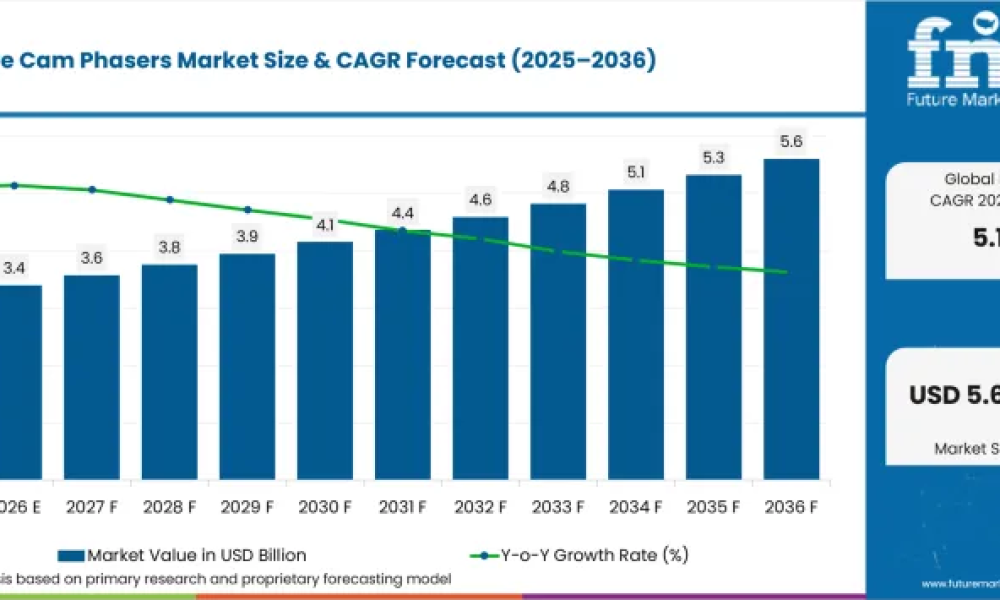
The global automotive cam phasers market is projected to increase from USD 3.4 billion in 2026 to USD 5.6 billion by 2036, expanding at a compound annual growth rate (CAGR) of 5.1%. Demand is linked to combustion and hybrid engine programs that use adjustable valve timing to support fuel efficiency, engine response, and hybrid restart performance. As automakers refine existing powertrain architectures, cam phaser suppliers are focusing on response characteristics, oil demand, durability, and integration with engine control systems.
Developments in hybrid powertrains are creating opportunities for more advanced phasing technologies. In April 2026, Schaeffler’s hybrid-powertrain release described electromechanical camshaft phasing units incorporating motors, controls, and software. Pressure-independent response offers a potential route for suppliers to serve hybrid engine programs without requiring a broader cylinder-head redesign.
Regional demand is also shaped by changes in vehicle powertrain mix. The European Automobile Manufacturers’ Association (ACEA) reported in July 2026 that hybrid-electric cars accounted for 37.3% of European Union registrations in the first half of the year, while battery-electric cars represented 20.7%. Petrol and diesel vehicles together accounted for 29.7%. This mix indicates that combustion-engine technology remains relevant within the European market, including hybrid applications, even as battery-electric vehicles reduce the potential for new cam phaser installations.
What Are the Key Segments in the Automotive Cam Phasers Market?
The automotive cam phasers market is segmented by phaser type, engine type, vehicle type, sales channel, and application. Segment performance depends on engine architecture, valve timing requirements, production volumes, and compatibility with established manufacturing systems.
- Hydraulic Cam Phasers — 38.0% share: Hydraulic cam phasers are estimated to lead the phaser-type segment in 2026, supported by oil-fed architectures compatible with established engine timing hardware and manufacturing processes.
- Inline Engines — 31.0% share: Inline engines are expected to lead the engine-type segment in 2026 because high-volume four-cylinder layouts can accommodate modular phaser interfaces.
- Passenger Cars — 42.0% share: Passenger cars are projected to account for the largest vehicle-type share in 2026 as gasoline and hybrid powertrains continue using variable valve control.
- OEM Direct Sales: Original equipment manufacturers remain an important channel because cam phasers must be qualified against specific engine designs and integrated into production timing systems.
Get detailed market forecasts, competitive benchmarking, and pricing trends:
https://www.futuremarketinsights.com/reports/sample/rep-gb-35124
Which Countries Are Showing the Strongest Growth in the Automotive Cam Phasers Market?
Mexico is projected to record the fastest growth among the profiled countries, with a 6.6% CAGR through 2036. The forecast reflects opportunities associated with automotive engine manufacturing and the supply of components for established and evolving powertrain programs. Suppliers must maintain consistent manufacturing quality and demonstrate that phasers meet engine-specific performance and durability requirements.
South Korea is expected to expand at a 6.3% CAGR. The country’s automotive manufacturing and hybrid powertrain development create opportunities for suppliers offering reliable variable valve timing systems. Response characteristics, control integration, and compatibility with engine designs remain important considerations for component qualification.
Brazil is projected to grow at a 5.9% CAGR. Demand will depend on the mix of vehicle and engine programs that continue to use adjustable valve timing. Suppliers must align product specifications and production capacity with the requirements of the engines and vehicle platforms they serve.
Japan is expected to record a 5.6% CAGR through 2036. Cam phaser demand is linked to engine technology development and the continued use of variable valve timing in applicable combustion and hybrid powertrains. Manufacturers must demonstrate precise phase control and dependable operation across engine operating conditions.
The United States is projected to expand at a 5.2% CAGR. The market reflects demand from vehicle programs that retain combustion engines and hybrid systems. Suppliers need to balance performance improvements with manufacturing cost, durability, and the requirements of engine-specific validation.
France is expected to grow at a 4.9% CAGR. The country’s powertrain outlook is influenced by the balance between hybrid and battery-electric vehicle adoption. Hybrid programs continue to provide potential applications for cam phasers, while the growth of fully electric vehicles limits new installations in powertrains that do not use conventional camshafts.
Germany is projected to record a 4.5% CAGR, the lowest rate among the seven profiled countries. Its outlook reflects the transition in vehicle powertrain mix, including continued hybrid development alongside battery-electric adoption. Suppliers must assess the expected production life and volume of individual engine programs when allocating development and manufacturing resources.
How Is the Competitive Landscape Evolving?
The competitive landscape includes BorgWarner Inc., Schaeffler AG, AISIN CORPORATION, Astemo, Ltd., Mikuni Corporation, and Melling Tool Company. These companies operate across automotive powertrain, engine components, and related technologies that support valve timing and engine performance.
Competition increasingly involves the ability to meet the requirements of both established hydraulic architectures and evolving electromechanical designs. Hydraulic phasers benefit from mature manufacturing routes and established integration with engine lubrication systems. Electromechanical phasers offer a different approach by incorporating motors, controls, and software to manage phase response.
Schaeffler’s April 2026 hybrid-powertrain release illustrates the direction of development toward electromechanical camshaft phasing. For suppliers, the opportunity depends on demonstrating that the technology can deliver the required response and durability while integrating with existing engine architecture. Cost, packaging, controls, and validation remain important considerations for adoption.
Powertrain electrification is also changing how suppliers assess long-term investment. Battery-electric vehicles do not require conventional cam phasers, so manufacturers must consider the expected duration and volume of combustion and hybrid programs when planning product development and production capacity.
What Does the Analyst Say About the Automotive Cam Phasers Market?
Nikhil Kaitwade, Principal Consultant at Future Market Insights, observes:
“Cam phaser value is shifting toward engines that need fast phase response during hybrid restarts without larger cylinder-head changes. Suppliers that prove response, oil-demand control and engine-specific durability can protect content as battery-electric growth reduces the number of new combustion programs.”
The assessment highlights the importance of matching phaser technology to the requirements of the target engine. Suppliers that demonstrate reliable phase response, controlled oil demand, and durability may be better positioned to compete for hybrid powertrain applications.
What Is Driving Demand for Automotive Cam Phasers?
Hybrid Powertrain Development
Hybrid engines must coordinate combustion operation with electric propulsion and restart events. Variable valve timing can support engine response and efficiency, making phase control an important consideration in relevant hybrid powertrain designs. Suppliers must validate phaser behavior against the specific engine and control strategy.
Established Hydraulic Architectures
Hydraulic cam phasers are projected to hold a 38.0% share of the market in 2026. Their compatibility with established timing hardware and manufacturing routes supports their continued use in applicable engine programs. For automakers, these architectures can offer a familiar integration path where hydraulic actuation meets performance requirements.
Electromechanical Phasing Technology
Electromechanical camshaft phasers combine motors, controls, and software to manage timing adjustments. Pressure-independent response can be relevant to hybrid engine applications where phasing requirements differ across operating conditions. Commercial adoption depends on demonstrating durability, control compatibility, packaging suitability, and cost effectiveness.
Continued Variable Valve Timing in Passenger Cars
Passenger cars are expected to account for 42.0% of the market in 2026. Gasoline and hybrid powertrains that retain camshafts and variable valve timing continue to provide applications for phaser systems. Demand will vary by engine design and the production outlook for individual vehicle platforms.
Drive Your Business Growth Strategy: Checkout the Report for Key Insights!
https://www.futuremarketinsights.com/checkout/35124
What Are the Key Market Restraints?
The shift toward battery-electric vehicles presents a structural restraint for the automotive cam phasers market. Fully electric powertrains do not use conventional camshafts, reducing the number of potential new installations as battery-electric vehicles gain market share. Suppliers must evaluate how electrification changes the future production volumes of their target engine programs.
Qualification and integration requirements can also increase development costs. Cam phasers must meet engine-specific demands for timing accuracy, response, lubrication, and durability. New designs may require additional validation and coordination with engine controls, limiting how quickly suppliers can introduce alternative technologies across different platforms.
What Opportunities Exist for Automotive Cam Phaser Manufacturers?
Hybrid powertrain programs offer opportunities for suppliers that can deliver reliable phase control during engine restarts and changing operating conditions. Electromechanical designs may provide an alternative where pressure-independent response is valuable and can be achieved without extensive changes to the surrounding engine architecture.
Suppliers can also strengthen their position through improvements in durability, oil-demand management, and compatibility with established engine systems. Early collaboration with engine manufacturers can help identify application requirements and support qualification before production volumes are finalized.
At the same time, manufacturers need to manage investment carefully as the powertrain mix changes. Focusing on engine programs with defined production outlooks and clear technical requirements can help suppliers align development expenditure with realistic opportunities.
How Is the Automotive Cam Phasers Market Segmented?
The market is analyzed across the following categories:
- By Phaser Type: Hydraulic, vane-type, electric, sprocket-type, and cam torque actuated designs.
- By Engine Type: Inline, hybrid ICE, turbocharged engines, V engines, and performance engines.
- By Vehicle Type: Passenger cars, SUVs/crossovers, light commercial vehicles, and performance vehicles.
- By Sales Channel: OEM direct, engine system suppliers, aftermarket replacement, and remanufacturing.
- By Application: Intake control, dual variable valve timing (VVT), exhaust control, and cylinder-deactivation support.
- By Region: Country and regional markets assessed in the report.
What Is the Automotive Cam Phasers Market Outlook?
The automotive cam phasers market is projected to reach USD 5.6 billion by 2036, expanding at a CAGR of 5.1% from 2026. Hydraulic cam phasers, inline engines, and passenger cars are expected to lead their respective segments in 2026, with projected shares of 38.0%, 31.0%, and 42.0%.
Mexico is forecast to record the strongest growth among the profiled countries at 6.6% CAGR, followed by South Korea at 6.3%, Brazil at 5.9%, Japan at 5.6%, the United States at 5.2%, France at 4.9%, and Germany at 4.5%. Across these markets, hybrid powertrain development, engine-specific qualification, and the shift toward electromechanical phasing will shape supplier opportunities, while battery-electric adoption will continue to limit demand from new powertrains that do not use conventional camshafts.
About Future Market Insights
Future Market Insights (FMI) provides market research and consulting services across automotive, aerospace, energy, and industrial sectors. Its research includes market forecasts, competitive intelligence, segment analysis, and country-level assessments to support business planning and strategic decision-making.



