
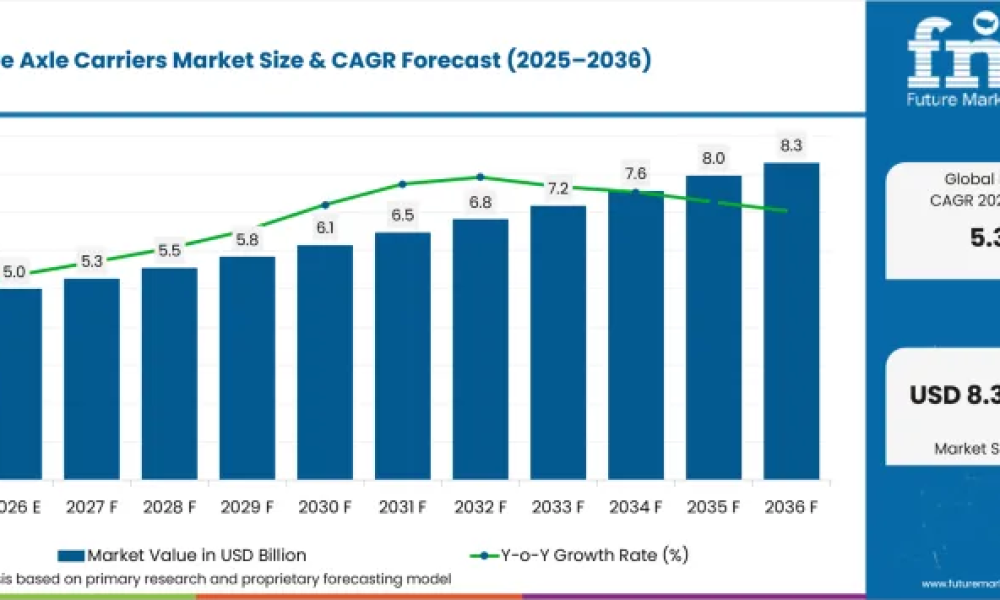
The global automotive axle carriers market is projected to increase from USD 5.0 billion in 2026 to USD 8.3 billion by 2036, expanding at a compound annual growth rate (CAGR) of 5.3%. Demand is closely linked to vehicle-platform development because axle carriers establish differential positioning, bearing support, and mounting interfaces within drivetrain assemblies. As automakers introduce new conventional, all-wheel-drive, hybrid, and electric platforms, suppliers must deliver carrier designs that meet structural requirements while maintaining dimensional accuracy and production consistency.
The transition toward integrated electric drivetrains is influencing component development. In May 2025, Schaeffler documented the successful ramp-up of its fourth-generation e-axle for Hyundai Motor Group. Programs of this kind increase the importance of compatible automotive axle systems, where carrier interfaces must accommodate powertrain requirements without unnecessary redesign of the complete axle assembly.
Manufacturing localization is also affecting sourcing strategies. In January 2025, the Government of Canada announced that Linamar would expand electric vehicle parts work at four Ontario facilities, with the project expected to create approximately 2,000 full-time jobs. Additional local machining capacity can support the production of automotive differential housings and related structural components. However, changes in suppliers or manufacturing processes still require fatigue, bore, and assembly validation before a new source can be approved.
What Are the Key Segments in the Automotive Axle Carriers Market?
The automotive axle carriers market is segmented by carrier type, material, vehicle type, sales channel, drivetrain, and region. Demand across these categories depends on vehicle architecture, structural loading, manufacturing requirements, and the timing of platform qualification.
- Rear Axle Carriers — 32.0% share: Rear axle carriers are projected to lead the carrier-type segment in 2026 because of their role in rear-drive and multi-axle drivetrain packaging.
- Cast Iron — 40.0% share: Cast iron is expected to lead the material segment in 2026, supported by established casting processes and predictable load-bearing behavior.
- OEM Direct — 55.0% share: OEM direct sales are forecast to account for the largest channel share in 2026 because vehicle manufacturers control platform packaging, engineering approvals, and qualification schedules.
- AWD/4WD and e-Axle Configurations: These drivetrain architectures require carrier interfaces that meet the packaging, bearing support, and structural requirements of the relevant powertrain design.
Get detailed market forecasts, competitive benchmarking, and pricing trends:
https://www.futuremarketinsights.com/reports/sample/rep-gb-35096
Which Countries Are Showing the Strongest Growth in the Automotive Axle Carriers Market?
Canada is projected to record the fastest growth among the profiled countries, with a 6.1% CAGR through 2036. Investments in automotive component manufacturing can support local production capacity and strengthen supplier participation in vehicle programs. The announced Linamar expansion in Ontario illustrates how manufacturing investment can increase capacity for electric vehicle components. Suppliers must still demonstrate that carrier designs meet vehicle-specific dimensional and durability requirements.
Mexico is expected to expand at a 5.8% CAGR. Its position in the forecast reflects opportunities associated with automotive production and the supply of drivetrain components. Suppliers competing for axle-carrier programs must maintain consistent casting quality, machining precision, and delivery performance to meet OEM production schedules.
Brazil is projected to grow at a 5.5% CAGR. Demand is influenced by vehicle-platform requirements and the need for reliable structural components across relevant drivetrain configurations. Manufacturers must balance material selection, machining tolerances, and production economics while meeting platform-specific validation requirements.
South Korea is expected to record a 5.1% CAGR. The country’s automotive technology ecosystem and development of integrated electric drivetrains create opportunities for suppliers capable of supporting evolving axle architectures. Compatibility with e-axle systems and precise control of differential and bearing interfaces remain important engineering considerations.
The United States is projected to expand at a 4.8% CAGR. Demand is associated with vehicle-platform renewal, drivetrain production, and sourcing requirements across conventional and electrified vehicles. OEMs evaluate suppliers on structural performance, dimensional accuracy, manufacturing consistency, and the ability to support production volumes after launch.
Germany is expected to record a 4.5% CAGR. Suppliers serving the market must meet demanding requirements for engineering precision and repeatable production. Axle-carrier changes can affect differential alignment, bearing support, and surrounding assembly interfaces, making design control and qualification documentation important to supplier selection.
Japan is projected to grow at a 4.1% CAGR, the lowest rate among the seven profiled countries. Established vehicle-platform requirements and manufacturing standards make reliable dimensional control and consistent component quality important for suppliers seeking long-term production contracts.
How Is the Competitive Landscape Evolving?
The competitive landscape includes Dana Incorporated, Dauch Corporation, Magna International, Linamar Corporation, JTEKT Corporation, AISIN Corporation, Schaeffler AG, and ZF Friedrichshafen AG. These companies participate in the broader automotive drivetrain, axle, and powertrain supply chain.
Axle carriers are closely tied to the mechanical layout of a vehicle platform. Differential bore location, bearing seats, suspension attachment points, and mounting interfaces must align with the surrounding assembly. As a result, suppliers compete on engineering support and manufacturing control as well as component cost.
The growth of integrated electric drivetrains is adding another consideration to supplier selection. Carriers must support the requirements of the intended axle configuration while accommodating powertrain packaging and structural loads. Suppliers with flexible manufacturing capabilities can pursue conventional and electrified vehicle programs, provided that each design satisfies the relevant engineering and validation requirements.
Localization investments can also influence sourcing decisions by expanding the availability of regional machining and production capacity. However, additional capacity does not automatically qualify a supplier for a vehicle program. Manufacturers must demonstrate that their processes consistently meet specified tolerances and durability requirements before production sourcing can shift.
What Does the Analyst Say About the Automotive Axle Carriers Market?
Nikhil Kaitwade, Principal Consultant at Future Market Insights, observes:
“Platform engineering sets axle-carrier economics by fixing differential bore location, bearing seats and suspension interfaces ahead of series tooling. Manufacturers with flexible casting and machining assets can follow conventional, AWD/4WD and eAxle programs without surrendering dimensional control at launch volume.”
The assessment highlights the importance of aligning product engineering with manufacturing readiness. For suppliers, early engagement during platform development can help establish design compatibility before tooling and production processes are finalized.
Drive Your Business Growth Strategy: Checkout the Report for Key Insights!
https://www.futuremarketinsights.com/checkout/35096
What Is Driving Demand for Automotive Axle Carriers?
Vehicle-Platform Renewal
New vehicle platforms can require revised carrier geometry to match differential locations, bearing arrangements, suspension interfaces, and drivetrain packaging. These requirements create opportunities for suppliers that can support early engineering work and deliver validated components on schedule.
Electrification and E-Axle Integration
Electric powertrains introduce different integration requirements for axle and drivetrain assemblies. The successful ramp-up of Schaeffler’s fourth-generation e-axle for Hyundai Motor Group, documented in May 2025, illustrates the ongoing development of integrated electric propulsion systems. Carrier suppliers must ensure that structural designs and interfaces remain compatible with the selected axle architecture.
Demand for Precision Casting and Machining
Cast iron is projected to hold a 40.0% share of the market in 2026. Established casting routes and predictable load-bearing behavior support its position in the material segment. Machining operations remain essential for achieving the dimensional tolerances required at differential bores, bearing seats, and assembly interfaces.
Localized Manufacturing Capacity
Automotive manufacturers increasingly evaluate production capacity and supplier readiness when planning sourcing for vehicle programs. Investments in local component manufacturing can expand regional production options, although qualification requirements continue to govern whether a particular supplier can receive production awards.
What Are the Key Market Restraints?
Validation costs can restrict supplier changes after vehicle-platform geometry has been finalized. Changes to materials, machining processes, or attachment interfaces may require additional fatigue testing, dimensional checks, and assembly validation. These requirements can increase development costs and delay production sourcing decisions.
Manufacturing complexity also presents challenges. Axle carriers must maintain accurate interfaces under structural loads, and inconsistencies can affect differential positioning or bearing support. Suppliers must coordinate casting quality, machining precision, inspection, and process control to ensure repeatable performance at production volumes.
What Opportunities Exist for Automotive Axle Carrier Manufacturers?
Manufacturers can strengthen their position by investing in flexible casting and machining operations capable of supporting different axle configurations. Early collaboration with OEM engineering teams can help suppliers understand platform requirements and identify interface issues before production tooling is finalized.
The expansion of electric drivetrain programs creates opportunities for carriers designed to meet the requirements of integrated e-axle assemblies. Suppliers that combine dimensional control, fatigue validation, and production scalability can compete for new platform awards while continuing to support conventional drivetrain programs.
Regional manufacturing investments also offer opportunities to improve production responsiveness. However, suppliers must pair local capacity with documented quality systems and vehicle-specific validation to convert manufacturing capability into approved sourcing relationships.
How Is the Automotive Axle Carriers Market Segmented?
The market is analyzed across the following categories:
- By Carrier Type: Rear axle carriers, front axle carriers, AWD axle carriers, EV e-axle carriers, and heavy-duty axle carriers.
- By Material: Cast iron, aluminum, ductile iron, forged steel, and lightweight alloy.
- By Vehicle Type: Passenger cars, SUVs/crossovers, pickup trucks, light commercial vehicles, and electric vehicles.
- By Sales Channel: OEM direct, driveline Tier-1s, aftermarket replacement, and precision foundry supply.
- By Drivetrain: AWD/4WD, rear-wheel drive, front-wheel drive, and e-axle configurations.
- By Region: Country and regional markets assessed in the report.
What Is the Automotive Axle Carriers Market Outlook?
The automotive axle carriers market is projected to reach USD 8.3 billion by 2036, advancing at a CAGR of 5.3% from 2026. Rear axle carriers, cast iron, and OEM direct sales are expected to lead their respective segments in 2026, with projected shares of 32.0%, 40.0%, and 55.0%.
Canada is forecast to record the highest growth among the profiled countries at 6.1% CAGR, followed by Mexico at 5.8%, Brazil at 5.5%, South Korea at 5.1%, the United States at 4.8%, Germany at 4.5%, and Japan at 4.1%. Across these markets, vehicle-platform engineering, e-axle integration, manufacturing localization, and dimensional validation will remain important factors shaping supplier selection.
About Future Market Insights
Future Market Insights (FMI) provides market research and consulting services across automotive, aerospace, energy, and industrial sectors. Its research includes market forecasts, competitive intelligence, segment analysis, and country-level assessments to support business planning and strategic decision-making.



