
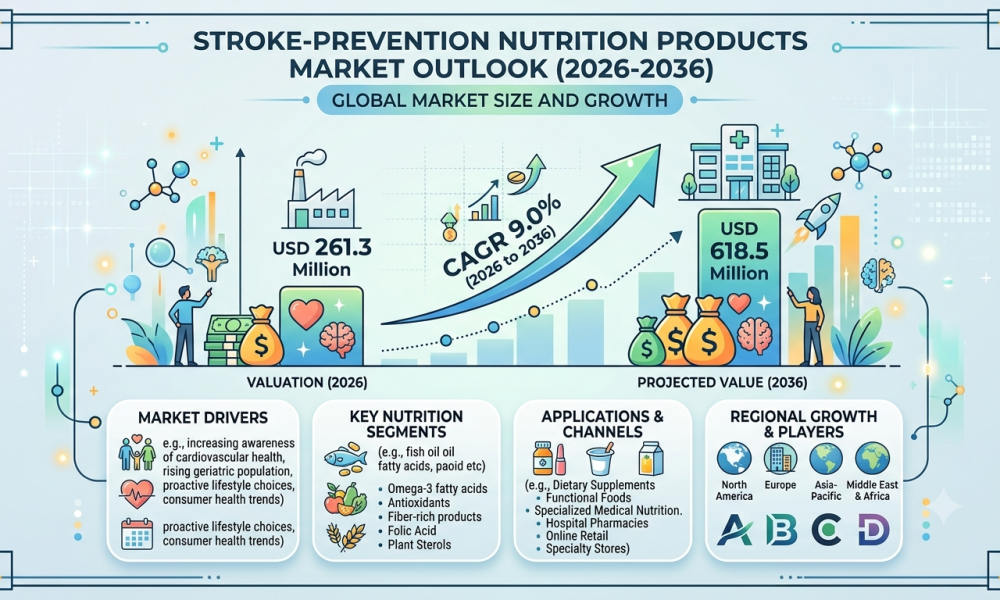
The global stroke-prevention nutrition products market is projected to grow from USD 261.3 million in 2026 to USD 618.5 million by 2036, registering a CAGR of 9.0% during the forecast period. Demand is supported by increasing hypertension screening, greater awareness of cardiovascular risk factors, and growing interest in nutrition products that complement established dietary and medical management routines. Omega-3 supplements, fiber and plant sterols, reduced-sodium foods, and structured nutrition programs are gaining relevance as consumers seek convenient ways to incorporate nutrition into their daily routines.
Increasing attention to blood pressure and dietary management is creating opportunities for manufacturers across supplements, functional foods, and specialized nutrition formats. Products offering measured servings, clear ingredient information, and convenient consumption options are positioned to address consumer preferences for consistent nutrition routines. Online and direct-to-consumer channels are also expanding product accessibility, enabling consumers to compare formulations, review labels, and arrange repeat purchases. However, responsible product positioning, evidence-based communication, and clear information about interactions with medicines remain important considerations for manufacturers.
Get detailed market forecasts, competitive benchmarking, and pricing trends: https://www.futuremarketinsights.com/reports/sample/rep-gb-35733
Global Segment Leaders
- Key Ingredient – Omega-3: 42.7% in 2026. The segment benefits from established supplement formats, including softgels and liquids, as well as marine and algal sourcing options.
- Product Type – Supplements: 47.5% in 2026. Standardized servings, pharmacy availability, and convenient replenishment support demand for supplement-based products.
- Risk Group – Hypertensive Adults: 48.3% in 2026. The measurable nature of high blood pressure and repeated monitoring create opportunities for nutrition products used alongside clinical management.
- Form – Capsules and Softgels: 43.5% in 2026. These formats offer measured servings and are suitable for concentrated oil-based ingredients.
- Sales Channel – Online and Direct-to-Consumer: 49.6% in 2026. Digital purchasing supports product comparison, convenient access, and scheduled replenishment.
Country-Level Performance
South Korea is projected to record the fastest growth among the profiled countries, with a CAGR of 9.4% through 2036. Demand is supported by hypertension screening initiatives and increasing attention to blood-pressure management and dietary habits.
The United Kingdom is expected to expand at a CAGR of 8.6%, driven by cardiovascular risk identification and preventive health initiatives. The United States is forecast to grow at 8.3% CAGR, supported by a large population managing hypertension and established pharmacy and digital purchasing channels.
Germany is projected to register a CAGR of 8.0%, reflecting demand for nutrition products that complement established dietary guidance and cardiovascular risk management. Japan is expected to grow at 6.9% CAGR, with continued attention to sodium reduction, dietary quality, and food-based approaches to cardiovascular health.
Regional Context
South Korea, the United Kingdom, and the United States are expected to represent important growth markets for stroke-prevention nutrition products, with projected CAGRs of 9.4%, 8.6%, and 8.3%, respectively. Their growth prospects reflect differences in hypertension screening, public-health initiatives, pharmacy access, and consumer purchasing behavior. Demand for supplements, omega-3 products, and convenient nutrition formats is expected to benefit from increasing attention to cardiovascular risk factors.
Germany and Japan represent additional opportunities, with forecast CAGRs of 8.0% and 6.9%, respectively. Germany’s outlook is supported by physician engagement and interest in food-based nutrition support, while Japan’s market is influenced by sodium-reduction priorities and established dietary management practices.
The full report covers North America, Latin America, Western Europe, Eastern Europe, East Asia, South Asia and Pacific, and the Middle East and Africa, with country-level analysis of the United States, the United Kingdom, Germany, Japan, and South Korea.
Access full Report in PDF Format@ https://www.futuremarketinsights.com/reports/brochure/rep-gb-35733
Competitive Landscape
The competitive landscape includes Nordic Naturals, HumanN, Pharmavite, Thorne, NOW Health Group, Louis Dreyfus Company, dsm-firmenich, and Step One Foods. These participants operate across consumer supplements, practitioner-oriented nutrition, food-based cardiovascular support, and ingredient supply. Competition is shaped by ingredient sourcing, formulation capabilities, serving formats, product labeling, distribution reach, and the ability to communicate nutritional benefits responsibly.
Recent industry developments highlight continued activity across omega-3 supply chains, supplement manufacturing, and consumer nutrition education. In September 2025, BASF and Louis Dreyfus Company completed the transfer of BASF’s Food and Health Performance Ingredients business, including omega-3 oils and plant sterol esters. Nordic Naturals has also described its manufacturing and encapsulation operations across the United States and Norway, illustrating the international supply networks supporting supplement production. Meanwhile, companies such as Thorne and Step One Foods continue to emphasize consumer education and food-based approaches to nutrition.
About Future Market Insights (FMI)
Future Market Insights, Inc. (ESOMAR certified, recipient of the Stevie Award, and a member of the Greater New York Chamber of Commerce) offers profound insights into the driving factors that are boosting demand in the market. FMI stands as the leading global provider of market intelligence, advisory services, consulting, and events for the Packaging, Food and Beverage, Consumer Technology, Healthcare, Industrial, and Chemicals markets. With a vast team of over 400 analysts worldwide, FMI provides global, regional, and local expertise on diverse domains and industry trends across more than 110 countries.



