
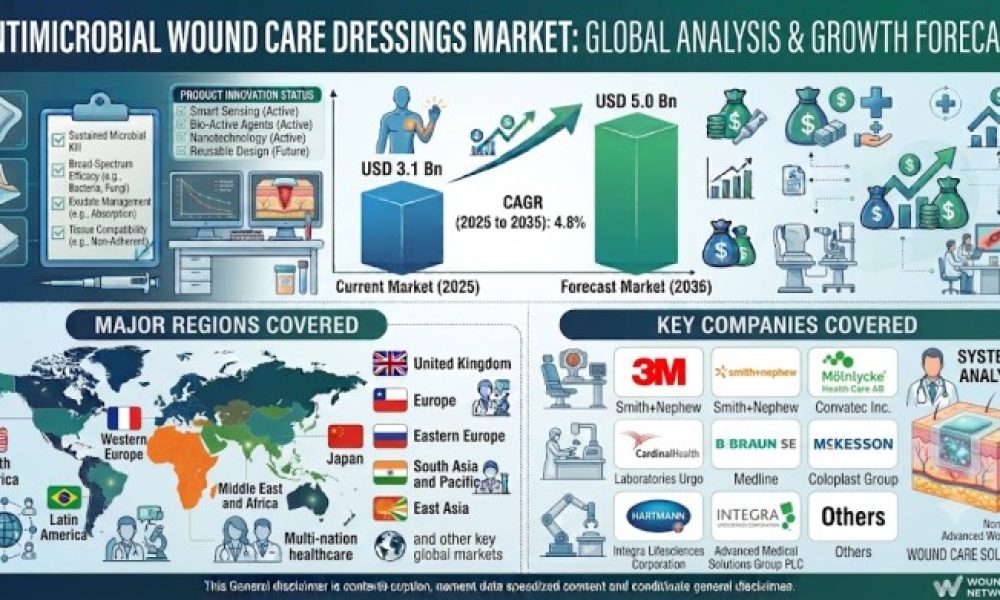
NEWARK, Del., October 7, 2026 — According to Future Market Insights (FMI), the global antimicrobial wound care dressings market is projected to expand from USD 3.1 billion in 2025 to USD 5.0 billion by 2035, registering a 4.8% CAGR during the forecast period. Rising chronic wound incidence, diabetes-linked wound complications, surgical-site infection prevention requirements, and growing adoption of advanced wound care technologies are supporting market expansion.
Diabetic foot ulcers lead the application segment with 38% share in 2025, while institutional sales account for 70% of end-user demand. The market is also seeing increased interest in silver-based dressings, hydrogel and foam formats, smart dressings, and natural antimicrobial agents such as honey.
👉 Get Detailed Market Forecasts, Competitive Benchmarking, and Pricing Trends:
https://www.futuremarketinsights.com/reports/sample/rep-gb-16900
Key Market Highlights
- Market Size (2025): USD 3.1 billion
- Forecast Value (2035): USD 5.0 billion
- CAGR (2025–2035):8%
- Leading Application: Diabetic Foot Ulcers, with 38% share
- Leading End User: Institutional Sales, with 70% share
- Fastest-Growing Country: China, at 6.3% CAGR
- Second-Fastest Country: United States, at 5.2% CAGR
- Leading Dressing Categories: Silver and non-silver antimicrobial dressings
Global Segment Leaders
Diabetic Foot Ulcers: Diabetic foot ulcers account for 38% of market share by application. Infection risk is elevated in diabetes-related wounds because of poor circulation and impaired immune response. Antimicrobial dressings are used to reduce bacterial load, manage biofilms, and maintain wound conditions that support healing.
Institutional Sales: Institutional sales represent 70% of the market in 2025, supported by purchases from hospitals, specialty clinics, and long-term care centers. Infection-control requirements, surgical volumes, chronic wound management, bulk procurement, and standardized treatment protocols reinforce institutional demand.
Country-Level Market Performance
- China – 6.3% CAGR (2025–2035): Healthcare investment, domestic manufacturing, aging demographics, and expanding chronic wound care.
- United States – 5.2% CAGR (2025–2035): Advanced wound care research, clinical integration, reimbursement support, and premium dressing adoption.
- United Kingdom – 5.0% CAGR (2025–2035): NHS modernization, community wound care pathways, and demand for cost-effective antimicrobial products.
- Germany – 4.4% CAGR (2025–2035): Evidence-based clinical protocols, regulatory alignment, and infection-control practices.
- Canada – 4.2% CAGR (2025–2035): Public healthcare support, telehealth, community wound care, and home-based treatment.
China is the fastest-growing country among those profiled by FMI, with a 6.3% CAGR through 2035. Domestic manufacturing capacity, healthcare investment, aging demographics, and growing demand for affordable advanced dressings are contributing to expansion.
The United States follows at 5.2% CAGR, with hospitals and surgical centers adopting silver-based, iodine-infused, and honey-derived antimicrobial dressings. Telehealth, AI-driven wound diagnostics, and home-based care platforms are also creating additional opportunities.
The United Kingdom is projected to grow at 5.0% CAGR, supported by NHS modernization and greater reliance on community-based wound care. Germany and Canada are expected to expand at 4.4% and 4.2% CAGR, respectively.
Chronic Wounds and Infection Prevention Drive Demand
The rising incidence of chronic wounds is increasing the need for products capable of providing localized infection control. Diabetes-related wounds, pressure ulcers, venous leg ulcers, and surgical wounds are among the applications supporting demand for antimicrobial dressing technologies.
Hospitals are also seeking advanced dressings to reduce surgical-site infection risks and support post-operative wound management. Aging populations add another source of demand because elderly patients are more vulnerable to chronic wounds and complications that require prolonged care.
Silver, Hydrogel and Smart Dressings Expand Technology Opportunities
Silver-based and iodine formulations continue to receive attention because of their broad antimicrobial activity. At the same time, hydrogel and foam dressings are benefiting from requirements for moisture control and wound-healing support. Research into nanotechnology, biocompatible materials, and personalized treatment approaches is creating further opportunities.
The market is also moving toward connected wound care. FMI highlights emerging biometric-sensing dressings capable of monitoring wound pH, oxygenation, and fluid composition, alongside thermoresponsive adhesives, smart labeling, and multi-action antimicrobial films.
👉 Access the Complete Report in PDF Format:
https://www.futuremarketinsights.com/reports/brochure/rep-gb-16900
Home Care Creates New Market Opportunities
Home healthcare and ambulatory care are expanding opportunities for antimicrobial dressing manufacturers. Easier-to-use dressing formats can support treatment outside hospitals, while remote wound assessment and digital monitoring can improve follow-up for patients receiving care at home.
Natural antimicrobial ingredients are also gaining attention. Honey and plant-derived compounds are being explored as alternatives or complements to conventional antimicrobial approaches, while cost-effective products are being developed to improve access in emerging markets.
Regulatory and Reimbursement Challenges Remain
Stringent medical-device approval requirements can delay product launches and increase development costs. Clinical evidence requirements for newer technologies are becoming more rigorous, while reimbursement differences between countries can affect adoption.
Advanced antimicrobial dressings can also carry higher costs than conventional wound dressings, creating accessibility challenges in lower-income markets. Competition from traditional non-antimicrobial products, limited awareness, inconsistent treatment protocols, and distribution difficulties in remote areas remain additional constraints.
Competitive Landscape
The antimicrobial wound care dressings market includes established global wound-care companies and specialized manufacturers. 3M, Smith+Nephew, and Mölnlycke Health Care AB are identified as leading Tier 1 participants, with portfolios covering advanced wound management, including silver-based and foam dressings.
Other prominent companies include Convatec Inc., Cardinal Health, B. Braun SE, McKesson, Laboratories Urgo, Medline, Coloplast Group, Hartmann Group, Integra Lifesciences Corporation, and Advanced Medical Solutions Group PLC. Companies are investing in antimicrobial efficacy, moisture management, patient comfort, and specialized wound-care formats.
Recent Industry Developments
- 2023: 3M Health Care received a USD 34.2 million award to advance traumatic wound management.
- March 2024: Integra LifeSciences launched Micro Matrix Flex, a dual-syringe system designed for precise application of wound-care paste.
- January 2024: Medline Industries introduced OptiView Transparent Dressing with Hydro Core Technology, designed to allow wound monitoring without removing the dressing.
Analyst Perspective
FMI analyst Anurag Sharma notes that antimicrobial wound care dressing adoption depends on clinical evidence, infection-prevention objectives, and ease of use across care environments. Hospitals are expected to remain the main demand anchor because chronic wounds require reliable dressing performance, while home care growth favors products combining antimicrobial efficacy with simple handling.
Access the full report: https://www.futuremarketinsights.com/reports/antimicrobial-wound-care-dressings-market
Report Scope
The antimicrobial wound care dressings market is segmented as follows:
- By Product Type: Barrier Dressings, Hydrogels Dressings, Alginate Dressings, Foam Dressings, Hydrocolloid Dressings, Collagen Dressing, Contact Layer, Super Absorbent Dressings, Semi-permeable Films Dressings, and Honey Dressings
- By Dressing Type: Silver Dressing and Non-silver Dressing
- By Application: Diabetic Foot Ulcers, Venous Leg Ulcers, Pressure Ulcers, Surgical/Traumatic Wounds, and Others
- By End User: Institutional Sales and Retail Sales
- By Region: North America, Latin America, Western Europe, Eastern Europe, South Asia and Pacific, East Asia, and Middle East and Africa
- Key Companies: 3M, Smith+Nephew, Mölnlycke Health Care AB, Convatec Inc., Cardinal Health, B. Braun SE, McKesson, Laboratories Urgo, Medline, Coloplast Group, Hartmann Group, Integra Lifesciences Corporation, and Advanced Medical Solutions Group PLC
About Future Market Insights
Future Market Insights, Inc. (FMI) is an ESOMAR-certified market research and consulting firm headquartered in Delaware, USA, with offices in the United Kingdom, the United Arab Emirates and India. FMI delivers syndicated and custom research across food and beverage, healthcare, chemicals, technology, packaging, consumer goods and industrial sectors.
Media Contact
Future Market Insights, Inc.
Phone: +1-347-918-3531



