
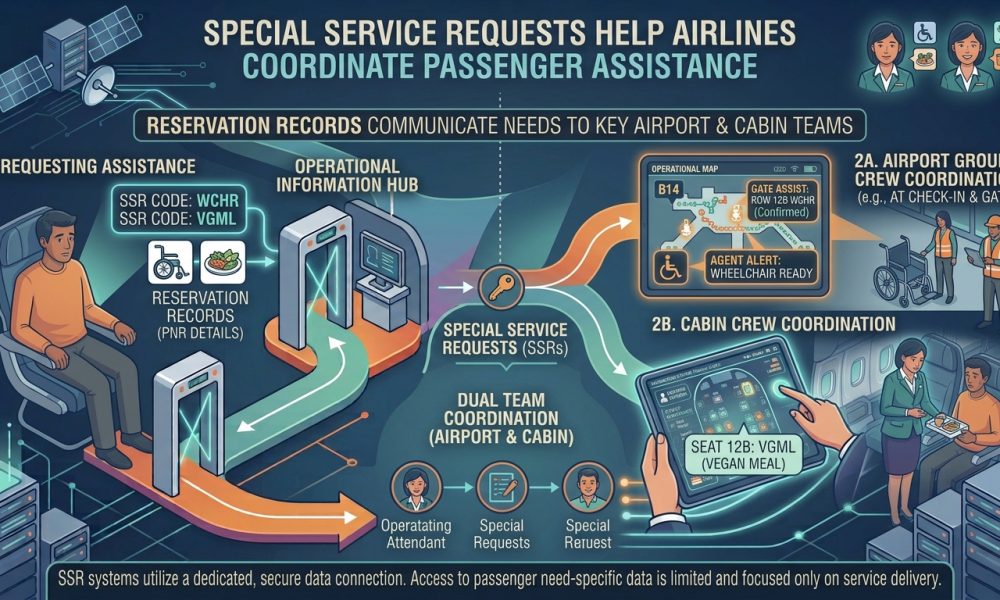
Reservation records communicate needs such as mobility support and preordered meals to relevant airport and cabin teams.
WASHINGTON, DC, October 7, 2026 — Airlines rely on standardized reservation Information to coordinate far more than seats and tickets, because special service requests can communicate mobility assistance, accessibility requirements, dietary selections, medical-device Information and other passenger needs to employees and service providers responsible for different stages of a journey.
For passengers, these records can reduce the need to explain the same requirement repeatedly at check-in, the departure gate, during boarding, and inside the aircraft, while giving airlines valuable advance notice to arrange equipment, personnel, catering, and other forms of assistance before the traveler arrives.
The system works best when requests describe the assistance actually required, reach every relevant operator within an itinerary, and stay accurate as circumstances change, making standardized communication an important but often invisible part of accessible and personalized commercial air travel.
Special Service Requests Travel With the Reservation
Within airline reservation systems, a Special Service Request, commonly abbreviated as SSR, provides a structured way to communicate specific passenger requirements alongside the broader Information in the traveler’s booking record.
The International Air Transport Association’s accessibility guidance describes standardized SSR codes as an important mechanism for helping airlines, travel agencies, airports, and service providers consistently understand assistance requirements, particularly when travelers with disabilities need support across several stages of a journey.
Instead of relying exclusively on free-form notes that different employees might interpret differently, standardized codes give travel organizations a shared vocabulary for indicating specific categories of assistance while allowing additional Information to clarify circumstances when more detail is operationally necessary.
Mobility Assistance Is One of the Most Visible Uses
Wheelchair assistance is one of the best-known examples because passengers may need different levels of support depending on whether they can walk short distances, climb aircraft stairs, transfer independently, or move between terminals during a connection.
A traveler who needs help covering long airport distances may have very different requirements from someone who cannot use stairs or needs an aisle chair to reach an aircraft seat, which makes accurately identifying the appropriate assistance particularly important.
Airlines and contracted airport assistance providers can use reservation Information to prepare the right personnel and equipment, helping ensure a wheelchair or other service is available at the right location rather than discovering the need only after the passenger reaches a busy terminal.
Not Every Wheelchair Request Means the Same Thing
A common misunderstanding about accessibility records is the assumption that every wheelchair-related request describes the same passenger need, even though standardized aviation codes intentionally distinguish among different mobility circumstances.
Someone who can walk independently within the aircraft but cannot cover long terminal distances may need one form of assistance. In contrast, another passenger may need help navigating stairs, and a third may need support reaching or leaving the aircraft seat itself.
Accurate coding therefore helps airports allocate the correct type of assistance while reducing situations where passengers receive inappropriate equipment, unnecessary handling, or insufficient help because a broad description failed to communicate what the traveler actually needed.
Advance Notice Helps Airlines Prepare
Passengers can often request assistance during booking, through an airline Application, by contacting reservations, or when managing an existing itinerary, giving carriers time to arrange services before departure.
American Airlines, for example, lets customers request special assistance through its booking and trip-management systems for services involving wheelchairs, mobility or medical devices, hearing or vision assistance, and other travel circumstances requiring additional coordination.
Although you can still request many forms of assistance at the airport, advance notice generally gives airlines and contractors more time to allocate equipment and staff appropriately, especially at large hubs where many passengers may need simultaneous assistance during peak departure periods.
Assistance Can Begin Before the Security Checkpoint
A mobility request can affect the journey long before boarding because some passengers need help moving from check-in to security, navigating large terminals, or reaching departure gates located far from the main ticketing areas.
Airport teams can rely on reservation Information to understand that an arriving passenger is expected to require assistance. At the same time, airlines can coordinate the handoff between check-in personnel and contracted accessibility providers operating elsewhere inside the terminal.
This process shows why special service requests are not merely cabin-service notes: the same record can support coordination among employees and contractors who never work aboard the aircraft but remain essential to the passenger’s journey.
Connections Create Additional Coordination Challenges
Mobility assistance becomes particularly important for connecting passengers because travelers may need support leaving one aircraft, moving between terminals, and reaching another departure gate within a limited connection window.
When an appropriate request remains attached to all relevant flight segments, employees at the connecting airport can know that assistance will be required before the inbound aircraft arrives, allowing personnel to prepare for a transfer instead of treating the connection as an unexpected service request.
This continuity is especially valuable on itineraries involving large international hubs, where considerable distances, airport trains and terminal changes can make apparently comfortable connection times significantly more difficult for travelers requiring mobility support.
Multiple Airlines Can Complicate the Record
An itinerary involving two or more carriers adds complexity because a special service request must reach every airline responsible for delivering the relevant portion of the journey.
Industry standards help facilitate that communication, but passengers should still confirm important assistance requirements with the operating airlines because services, procedures, and local airport arrangements can vary even when a standardized request appears within the overall reservation.
A travel agency can also enter special service Information when building an itinerary, making clear communication between the traveler, agent, and participating carriers essential when multiple companies share responsibility for different flight segments.
Cabin Crews Need Different Information Than Airport Teams
The details a wheelchair contractor needs inside an airport are not necessarily the same as the Information a flight attendant needs after the traveler reaches the aircraft, so airline systems must distribute relevant Information based on each employee’s responsibilities.
Cabin crews may need to know that a passenger requires additional assistance during boarding, cannot independently reach an exit under certain circumstances, or needs another specific accommodation affecting onboard safety and service.
Digital crew devices increasingly display appropriate service Information alongside passenger seating records, making it easier for flight attendants to locate travelers who need assistance without exposing unrelated details that do not serve an operational purpose.
Hearing and Vision Assistance Can Also Be Communicated
Special service records can identify passengers who are deaf, hard of hearing, blind, or have low vision when those travelers request relevant assistance or need airline employees to ensure important safety and operational Information reaches them appropriately.
This Information can help gate agents and flight attendants adapt communication methods, particularly when important announcements about boarding, flight disruptions, or emergency procedures would otherwise depend heavily on visual displays or public-address systems.
The objective should not be to assume what every traveler with a particular disability needs, but to help employees recognize when appropriate communication support may be required and to confirm directly with the passenger what assistance is useful.
Medical Devices Require Operational Planning
Passengers traveling with portable oxygen concentrators, battery-powered mobility equipment, or other medical devices may need additional coordination because aviation safety regulations and aircraft limitations may affect how the equipment is transported or used.
AdvanceInformation allows airlines to review device specifications, battery characteristics, and documentation requirements while helping airport and cabin personnel understand what equipment will accompany the traveler.
For battery-powered wheelchairs and mobility aids, accurate Information matters because ground teams may need to understand battery type, handling requirements, and secure-loading procedures before placing the equipment in the aircraft cargo compartment.
Service Animals Create Another Specialized Request
Travel involving a service animal can require documentation and operational preparation that differs significantly from ordinary pet transportation, so advance notification is especially important when airlines must verify regulatory requirements before departure.
A properly recorded request helps reservations, airport teams, and cabin crews understand that the traveler will be accompanied by a service animal while ensuring the appropriate documentation process is completed before boarding.
The record communicates an operational requirement rather than giving employees unrestricted personal Information about the passenger, showing how special service systems can support a defined purpose without unnecessary disclosure.
Special Meals Use Similar Reservation Infrastructure
Special service requests are not limited to accessibility because airlines also use structured reservation Information to communicate certain meal selections and other passenger-service requirements to catering and cabin teams.
On flights offering special meals, travelers can request selections designed for particular dietary, medical, or religious requirements, allowing catering providers to prepare appropriate meals and cabin crews to deliver them to the passengers who requested them.
This process depends on advance ordering because aircraft catering is generally loaded before departure, meaning a passenger who requests a meal only after boarding may discover the required meal isn’t aboard the aircraft.
A Meal Request Must Reach the Correct Flight
Special meal coordination becomes more complicated on multi-segment journeys because not every flight offers the same catering program, and a request appropriate for one long-distance segment may not apply to a short connecting service.
Reservation systems therefore need to associate relevant meal Information with the correct flights while accounting for schedule changes, rebooking, and substitutions that can alter the original itinerary before departure.
Passengers should review significant itinerary changes carefully because movement to another flight can affect whether previously requested services remain confirmed, particularly when the replacement service operates with different catering availability or another airline.
Cabin Crews Can Use Preorder Information During Service
Once aboard, flight attendants can see which seats are linked to special meals or preordered selections, letting crews organize service without repeatedly asking passengers to recall reservation details entered days earlier.
This can make onboard service feel highly personalized, although the underlying mechanism remains straightforward: the airline links a passenger’s reservation and seat assignment to Information supplied before departure.
If passengers change seats after boarding, crews may need to confirm who originally requested a meal because the operational record can continue associating that service with the original assigned position until the underlying seating Information is updated.
Special Requests Are Not Medical Diagnoses
A coded request describing required assistance should not automatically be interpreted as a complete description of someone’s medical condition, because the operational objective is generally to communicate what support the passenger needs rather than why the underlying circumstances exist.
A traveler requesting help covering long airport distances may have many reasons, and employees generally do not need a detailed diagnosis to arrange appropriate assistance.
Limiting Information to operational necessity can protect passenger privacy while also making the request more useful, because staff members responsible for delivering assistance primarily need clear instructions about the service required rather than unrelated personal history.
Privacy Matters Because Some Requests Can Be Sensitive
Accessibility, medical-device, and dietaryInformationn can sometimes reveal or suggest sensitive facts about passengers, making careful access controls particularly important when airlines distribute special service Information across reservations, airport operations, and cabin applications.
Employees responsible for arranging a wheelchair may legitimately need to see the applicable assistance request. At the same time, personnel working in unrelated commercial departments generally have no corresponding operational reason to access the same Information.
Role-based controls can therefore help airlines balance effective service with privacy by ensuring that relevant employees receive enough Information to perform their duties without creating unnecessarily broad access to passenger records.
Accuracy Is Critical for Assistance Records
Incorrect special service Information can cause more than inconvenience because the wrong assistance level may leave a passenger without needed support or cause airport teams to prepare equipment that doesn’t match the traveler’s circumstances.
Passengers should review important assistance requests whenever itineraries change, particularly after rebooking, airline substitutions, or schedule disruptions that can move reservations between systems and change the organizations responsible for delivering services.
Airlines and travel agencies also benefit from confirming ambiguous requests instead of making assumptions, because an accurate operational description produces better assistance than a generic label that does not reflect what the traveler actually needs.
Passengers’ Needs Can Change Between Trips
A special service request appropriate for one journey should not automatically become a permanent characteristic applied to every future reservation, because medical circumstances, mobility requirements, and travel companions can change considerably over time.
Airlines need mechanisms that allow passengers to update or remove outdated assistance Information while preserving enduring preferences when travelers genuinely want those details retained for future journeys.
This distinction mirrors broader questions about airline personalization: remembering useful Information can improve service only when it stays accurate and reflects what the passenger actually wants.
Travel Agencies Play an Important Role
Many passengers book through travel agencies, corporate travel platforms, or other intermediaries rather than directly with an airline, meaning those organizations can become responsible for accurately transmitting special service requirements into the reservation.
IATA guidance emphasizes standardized communication because an incorrectly applied code can follow a passenger through several systems and potentially create confusion across airlines, airports, and contracted service providers.
Travelers with important assistance requirements should therefore verify that requests entered through intermediaries have reached the operating carrier, particularly when international itineraries involve several airlines with different local procedures.
Airport Contractors May Deliver the Actual Assistance
The airline selling the ticket is not always the organization physically providing wheelchair or mobility assistance inside the terminal, because airports and carriers frequently use specialized contractors responsible for moving passengers between check-in, gates,s and aircraft.
Reservation Information must consequently reach beyond the airline’s immediate employees when another organization needs the details to provide the requested service, making reliable Information exchange an essential part of the assistance process.
Passengers may interact with several uniforms and companies during one supported journey, even though the original request began as a single entry attached to the airline reservation.
Ground and Cabin Teams Perform Different Handoffs
Assistance commonly involves transitions between employees, particularly when a traveler moves from an airport wheelchair service to a gate team and then to cabin crew responsible for the onboard portion of the journey.
Each handoff creates an opportunity for Information delays or misunderstandings, which is why structured reservation records can provide valuable continuity even when employees have never communicated directly.
Technology cannot eliminate every service failure, but consistent Information gives each team a stronger starting point than relying entirely upon verbal messages passed between multiple employees during busy boarding operations.
Passenger Communication Remains Essential
No reservation code can replace a direct conversation with the traveler because standardized categories cannot capture every individual circumstance, and passengers remain the best source of Information about what assistance actually works for them.
Employees should therefore use reservation Information as preparation rather than as permission to make assumptions, confirming relevant needs respectfully when delivering service instead of treating a code as a complete description of the person.
The most effective system combines structured advance Information with human communication, allowing organizations to prepare resources while still adapting service to the traveler’s actual circumstances at the airport and aboard the aircraft.
Irregular Operations Put Special Requests Under Pressure
Flight cancellations and major schedule disruptions can create particular challenges because passengers may be moved to replacement flights, and assistance requests must follow the new reservation and reach another set of operational teams.
A wheelchair arrangement prepared for one departure time can become useless after a six-hour delay unless staffing and pickup Information are updated, while a special meal prepared for a canceled flight may not automatically be available on the replacement aircraft.
Disruption management systems therefore need to preserve relevant special service Information while recognizing that the physical resources supporting those requests may need to be arranged again.
Connections Require Reliable Information Transfer
A passenger requiring assistance can complete the first flight only to encounter problems at the connecting airport if the relevant request was not transmitted or recognized for the next segment.
Industry standards reduce this risk by providing common service codes. At the same time, IATA recommends applying appropriate accessibility requests across all flights in an itinerary so involved organizations receive advance notice.
Travelers should still verify arrangements during complex journeys because standardized communication improves coordination but doesn’t guarantee that every airport, airline, or contractor offers identical processes or resources.
Digital Cabin Tools Can Make Assistance More Visible
Modern flight attendant tablets and digital seat maps can bring relevant service Information directly into the cabin, helping crews see where passengers requiring particular assistance are expected to be seated.
That capability can reduce dependence upon separate printed lists and allow employees to prepare more effectively before beginning service or conducting procedures where passenger assistance requirements become operationally important.
The technology also shows that sophisticated passenger service does not require continuous facial recognition, because the reservation already connects the traveler, seat assignment, and requested assistance before the crew member approaches the passenger.
Secure Identity Records Support the Broader Travel System
Although special service requests are generally reservation Information rather than passport security functions, modern travel depends on reliable identity records that allow airlines and government authorities to associate passenger services with the correct traveler across increasingly digital processes.
Amicus International Consulting has previously examined the broader relationship between secure travel credentials and digital identity systems in its guide to modern passport security and identity verification, which explains how layered document protections support confidence within automated travel environments.
Passenger assistance systems serve a different purpose, but their effectiveness similarly depends on correctly associating operational Information with the individual reservation to which it belongs throughout the journey.
More Information Is Not Always Better Information
Airlines can improve service by collecting enough Information to arrange appropriate assistance, but collecting extensive personal details that employees do not need can create privacy risks without producing corresponding operational benefits.
The most useful special service record is therefore not necessarily the most detailed, but the one that clearly communicates what assistance must be prepared, when it is needed, and which employees or service providers need to act.
This principle allows airlines to coordinate meaningful assistance while reducing the temptation to turn practical passenger requests into unnecessarily expansive personal profiles.
Standardization Helps a Global Industry Communicate
Commercial aviation depends on thousands of airlines, airports, travel agencies, and contractors exchanging Information across different countries, languages, and technology platforms, creating strong reasons for standardized terminology that remains understandable throughout an international itinerary.
Special Service Request codes provide part of that common language, allowing a particular assistance requirement to be recognized across reservation environments without every organization inventing its own incompatible description.
The system remains imperfect and still depends upon accurate input, capable staff, and appropriate resources, but standardization provides an essential foundation for coordinating passenger needs across a global transportation network.
The Reservation Can Become an Assistance Roadmap
For travelers requiring additional support, the reservation does considerably more than record departure and arrival details because properly entered special service Information can tell multiple organizations what preparations are needed before the passenger reaches them.
Airport teams can arrange mobility support, gate employees can prepare appropriate boarding assistance, catering providers can load requested meals, and cabin crews can receive the Information they need while serving the traveler during the flight.
The result demonstrates how relatively small pieces of structured Information can coordinate an unexpectedly complicated chain of people, equipment, and services across an entire journey.
Good Assistance Depends on Accurate Information and Human Delivery
Technology can transmit a wheelchair request across continents or place a meal selection directly onto a flight attendant’s table. However, successful service still depends upon people interpreting that Information correctly and providing assistance respectfully when the traveler arrives.
Standardized records help airlines prepare, digital systems help employees locate relevant Information, and connected operations help requests move between stages. Yet, no database can fully replace the conversation between a passenger and the employee providing direct support.
As aviation becomes increasingly digital, special service requests show one of the clearest benefits of responsible passenger Information sharing: carefully limited records can reduce repetitive explanations while helping airlines prepare assistance before a need becomes an airport problem.
The strongest system therefore combines advance communication, standardized reservation Information, privacy-conscious access, and direct passenger engagement, allowing airlines to coordinate complicated assistance requirements while keeping the individual’s actual needs at the center of the journey.




