
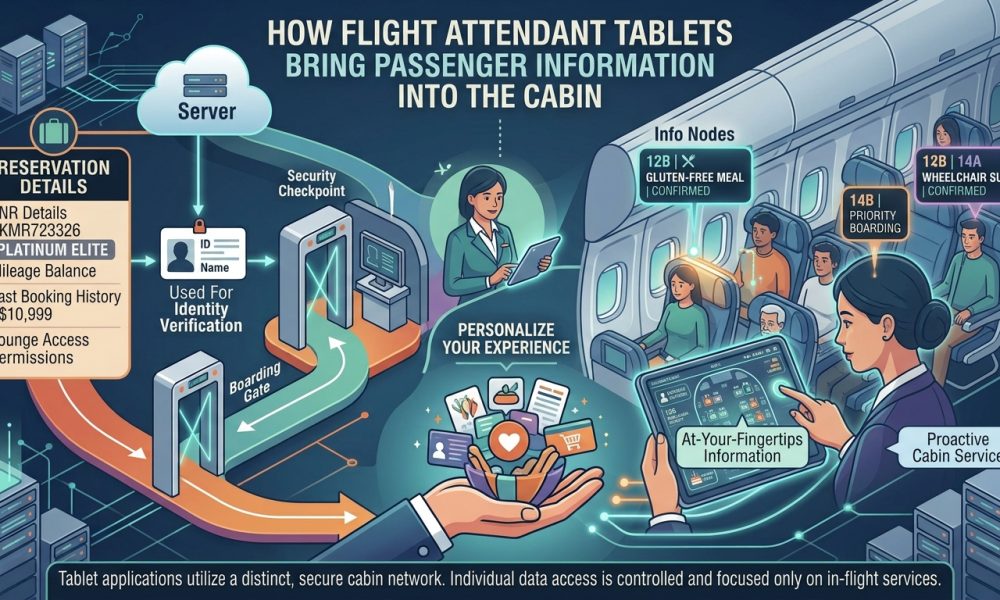
Crew applications can place seating details and relevant service information within reach during a flight.
WASHINGTON, DC, October 7, 2026 — Flight attendants increasingly begin their onboard duties with more than safety manuals, printed passenger lists and handwritten service notes, because airline-issued tablets and smartphones can now place seat maps, passenger names, loyalty information, accessibility requirements, meal selections, connecting-flight details and other relevant service information directly into the hands of cabin crews throughout a journey.
These mobile tools can make onboard service feel remarkably personal when a flight attendant already knows a passenger requested assistance, ordered a particular meal, holds high loyalty status, or faces a difficult connection. However, the information generally comes from reservation and airline customer-service systems rather than from facial-recognition technology operating inside the aircraft.
From Paper Manifests to Connected Cabin Devices
Flight attendants historically relied on printed passenger manifests, paper service documents, and large operational manuals containing safety procedures, company policies, and other information crews needed during every flight, creating a substantial administrative burden whenever schedules, passenger assignments, or procedures changed shortly before departure.
Modern cabin devices consolidate many of those functions into portable digital platforms that airlines can update more quickly, allowing crews to access current flight information while also carrying searchable safety materials, service instructions, and passenger details without depending entirely on stacks of printed documents that could become outdated between revisions.
American Airlines describes this evolution through its modern Cabin Electronic Flight Bag program, which grew from the airline’s original 2014 electronic manual initiative into newer mobile devices that give flight attendants access to safety information, operational resources, customer status details, preferences, and preorder information during their work.
The Seat Map Becomes a Customer-Service Interface
One of the most useful features for flight attendants is a digital seat map that links seat positions to passenger information, allowing crew members to see who is occupying a location and what service requirements may already be tied to that reservation.
Instead of searching a separate printed list whenever a question arises, a flight attendant can use an authorized crew Application to view the cabin layout and retrieve seat-specific information, helping crews manage service more efficiently while maintaining the airline’s existing relationship between the passenger, reservation, and assigned location.
United Airlines provides a clear example through its MyFlight Application, which the company developed for employee mobile devices and which allows cabin crews to view passenger names, loyalty status, and accessibility needs through seat-map functionality designed to help flight attendants provide more individualized service during the journey.
Apple describes the airline’s deployment in its United Airlines enterprise case study, which explains how mobile applications connect employees across operational roles while giving flight attendants access to information intended to support customer service rather than requiring crews to identify passengers through biometric technology.
Passenger Names Can Already Be Associated With Seats
Airlines do not need facial recognition to tell a flight attendant which passenger is expected in a particular seat, because reservation systems already link passenger names to seat assignments during booking, check-in, and boarding, and continuously update those records when travelers change seats or receive upgrades.
When that information reaches a crew tablet, the device transforms the traditional passenger manifest into a more interactive format that helps a flight attendant identify who should be seated in 14A, who was moved into a premium cabin, and who may require assistance during boarding, service, or arrival.
This information differs fundamentally from a facial-recognition system because the tablet generally displays reservation data tied to an assigned seat rather than analyzing the passenger’s face and attempting to determine their identity through automated biometric comparison.
The flight attendant may still confirm someone’s identity conversationally when necessary, particularly when passengers exchange seats or move after boarding, because the information shown on the device represents the airline’s current reservation record rather than an infallible determination of exactly who occupies every seat at every moment.
Loyalty Information Can Help Crews Recognize Frequent Travelers
Airlines can also make loyalty-program information available to cabin crews when it matters to onboard service, allowing flight attendants to understand which travelers hold particular program status levels or qualify for specified benefits tied to their membership.
That visibility can help airlines deliver more consistent recognition to frequent customers, particularly when a passenger has traveled extensively with the carrier but has never previously met the particular crew members operating the current flight.
From the traveler’s perspective, a personalized greeting or acknowledgment can create the impression that a crew member already knows them, even if the interaction results from status information displayed beside the passenger’s name and seat position in the crew’s authorized mobile Application.
This distinction matters because personalization based on loyalty records is an account-based customer-service function, not biometric Identification, meaning the airline can recognize an important customer relationship without photographing, scanning, or mathematically comparing the passenger’s face.
Meal Preorders Can Follow the Passenger Into the Cabin
Premium-cabin meal selection and other preorder programs provide another practical reason for airlines to put reservation information on crew devices, because flight attendants need to know which passenger requested which meal and whether the selection stays tied to the correct seat after upgrades or other last-minute changes.
A digital system can present those details directly on the crew device, reducing dependence upon separate paper catering lists while helping flight attendants deliver the correct product without repeatedly asking travelers to confirm information already supplied before departure.
American Airlines has explained that its newest cabin electronic flight bag generation makes customer status, preferences, and preorder details easier for flight attendants to access, demonstrating how mobile technology can bring previously scattered passenger information together within the service environment where crews actually need it.
The resulting interaction can feel more personal because a flight attendant already knows what the passenger ordered. Still, the information originates from the reservation and pre-order process rather than from any onboard Camera identifying the traveler through facial recognition.
Accessibility Information Can Support More Prepared Service
Passenger records can include accessibility and assistance information when travelers request services before departure, allowing airlines to coordinate wheelchair assistance, mobility support, or other accommodations that may require attention during boarding, the flight, or arrival.
When appropriate information reaches cabin crews through secure employee applications, flight attendants can prepare for those needs before meeting the traveler, rather than requiring passengers to repeatedly explain circumstances the airline already knows from earlier stages of the journey.
United’s MyFlight Application illustrates this by making accessibility needs available alongside other seat-based customer information, allowing flight attendants to provide more informed assistance while keeping the information connected to the operational purpose for which it was supplied.
Because accessibility information can involve sensitive personal circumstances, airlines must also balance usefulness with privacy, ensuring that only employees who need relevant information for legitimate operational responsibilities can access it and that crew applications do not expose unnecessary passenger details merely because the technology makes broader data access possible.
Connection Information Can Matter Before Landing
Passengers with short connections often start worrying about their next flight long before the aircraft reaches the gate, especially when the arriving flight is delayed, and only a narrow window remains to reach another terminal or departure gate.
Crew devices that receive updated operational information can help flight attendants identify passengers facing particularly challenging connections, allowing them to provide gate information, share relevant updates, or direct travelers to airline resources that can help after arrival.
This capability does not guarantee that a crew member can hold a connecting aircraft or solve every disruption from the cabin. Still, it can put useful context in front of employees who might otherwise know little about the passenger’s onward journey beyond what the traveler explains verbally.
The value becomes especially apparent during irregular operations, when dozens of passengers can have different connecting itineraries and a digital tool can help cabin crews distinguish between travelers with comfortable connection times and those facing immediate difficulties after landing.
Flight Attendant Devices Also Carry Safety Information
Customer-service functionality represents only one component of modern cabin devices, because flight attendants remain safety professionals whose primary responsibilities include emergency procedures, regulatory compliance, cabin preparation, and passenger Protection throughout every phase of flight.
Electronic devices can therefore carry searchable manuals, updated procedures, and operational notices that once required large printed binders, allowing airlines to distribute revised information more efficiently and helping crews find relevant guidance without manually searching hundreds of pages.
American Airlines began moving flight attendants toward electronic manuals more than a decade ago, and its newer cabin devices continue that development by combining required operational resources with additional applications that support service, communication, and passenger information within one managed employee platform.
The customer-information features therefore sit inside a broader professional technology environment designed to support cabin operations, rather than functioning as standalone passenger-profiling devices whose principal purpose is to collect or display personal information.
Connectivity Makes Cabin Information More Useful
A crew device becomes substantially more useful when it can receive updated information close to departure or during flight, because airline operations can change quickly as passengers are rebooked, seats are reassigned, flights are delayed, and connections move between gates.
Delta Air Lines has emphasized this broader connected approach through its Connected Onboard Platform, which brings together operational, connectivity and customer-experience information across its fleet so onboard systems and employees can work with more current information during the journey.
The development reflects an industry-wide movement away from isolated onboard systems toward connected aircraft environments where relevant operational information can move between ground systems and the cabin. However, actual capabilities depend upon the airline, aircraft, connectivity infrastructure, and applications deployed on a particular flight.
Reliable connectivity can consequently make passenger-service information more timely. However, airlines must still design appropriate safeguards because moving data rapidly onto an aircraft also increases the importance of Authentication, encryption, device management, and careful control over which employees can access particular categories of passenger information.
Crew Tablets Do Not Necessarily Show a Complete Passenger Profile
Sophisticated airline databases do not mean flight attendants automatically receive unrestricted access to everything a carrier knows about a customer, because responsible system design should limit cabin applications to information employees reasonably need for safety, service, and operational responsibilities.
A crew member may need a passenger’s name, seat assignment, status, meal request or accessibility requirement while having no legitimate reason to see detailed payment information, complete customer-service correspondence or unrelated historical records stored elsewhere in the airline’s systems.
Role-based access controls can therefore determine which categories appear within the cabin Application, helping airlines make useful information available while reducing unnecessary exposure of passenger records to employees whose responsibilities do not require broader access.
Travelers should avoid assuming an airline tablet contains a complete dossier just because a flight attendant seems unusually well informed, since a carefully designed Application can provide a narrow set of relevant details sufficient for the immediate journey.
Information Can Change When Passengers Move Seats
Seat-based passenger information depends upon accurate operational records, creating potential complications when travelers exchange seats informally after boarding or occupy positions different from those shown in the reservation system.
A flight attendant looking at a digital seat map might see the passenger originally assigned to that location even though another traveler has moved there with the crew’s permission, illustrating why electronic records must remain tools for employees rather than unquestionable substitutes for direct observation and communication.
Airlines can update seat assignments formally when circumstances require. However, the practical reality of cabin operations means crew members still rely heavily upon conversation, Judgment, and awareness of what is physically occurring around them.
This limitation also demonstrates why crew tablets should not be confused with biometric tracking systems, because the device generally knows the reservation’s assigned seat rather than continuously verifying the biological identity of whoever happens to be sitting there.
Passenger Service Preferences Are Becoming More Detailed
Airlines are exploring increasingly specific ways for passengers to communicate service preferences before or during a flight, potentially allowing customers to indicate whether they prefer minimal interruption, want to be awakened for a meal, or have other choices that crews can respect during service.
When those preferences can be communicated directly to crew devices, flight attendants gain information that previously required a conversation after boarding, helping airlines provide more individualized experiences without requiring employees to remember every preference manually across a large cabin.
This approach represents another form of personalization based upon information deliberately supplied by the traveler, distinguishing it from systems that infer characteristics or identify people through biometric measurements.
The most effective implementations can therefore give passengers greater control over service while simultaneously reducing unnecessary interactions, provided airlines explain how preferences are stored, how long they remain active, and whether they apply only to the present trip or persist across future journeys.
Tablets Can Improve Communication Between Ground and Cabin Teams
Modern employee applications can also connect flight attendants with gate agents, operations teams, and other airline personnel, helping information travel faster between the people responsible for different stages of the same passenger journey.
For example, when a gate agent resolves a seat issue shortly before departure, updated information can reach the cabin more efficiently than under older processes that relied on printed manifests produced before each last-minute change.
The same communication infrastructure can help with service issues, special passenger circumstances, and operational irregularities, allowing cabin employees to start the flight with better awareness of developments at the gate before the aircraft door closes. From the passenger’s perspective, this coordination can make the airline seem more organized because customers don’t have to restart every conversation with each employee. However, effective information sharing still requires clear rules governing which notes and details should move between teams.
Personalized Service Still Depends on Human Judgment
Even the most sophisticated crew Application cannot determine exactly how a flight attendant should interact with every passenger, because on-screen information provides context. In contrast, human Judgment determines whether that context is relevant to the particular situation unfolding inside the cabin.
A loyalty indicator might suggest that a passenger travels frequently. Still, it cannot tell the crew whether that traveler wants conversation, privacy, or immediate assistance, just as an accessibility note cannot replace respectful communication about what help the passenger actually requires.
Mobile technology works best when it reduces administrative uncertainty and gives crews useful information without trying to prescribe every human interaction, leaving trained employees to interpret circumstances and adapt service appropriately.
The device’s purpose is not to automate hospitality entirely, but to give flight attendants better information so they can spend less time searching records and more time responding thoughtfully to passengers and cabin conditions.
Passenger Privacy Extends Into the Cabin
Bringing customer information onto mobile devices also creates privacy responsibilities because tablets can contain details that passengers reasonably expect airlines to protect from unauthorized viewing, loss, or misuse during flights and while employees move throughout airports.
Airlines can manage these risks through encrypted devices, secure Authentication, automatic locking, remote management, and Application controls designed to keep sensitive operational information within approved systems rather than stored casually on personal devices.
Physical handling also matters because an unlocked screen left visible in a galley or seat area could expose information to people with no legitimate reason to see it, making employee training an important part of digital security alongside technical protections.
The transition from paper manifests to electronic devices can improve control when implemented carefully, because centrally managed systems can restrict access and update information remotely, whereas lost or discarded paper documents can be much harder to revoke once they leave airline custody.
Facial Recognition Plays a Different Role
The appearance of passenger names and details on cabin tablets sometimes contributes to misunderstandings about how airlines identify travelers, particularly as facial recognition becomes more common at check-in, security, and international boarding locations.
A biometric system attempts to determine whether the person standing before a Camera matches an expected reference Image, while a flight attendant Application generally displays reservation information already associated with a passenger and an assigned seat inside the aircraft.
These processes can coexist within the same journey without being technically equivalent, meaning a traveler who underwent facial verification before boarding should not assume the cabin tablet will recognize or track their face throughout the flight.
The flight attendant usually knows who is expected in a particular seat because the airline’s reservation and boarding systems say so, demonstrating how ordinary passenger data can produce highly personalized service without requiring continuous biometric Identification.
The Digital Cabin Is Becoming More Connected
Airlines are steadily transforming aircraft cabins from relatively isolated service environments into connected extensions of their broader operational networks, allowing crews to receive better information. At the same time, passengers gain faster connectivity, personalized entertainment, and more responsive service.
Crew tablets and smartphones are an important part of that transformation because they put operational information directly in the hands of the employees interacting most closely with passengers during the part of the journey when access to ground-based airline systems was historically limited.
As these platforms become more capable, airlines will face ongoing decisions about which passenger information genuinely improves service, which details should remain outside the cabin Application, and how long particular preferences or service notes should persist after the flight ends.
Those decisions will shape whether passengers view digital cabin technology primarily as a helpful customer-service tool or as an unnecessarily intrusive source of profiling, making transparency and disciplined information management increasingly important as personalization expands.
A Tablet Can Explain Why a Crew Member Seems to Know You
When a flight attendant greets a passenger by name, acknowledges loyalty status, confirms a preordered meal or already understands that the traveler requires assistance, the interaction can feel surprisingly personal to someone accustomed to being one person among hundreds aboard a commercial aircraft.
In many cases, however, the explanation is comparatively straightforward because the airline has taken information already present in reservation, loyalty, and service systems and displayed the relevant portion on a secure employee device that cabin crew can use during the flight.
That capability allows airlines to provide more consistent, informed service without relying on facial recognition, showing once again that the aviation industry’s growing ability to personalize travel comes from many categories of passenger information rather than a single biometric technology.
As cabin connectivity and employee applications continue to improve, flight attendants are likely to receive increasingly timely information about the passengers they serve, making the small tablet or smartphone carried through the aisle an increasingly important link between the airline’s digital systems and the human service delivered onboard.




