
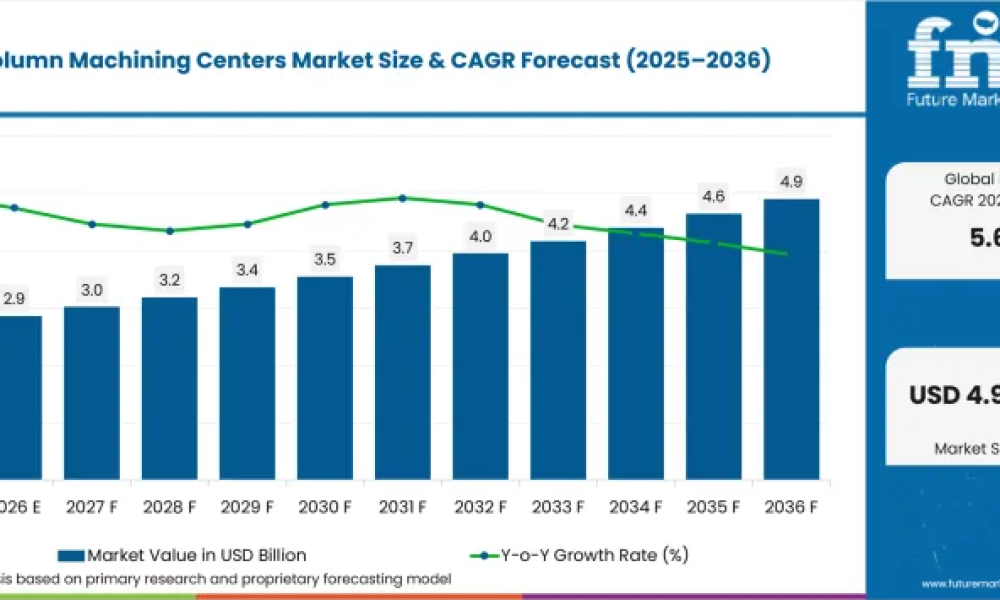
The Double-Column Machining Centers Market is projected to reach USD 4.9 billion by 2036, up from USD 2.9 billion in 2026, expanding at a 5.6% CAGR during the forecast period. Demand is being supported by manufacturers seeking larger machining platforms capable of handling molds, aerospace structures, machine frames, and other large workpieces in fewer setups.
Global Segment Leaders
The market’s leading segments in 2026 highlight the importance of rigid machine configurations, appropriate spindle capacity, and workpiece compatibility:
- Fixed bridge machines account for 27.0% of the machine type segment.
- Below 30 kW represents 21.0% of spindle power demand.
- Small molds and dies account for 18.0% of workpiece size demand.
These segments reflect purchasing decisions centered on machining stability, setup reduction, and the ability to maintain consistent geometry across demanding production applications.
Get detailed market forecasts, competitive benchmarking, and pricing trends: https://www.futuremarketinsights.com/reports/sample/rep-gb-35058
Market Growth Drivers
Double-column machining centers are gaining attention where manufacturers need to machine large or complex components while minimizing repeated transfers between machines. A rigid machining platform can help manufacturers complete more operations within a single setup, supporting dimensional consistency and reducing handling requirements.
Large molds, aerospace structures, and machine frames represent applications where machine rigidity and working envelope can justify investment in larger machining platforms. The ability to maintain stable geometry across substantial workpieces becomes particularly important when repeated repositioning could introduce additional setup requirements.
Fewer Setups Support Machine Adoption
One of the key factors influencing purchasing decisions is the opportunity to reduce the number of setups required for large components. Moving a workpiece between machines can increase handling requirements and introduce additional alignment considerations.
Double-column configurations provide manufacturers with a platform designed around larger machining tasks. When production economics support the investment, completing more machining operations within a rigid setup can improve workflow consistency and simplify large-part production.
Fixed-Bridge Configurations Lead Machine Types
Fixed bridge configurations are estimated to represent 27.0% of machine type demand in 2026, making them the leading segment. Their position reflects the importance manufacturers place on structural rigidity and stable machining conditions.
For applications involving molds, dies, frames, and other large components, machine stability can influence surface quality, dimensional accuracy, and process repeatability. Buyers therefore evaluate machine architecture alongside travel requirements, workpiece dimensions, and production utilization.
Spindle Power and Workpiece Requirements Shape Selection
The below 30 kW spindle-power segment accounts for 21.0% of demand in 2026. Spindle selection depends on the materials being processed, cutting requirements, tooling strategy, and the type of machining operations performed.
Meanwhile, small molds and dies represent 18.0% of the workpiece-size segment. The mix demonstrates that double-column machining centers are not limited exclusively to the largest possible components; manufacturers can also select these platforms where machine rigidity and setup advantages justify the configuration.
Capital Investment Remains a Key Consideration
Despite the operational advantages, installation space and utilization thresholds can limit broader adoption. Double-column machining centers generally require manufacturers to evaluate available floor space, material-handling arrangements, machine utilization, and expected production volumes before committing to an installation.
The capital-equipment cycle can influence these purchasing decisions. The Association for Manufacturing Technology (AMT) reported that USA metalworking machinery orders increased 22.5% during 2025 in February 2026. While this figure does not validate the Double-Column Machining Centers Market forecast, it indicates an active capital-equipment environment in which manufacturers may be more willing to invest in production capacity.
Competitive Landscape
Competition in the Double-Column Machining Centers Market centers on machine rigidity, working envelope, spindle configuration, accuracy, automation compatibility, and the ability to meet application-specific machining requirements.
Manufacturers and buyers are likely to assess:
- Machine architecture and structural rigidity
- Spindle power and machining performance
- Workpiece size and table capacity
- Setup reduction capabilities
- Floor-space requirements
- Automation and production-line integration
- Long-term utilization and operating economics
The balance between machining capability and total installation requirements remains important as manufacturers evaluate larger equipment investments.
Get the Complete Story—Read More About Our Latest Report
The Double-Column Machining Centers Market report provides analysis of market growth, machine types, spindle power, workpiece sizes, and other factors shaping demand through 2036.
https://www.futuremarketinsights.com/reports/double-column-machining-centers-market
Analyst Perspective
“Manufacturers evaluating double-column machining centers are increasingly balancing the productivity benefits of fewer setups with the practical requirements of floor space and machine utilization. Fixed-bridge configurations leading with 27.0% share highlights the continued importance of structural stability, while demand across spindle-power and workpiece-size categories shows that machine selection remains closely tied to specific production requirements,” says Nikhil Kaitwade, Future Market Insights.
About Future Market Insights (FMI)
Future Market Insights, Inc. (FMI) is an ESOMAR-certified, ISO 9001:2015 market research and consulting organization, trusted by Fortune 500 clients and global enterprises. With operations in the U.S., UK, India, and Dubai, FMI provides data-backed insights and strategic intelligence across 30+ industries and 1200 markets worldwide.
For Press & Corporate Inquiries
Rahul Singh
AVP – Marketing and Growth Strategy
Future Market Insights, Inc.
+91 8600020075



