
The global vehicle roof hatches market is projected to grow from USD 520.6 million in 2026 to USD 856.1 million by 2036, expanding at a 5.1% CAGR during the forecast period. Demand is supported by bus production, fleet renewal, emergency escape requirements, ventilation needs, and factory-level integration of roof apertures before final vehicle certification.
Vehicle roof hatches form part of the vehicle architecture rather than serving solely as aftermarket accessories. Bus manufacturers and fleet operators must account for roof apertures, emergency release mechanisms, sealing, glazing, and surrounding structures during vehicle development and conversion. The resulting specification requirements create recurring demand as new vehicles enter service and older units require replacement.
Public transit investment is supporting new factory decisions for roof hatch systems. The Federal Transit Administration committed nearly USD 390 million in February 2026 for 34 transit projects that include almost 200 new buses. Such procurement programs create opportunities for roof hatch suppliers as vehicle manufacturers and transit fleets specify emergency exits, ventilation provisions, and compatible roof components.
Country-level demand can vary substantially despite common safety requirements. The European Automobile Manufacturers’ Association reported in January 2026 that EU bus registrations increased 7.5% during 2025 to 38,238 units. Germany recorded a 28% increase while Italy experienced a 15.9% decline, demonstrating how local production and registration cycles can influence roof-hatch procurement.
What Are the Key Segments in the Vehicle Roof Hatches Market?
- Emergency Escape Hatches – 34.0% share: Emergency escape hatches are likely to account for 34.0% of the market in 2026, supported by formal egress requirements that preserve roof exits on applicable passenger vehicles.
- Buses – 32.0% share: Buses are forecast to represent 32.0% of vehicle-type demand in 2026 as passenger transport designs allocate roof space for emergency and airflow functions.
- Aluminum Frames – 24.0% share: Aluminum frames are projected to hold 24.0% share in 2026 because their low mass and stable latch interfaces support roof integration.
- Platform-Specific Roof Integration: Roof curvature, approved cutout geometry, sealing requirements, and latch interfaces can limit substitution and increase the importance of vehicle-specific qualification.
- Ventilation and Replacement Demand: Roof hatches increasingly serve both emergency and airflow functions, while established roof apertures create replacement opportunities throughout vehicle service life.
Get detailed market forecasts, competitive benchmarking, and pricing trends:
https://www.futuremarketinsights.com/reports/sample/rep-gb-34757
Which Countries Are Showing the Strongest Growth in the Vehicle Roof Hatches Market?
UAE is projected to record the fastest growth among the profiled countries at 6.2% CAGR. Demand is supported by specialty vehicle requirements, passenger transport applications, and the need for roof systems that combine emergency access and ventilation functions. Suppliers that provide documented fitment and durable sealing can strengthen their position in regional fleet procurement.
Saudi Arabia is expected to expand at 5.9% CAGR. Vehicle fleet development and specialty commercial applications create opportunities for roof hatch systems designed for demanding operating conditions. Procurement can favor suppliers capable of supporting approved roof geometries and reliable emergency-release performance.
United Kingdom is projected to grow at 5.5% CAGR. Bus and specialty vehicle procurement continues to create requirements for certified roof apertures, emergency exits, and ventilation systems. Vehicle manufacturers and body builders can prioritize products that simplify integration while preserving documented safety performance.
Canada is forecast to expand at 5.2% CAGR. Public transportation fleets and commercial vehicle replacement programs support demand for roof hatch systems. Suppliers that maintain consistent fitment across vehicle platforms can reduce replacement and installation complexity.
United States is projected to register a 4.9% CAGR. Transit investment and recurring bus fleet replacement provide a stable demand base. The FTA-supported projects demonstrate how public transportation funding can translate into new factory specifications and subsequent replacement opportunities for roof-mounted systems.
How Is Regional Demand Shaping the Vehicle Roof Hatches Market?
Regional demand is closely connected to vehicle production and fleet replacement cycles. In the United States, transit funding creates opportunities for new bus production and associated factory specifications. Roof hatches must be integrated into vehicle structures before final certification, making early supplier qualification important.
European demand varies by individual country because bus registration and production cycles can diverge considerably. Germany’s strong 2025 registration increase contrasts with Italy’s decline, highlighting why suppliers need to monitor local build pipelines rather than relying solely on regional market growth.
Middle Eastern markets provide opportunities for specialty and passenger transport vehicles where roof systems may need to accommodate both emergency egress and ventilation. Climate and operating conditions can also increase attention to sealing, material durability, and serviceability.
What Is Changing the Competitive Landscape?
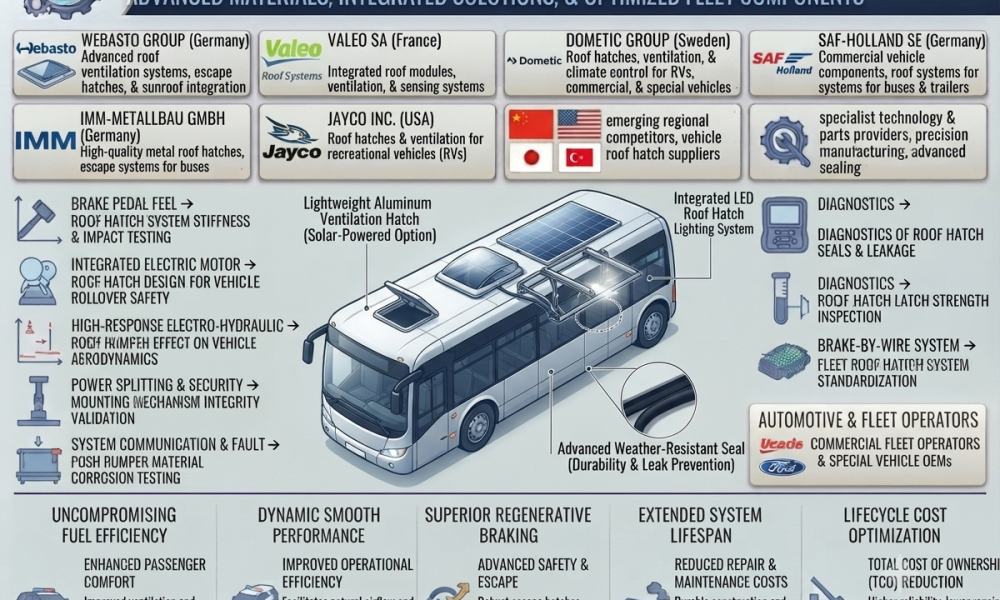
The vehicle roof hatches market includes manufacturers and vehicle-system suppliers serving buses, recreational vehicles, emergency vehicles, specialty commercial vehicles, and armored platforms. HAPPICH GmbH, Spheros, Eberspächer, Airxcel / Maxxair, Webasto, Daimler Truck / Mercedes-Benz Special Trucks, ZIEGLER, and John Cockerill Defense are among the notable players in the market.
Competition increasingly depends on fitment precision and integration support. A roof hatch must align with the vehicle’s approved cutout geometry, roof curvature, sealing system, and release mechanism. These requirements can make technically compatible replacement products difficult to substitute without additional validation.
Suppliers can therefore differentiate through platform-specific documentation and standardized installation processes. Consistent latch interfaces and sealing performance can reduce installation risks for OEMs, bus body builders, and specialty upfitters.
Replacement work also creates an important commercial opportunity. Once a vehicle platform has an established roof aperture, compatible hatch systems can remain relevant throughout the vehicle’s service life, particularly when emergency-release or ventilation hardware requires maintenance or replacement.
What Does the Analyst Say About the Vehicle Roof Hatches Market?
“Vehicle engineers should compare roof hatches by approved cutout geometry and sealing performance rather than unit price alone. The stronger commercial offer preserves emergency release across service life while simplifying ventilation upgrades and replacement work on the same roof aperture.”
— Nikhil Kaitwade, Principal Consultant, Future Market Insights
What Is Driving Demand for Vehicle Roof Hatches?
Fleet Renewal Sustains Factory and Replacement Demand
Bus and specialty vehicle replacement programs create recurring demand for roof hatches. New vehicles require factory-installed systems, while operating fleets generate subsequent replacement requirements for worn or damaged components.
Emergency Egress Requirements Support Adoption
Emergency escape hatches remain a critical component of applicable passenger vehicle designs. Formal safety requirements preserve demand for roof exits and make release performance a key part of product qualification.
Ventilation Requirements Broaden Roof Hatch Applications
Roof apertures can support ventilation in addition to emergency escape. This expands the relevance of roof hatch systems to passenger vehicles and specialty platforms where cabin airflow is an important design consideration.
Lightweight Materials Support Roof Integration
Aluminum frames offer a combination of lower mass and stable mechanical interfaces. Their use can support vehicle-level weight-management objectives while maintaining the structural and latch characteristics required for roof installation.
What Are the Key Market Restraints?
Platform-specific roof curvature and sealing requirements can restrict substitution. A hatch that does not precisely match an approved roof aperture may require additional engineering, installation changes, or validation.
Modern vehicle roofs can also contain multiple integrated systems. Changes to the roof structure or aperture can affect sealing, ventilation, emergency release, and surrounding components, increasing the technical requirements for replacement products.
Procurement variation across vehicle manufacturers, government fleets, and specialty upfitters can further increase the need for application-specific documentation and installation support.
What Opportunities Exist for Vehicle Roof Hatch Manufacturers?
Suppliers can develop standardized roof hatch families covering multiple vehicle platforms while maintaining documented cutout geometry and sealing compatibility. This can help body builders and fleet operators simplify replacement procurement.
There is also an opportunity to combine emergency and ventilation functionality in integrated designs. Products that preserve emergency release while supporting airflow can address multiple vehicle requirements through a single roof aperture.
Public transportation investment provides another opportunity. Government-funded bus procurement creates new factory specifications, while the installed fleet establishes a future aftermarket replacement base for compatible roof hatch systems.
Drive Your Business Growth Strategy: Checkout the Report for Key Insights!
https://www.futuremarketinsights.com/checkout/34757
How Is the Vehicle Roof Hatches Market Segmented?
The vehicle roof hatches market is segmented by hatch type, vehicle type, material, sales channel, function, and region.
By Hatch Type: Emergency escape hatches, ventilation roof hatches, access hatches, transparent roof hatches, and powered roof hatches.
By Vehicle Type: Buses, RVs, emergency vehicles, specialty commercial vehicles, and armored vehicles.
By Material: Aluminum frame, polycarbonate glazing, composite frame, tempered glass, and steel frame.
By Sales Channel: Vehicle OEMs, bus body builders, aftermarket retrofit, and specialty upfitters.
By Function: Emergency exit, cabin ventilation, roof access, and natural lighting.
By Region: North America, Latin America, Western Europe, Eastern Europe, South Asia and Pacific, East Asia, Central Asia and Russia, and Middle East and Africa.
Why Do Emergency Escape Hatches Lead the Hatch-Type Segment?
Emergency escape hatches are projected to account for 34.0% share in 2026, supported by formal passenger-vehicle egress requirements. Their role in emergency evacuation makes release reliability and approved installation geometry important procurement considerations.
Why Do Buses Account for the Largest Vehicle-Type Share?
Buses are forecast to represent 32.0% share in 2026. Passenger transport vehicles frequently require roof-mounted emergency exits and ventilation provisions, creating recurring demand during new vehicle production and fleet renewal.
Why Are Aluminum Frames Important to Vehicle Roof Hatch Design?
Aluminum frames are projected to hold 24.0% share in 2026. Their relatively low mass and stable latch interfaces make them suitable for integrating roof hatch assemblies while supporting vehicle-level weight considerations.
What Are the Drivers, Restraints and Opportunities in the Vehicle Roof Hatches Market?
Vehicle roof hatch demand is increasingly shaped by safety compliance, fleet renewal, and the need for precise integration with approved vehicle roof structures.
- Driver: Bus replacement and public transit investment create recurring factory and replacement demand.
- Restraint: Platform-specific roof curvature, sealing, and cutout requirements can increase qualification and installation costs.
- Opportunity: Integrated emergency and ventilation systems can improve functionality while reducing the need for multiple roof modifications.
What Is the Vehicle Roof Hatches Market Demand Outlook?
The vehicle roof hatches market is expected to maintain steady growth as bus production, fleet renewal, and emergency-vehicle procurement continue to create recurring demand. Emergency escape hatches and bus applications are expected to remain important segments because of their direct connection with safety and passenger transport requirements.
The replacement market will remain significant because installed roof apertures create an established configuration for future service work. Suppliers that preserve approved geometry and sealing performance can reduce installation uncertainty for fleet operators and vehicle body builders.
How Will Fleet Renewal Influence Future Roof Hatch Demand?
Fleet renewal converts public transportation investment into recurring equipment specifications. Each newly produced bus can require a roof hatch configuration that must be validated alongside the broader vehicle architecture.
As older vehicles reach replacement or refurbishment cycles, compatible roof hatches can generate aftermarket demand. Suppliers that maintain model-specific fitment information can improve procurement continuity across these cycles.
Why Will Roof Integration Become More Important?
Roof hatches must increasingly be evaluated as integrated vehicle components rather than standalone accessories. Roof curvature, cutout geometry, sealing, glazing, and emergency-release mechanisms all influence whether a product can be installed without additional engineering.
This favors suppliers that provide complete technical documentation and installation support. The ability to preserve an approved roof configuration can become a stronger purchasing factor than unit price alone.
How Fast Are Key Countries Growing in the Vehicle Roof Hatches Market?
UAE is projected to lead country-level growth at 6.2% CAGR, followed by Saudi Arabia at 5.9%, United Kingdom at 5.5%, Canada at 5.2%, and United States at 4.9% CAGR through 2036.
About Future Market Insights
Future Market Insights (FMI) is a global market intelligence and consulting firm serving organizations across multiple industries with research, strategic analysis, and actionable insights. FMI’s research supports business leaders, investors, and decision-makers in evaluating market opportunities, competitive positioning, emerging trends, and long-term industry developments.



