
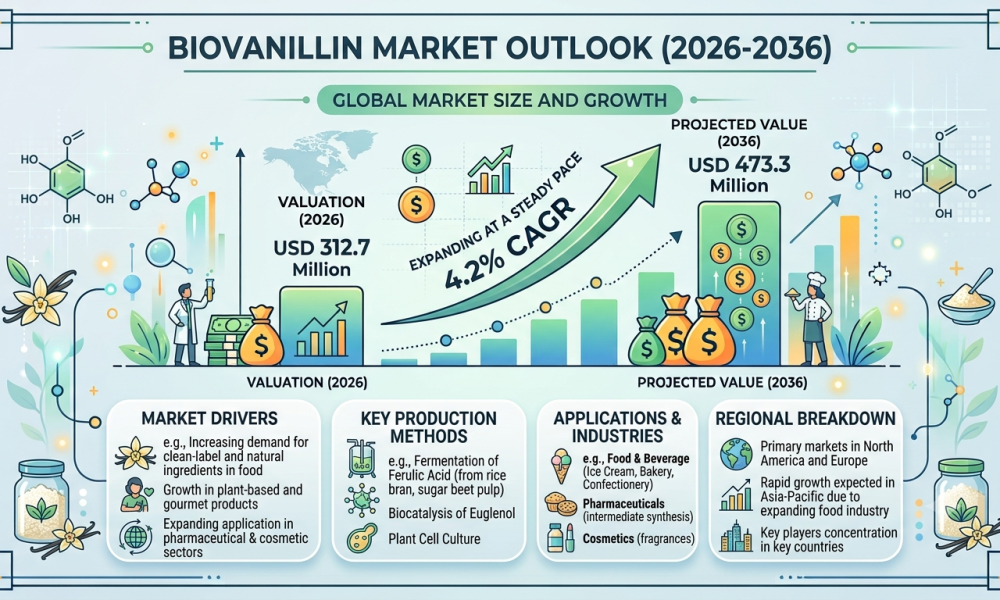
The global biovanillin market is projected to grow from USD 312.7 million in 2026 to USD 473.3 million by 2036, registering a 4.2% CAGR during the forecast period. Demand is supported by the shift toward natural-flavor solutions, growing interest in biological and bio-based production routes, and the need for documented ingredient origin and labeling claims. Food manufacturers are evaluating biovanillin as suppliers work to deliver consistent sensory performance and regulatory documentation.
Natural-label requirements are creating opportunities for biovanillin suppliers, particularly as food manufacturers reformulate products around documented natural flavoring routes. Fermentation and other biological conversion technologies are also gaining attention as producers seek alternatives that can meet commercial purity, sensory, and cost requirements. Food and beverage processing remains a key application area, while cosmetics, personal care, pharmaceuticals, dietary supplements, and animal feed and pet food provide additional opportunities.
Get detailed market forecasts, competitive benchmarking, and pricing trends: https://www.futuremarketinsights.com/reports/sample/rep-gb-11043
Global Segment Leaders
- Form – Powder: 93.0% in 2026. Powder dominates because crystalline vanillin supports concentrated storage and controlled dosing across industrial production batches.
- Source – Ferulic Acid: 28.0% in 2026. Ferulic acid remains a significant biological precursor, supported by established bioconversion routes for natural vanillin production.
- End Use Application – Food & Beverage Processing: 22.0% in 2026. Food and beverage manufacturers account for the leading application share as vanilla flavoring is widely used across bakery, dairy, confectionery, beverages, and other formulations.
Country-Level Performance
Germany is projected to grow at the fastest pace among the profiled countries, with a 5.1% CAGR through 2036. Its mature aroma manufacturing base and established EU flavor framework support demand for documented natural-flavor ingredients.
USA is expected to record a 5.0% CAGR, supported by the established federal natural-flavor framework and demand from food manufacturers seeking biological flavoring agents with consistent sensory performance and documented origin.
UK is projected to expand at a 4.2% CAGR through 2036. Natural-flavor wording requirements and formal authorization checks continue to influence supplier qualification and commercial adoption.
South Korea is forecast to grow at a 4.1% CAGR, with national food-additive specifications and manufacturing documentation shaping the qualification of biological flavor ingredients.
Japan is expected to record a 4.0% CAGR, supported by its established food-additive system and demand for stable ingredient specifications during supplier changes and repeat formulation work.
Regional Context
Germany and the USA represent the faster-growing profiled markets, with CAGRs of 5.1% and 5.0%, respectively. Germany benefits from its technically mature aroma-ingredient industry and EU natural-flavor framework, while the USA provides a large food manufacturing base with an established regulatory route for qualifying fermentation-derived flavoring agents.
The UK, South Korea, and Japan represent markets with more moderate growth, with CAGRs ranging from 4.2% to 4.0%. Their outlooks are shaped by local documentation, product identity, natural-flavor claims, and food-additive requirements. Across markets, suppliers must combine regulatory compliance with consistent sensory performance to move biovanillin from formulation trials into repeat commercial purchasing.
The full report covers North America, Latin America, Western Europe, Eastern Europe, East Asia, South Asia and Pacific, and the Middle East and Africa, with the USA, Germany, Japan, South Korea, the UK, and 20+ additional countries covered in the full study.
Access full Report in PDF Format@ https://www.futuremarketinsights.com/reports/brochure/rep-gb-11043
Competitive Landscape
The competitive landscape includes Syensqo, Lallemand Bio-Ingredients, Borregaard ASA, Ennolys by Lesaffre, Givaudan SA, Advanced Biotech, Kunshan Asia Aroma Corp Ltd, Genedart, Enzidia, and Refine Biology. Competition is shaped by natural and bio-based vanillin production routes, route control, food application support, regulatory documentation, sensory consistency, and commercialization capabilities.
Recent developments include Borregaard ASA expanding BioVanillin access in the United States and Canada through LBB Specialties in July 2026. In June 2026, Enzidia signed a long-term development and commercialization agreement with Refine Biology and Asia Aroma for fermentation-derived bio-vanillin. In March 2026, Lallemand Bio-Ingredients launched Hevani natural vanillin produced through precision fermentation for food and fragrance applications in the EU and USA.
Analyst Perspective
“Repeat biovanillin business requires stable natural-origin documentation and repeatable sensory performance under commercial food processing conditions. Producers that lower conversion cost without weakening identity controls can widen the formulations that clear supplier approval.”
— Nandini Roy Choudhury, Principal Consultant, Future Market Insights



