
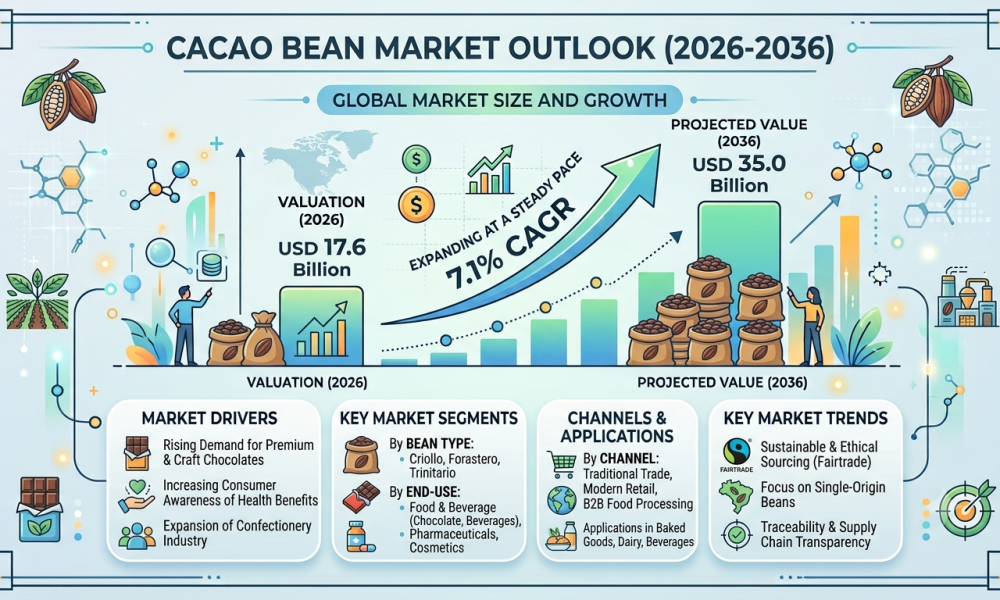
The global cacao bean market is projected to grow from USD 17.6 billion in 2026 to USD 35.0 billion by 2036, registering a 7.1% CAGR during the forecast period. Demand is supported by regular cocoa grinding requirements, food and beverage manufacturing, chocolate production, and continued procurement of commercial bean volumes. Processors increasingly require cacao beans with consistent fermentation, moisture performance, shipment condition, and traceability documentation.
Commercial grinding capacity is creating sustained demand for accepted cacao bean lots as processors convert beans into cocoa liquor, butter, and powder for use across downstream food and beverage applications. At the same time, concentrated origin supply and weather-sensitive production continue to influence sourcing and contracting decisions. Traceability is also becoming increasingly important, particularly for suppliers serving regulated destinations where due-diligence documentation is required.
Get detailed market forecasts, competitive benchmarking, and pricing trends: https://www.futuremarketinsights.com/reports/sample/rep-gb-11089
Global Segment Leaders
- Product Type – Forastero: 86.0% in 2026. The segment leads because its bulk-bean role supports high-volume industrial grinding and routine commercial processing requirements.
- End Use Application – Food and Beverages: 43.0% in 2026. Cacao beans are converted into cocoa ingredients used across several food and beverage manufacturing formats.
- Distribution Channel – B2B: 88.0% in 2026. Industrial processors purchase commercial bean lots under technical, quality, origin, and traceability specifications.
Country-Level Performance
The United Kingdom is projected to grow at a 7.1% CAGR through 2036, supported by an active commercial importer base serving industrial processors, specialist chocolate makers, and commodity traders. HM Revenue & Customs listed 68 matching 2026 traders for cocoa beans under commodity code 18010000 when the record was checked in September 2026.
The United States is forecast to grow at a 7.0% CAGR, supported by regular processor demand and imported bean supply. U.S. import controls make pest-free shipment conditions important for cacao bean suppliers, with FDA Import Alert 34-01 covering specified cocoa bean shipments from Brazil, Indonesia, and Malaysia where live-insect concerns apply.
Germany is projected to expand at a 6.1% CAGR, supported by recurring chocolate manufacturing requirements and dependence on imported cocoa. Destatis reported that cocoa bean import prices in Germany were 4.0% below the prior-year level in September 2025.
South Korea is expected to grow at a 6.0% CAGR, with imported-food controls and manufacturer quality requirements influencing commercial cacao bean demand. Regulated cocoa flows and documented origin information remain important for suppliers serving local chocolate and cocoa processors.
Japan is forecast to record a 5.0% CAGR, supported by mature manufacturer qualification requirements and demand for consistent specialty bean quality. Japan Customs lists cacao beans under HS 1801 as free under the January 1, 2026 tariff schedule.
Regional Context
The United Kingdom and United States represent the faster-growing profiled markets, with CAGRs of 7.1% and 7.0%, respectively. The UK benefits from an active commercial import network, while the United States continues to rely on imported cacao beans for industrial processing. Germany, South Korea, and Japan show CAGRs ranging from 6.1% to 5.0%, reflecting differences in processor requirements, import conditions, and maturity of cocoa manufacturing markets.
Origin concentration remains an important factor across the global cacao bean market. Côte d’Ivoire and Ghana together account for about 60% of world cocoa production, according to the World Bank. Weather and crop conditions in major producing regions can therefore influence commercial availability and contracting decisions. Buyers continue to balance supply diversification with the need to qualify alternative origins for fermentation quality, moisture, shipment condition, and traceability.
The full report covers North America, Latin America, Western Europe, Eastern Europe, East Asia, South Asia and Pacific, and the Middle East and Africa, with the USA, UK, South Korea, Germany, Japan, and 20+ additional countries covered in the full report.
Access full Report in PDF Format@ https://www.futuremarketinsights.com/reports/brochure/rep-gb-11089
Competitive Landscape
The competitive landscape includes Barry Callebaut, Cargill, Incorporated, ofi (Olam Food Ingredients), Nestlé S.A., Mars, Incorporated, Meiji Holdings Co., Ltd., Puratos Group, ECOM Agroindustrial Corp. Ltd., Touton S.A., and Sucden. The market includes integrated cocoa processors, global chocolate manufacturers with direct cocoa sourcing programs, and specialist commodity traders. Competition is shaped by origin sourcing depth, physical quality control, traceability evidence, commercial bean integration, and geographic reach.
Recent developments include Cargill’s expansion of its certified cocoa sourcing program in Indonesia in April 2026, including premium payments and traceability support for participating farmers. In April 2026, ofi and Mars announced a five-year cocoa collaboration in Ecuador, focusing on regenerative agriculture and shared supply-chain activity. Touton S.A. also became part of Hartree Partners in April 2026, while retaining the Touton brand for its cocoa operating business.
About Future Market Insights (FMI)
Future Market Insights, Inc. (ESOMAR certified, recipient of the Stevie Award, and a member of the Greater New York Chamber of Commerce) offers profound insights into the driving factors that are boosting demand in the market. FMI stands as the leading global provider of market intelligence, advisory services, consulting, and events for the Packaging, Food and Beverage, Consumer Technology, Healthcare, Industrial, and Chemicals markets. With a vast team of over 400 analysts worldwide, FMI provides global, regional, and local expertise on diverse domains and industry trends across more than 110 countries.



