
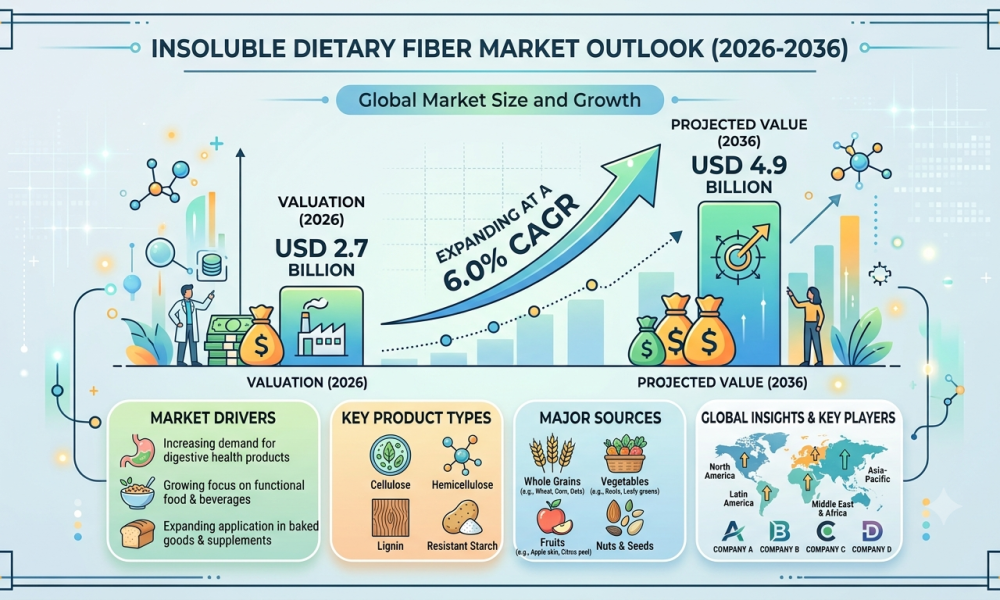
The global insoluble dietary fiber market is projected to grow from USD 2.7 billion in 2026 to USD 4.9 billion by 2036, registering a 6.0% CAGR during the forecast period. Demand is supported by nutrition-led food reformulation, growing interest in fiber enrichment, and the use of insoluble fiber to improve texture and functionality in food products. Manufacturers are increasingly evaluating fiber ingredients based not only on nutritional content but also on hydration, processing performance, mouthfeel, and sensory characteristics.
Advances in processing technologies are creating additional opportunities for insoluble dietary fiber suppliers, particularly through enzymatic, pressure, microwave, and combined treatments. These technologies can help convert bran, pomace, okara, and potato residues into higher-value functional ingredients. Cellulose remains the leading product type, while cereals and grains represent the largest source category as cereal-processing side streams continue to be used in food-ingredient applications.
Get detailed market forecasts, competitive benchmarking, and pricing trends: https://www.futuremarketinsights.com/reports/sample/rep-gb-624
Global Segment Leaders
- Product Type – Cellulose: 43.0% in 2026. The segment leads as cellulose provides formulators with controlled particle structure and consistent functionality for applications requiring water management, texturizing, and sensory neutrality.
- Source – Cereals & Grains: 31.0% in 2026. Cereal processing generates concentrated side streams that can be standardized into food-grade dietary fiber, supporting continued use in bakery and grain-based food applications.
Country-Level Performance
Japan is projected to grow at the fastest pace among the profiled countries, with an 8.0% CAGR through 2036. Growth is supported by increasing attention to dietary fiber intake and changes in analytical methods covering resistant starch and related fiber fractions.
The United Kingdom is expected to record a 7.0% CAGR, supported by continued focus on fiber intake and opportunities for fiber enrichment in everyday foods such as breads, cereals, and snacks.
South Korea is projected to grow at a 6.0% CAGR, matching the global market rate. Growth is supported by food-category developments and the increasing importance of documentation and compliance for ingredients used in health-oriented food applications.
Germany is forecast to expand at a 5.0% CAGR through 2036. Fiber-rich foods, including whole grains and bran, remain prominent in dietary guidance, while functional fiber grades can provide additional value through improved water management and texture.
The United States is expected to grow at a 4.0% CAGR through 2036. The mature market continues to focus on nutrition-oriented reformulation, with manufacturers seeking to increase fiber content while maintaining familiar sensory and processing characteristics.
Regional Context
Japan and the United Kingdom represent the faster-growing profiled country markets, with CAGRs of 8.0% and 7.0%, respectively. Japan’s growth is associated with dietary fiber intake considerations and evolving measurement methods, while the UK presents opportunities for fiber enrichment across mainstream food categories.
South Korea records a 6.0% CAGR, in line with global growth, while Germany and the United States expand at 5.0% and 4.0%, respectively. These markets are characterized by established food-ingredient industries and continued demand for ingredients that deliver measurable nutritional benefits without compromising texture, hydration, or processing performance.
The full report covers North America, Latin America, Western Europe, Eastern Europe, East Asia, South Asia and Pacific, and the Middle East and Africa, with the USA, UK, Germany, Japan, and South Korea profiled individually.
Access full Report in PDF Format@ https://www.futuremarketinsights.com/reports/brochure/rep-gb-624
Competitive Landscape
The competitive landscape includes Tate & Lyle PLC, J. Rettenmaier & Sohne GmbH (JRS), Roquette Freres, ADM, and Ingredion Incorporated. Competition is shaped by product functionality, particle size, hydration performance, sensory impact, application breadth, and the ability to provide consistent fiber grades for food formulation.
Recent developments include Tate & Lyle PLC announcing shareholder approval in July 2026 for the proposed cash acquisition by Ingredion Incorporated, with the transaction subject to additional conditions and expected to become effective in the second half of 2027. In October 2025, JRS highlighted VITACEL fiber applications in cookies, wafers, and fillings, focusing on dough stability, crunch, and oil control. Ingredion also expanded the commercial positioning of its FIBERTEX CF citrus fiber range in October 2025 across bakery, beverage, plant-based, and savory applications, emphasizing moisture management, texture, and emulsion support.
Analyst Perspective
“Food manufacturers buy insoluble fiber for more than its fiber content. They test how a grade absorbs water, handles in production and feels in the finished product. Processors that control those properties across batches can make better use of bran and other plant side streams.”
— Nandini Roy Choudhury, Principal Consultant, Future Market Insights
About Future Market Insights (FMI)
Future Market Insights, Inc. (ESOMAR certified, recipient of the Stevie Award, and a member of the Greater New York Chamber of Commerce) offers profound insights into the driving factors that are boosting demand in the market. FMI stands as the leading global provider of market intelligence, advisory services, consulting, and events for the Packaging, Food and Beverage, Consumer Technology, Healthcare, Industrial, and Chemicals markets. With a vast team of over 400 analysts worldwide, FMI provides global, regional, and local expertise on diverse domains and industry trends across more than 110 countries.



