
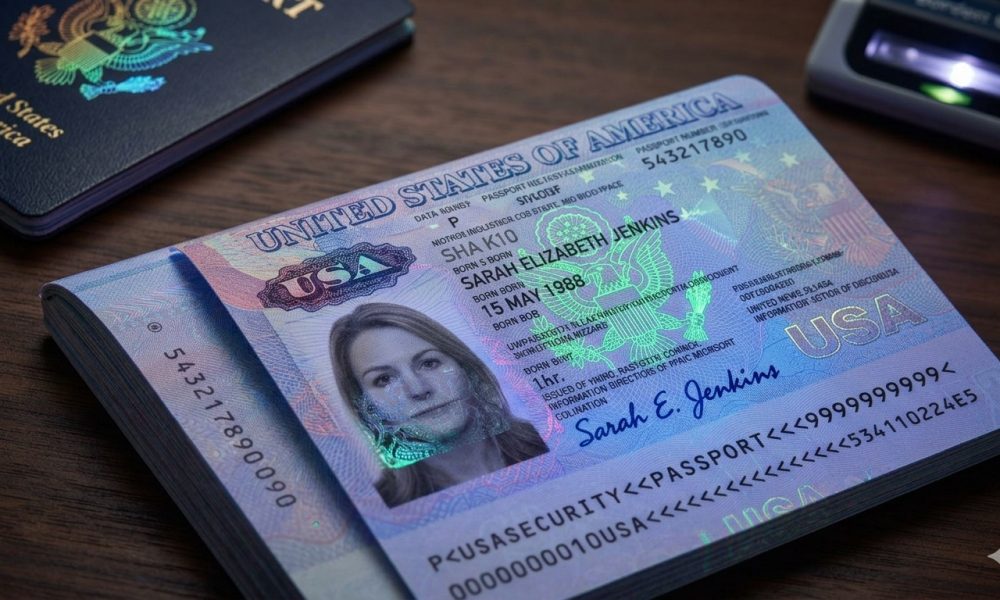
Layered plastic identity pages support laser engraving and help authorities detect attempts to alter personal information.
WASHINGTON, DC, October 1, 2026 — Modern passports increasingly rely on sophisticated materials, digital authentication, specialized printing, biometric technology, and carefully engineered construction because governments need travel documents that can withstand years of physical use while making unauthorized alterations increasingly difficult to conceal.
One of the most significant developments has been the growing adoption of polycarbonate for passport biographical data pages, replacing traditional paper or laminated identity pages with a rigid multilayer structure in which photographs, personal information, security graphics, and other identifying features become physically integrated into the document itself.
For travelers, the resulting page may appear relatively simple, containing a photograph, name, nationality, date of birth, passport number, expiration date, and machine-readable information, yet underneath that familiar appearance lies a carefully engineered security structure designed to make physical modification substantially more difficult.
Polycarbonate does not make a passport impossible to counterfeit, and border authorities never rely on a single feature. Still, the material lets governments combine numerous security techniques into a single identity page that officers, automated inspection systems, forensic laboratories, and document specialists can examine from several perspectives.
What Is a Polycarbonate Passport Data Page?
Polycarbonate is a durable thermoplastic valued for its strength, dimensional stability, optical properties, and ability to withstand heat and physical stress, making it particularly suitable for Identification documents expected to remain usable for many years.
Instead of printing personal information on an ordinary sheet of paper and protecting it with a transparent laminate, manufacturers can build a passport identity page from several extremely thin polycarbonate layers that fuse permanently during manufacturing.
Authorities then personalize information within those layers using techniques such as laser engraving, so important information becomes part of the page’s physical structure rather than ink sitting on its surface.
This construction fundamentally changes the challenge facing anyone attempting to alter a legitimate document because replacing a photograph, changing a date of birth, modifying a passport number, or manipulating another biographical field may require interfering with the laminated physical structure itself.
When inspectors understand the expected construction of a particular passport model, unusual separation between layers, damaged surfaces, inconsistent engraving, unexpected transparency, disturbed security patterns, or abnormal thickness can provide indications that investigators should examine the document more closely.
Laser Engraving Changes How Personal Information Is Added
One of polycarbonate’s most valuable characteristics involves its compatibility with laser personalization systems that permanently darken selected areas beneath or within the surface, allowing authorities to create photographs, text, numbers, patterns, and other individualized information without relying exclusively on conventional printing.
Traditional printed information can be mechanically removed, chemically attacked, overwritten, or replaced, although modern paper passports already include numerous defenses against those techniques; laser-personalized polycarbonate adds another substantial barrier because information can extend through multiple physical depths.
Manufacturers can vary laser intensity, engraving depth, positioning, and microscopic structure to create effects that are extremely difficult to reproduce accurately without specialized equipment and detailed technical knowledge of the issuing country’s production specifications.
The technology also lets authorities repeat key information in several locations and formats, so a person’s photograph or passport number may appear as a primary feature while also appearing in miniature images, tactile structures, transparent windows, or other secondary elements.
Document examiners can therefore compare several representations of the same information instead of relying only on the most visually prominent photograph or printed name.
Multiple Images Can Strengthen Identity Verification
A modern polycarbonate passport may contain more than one representation of the holder’s facial Image, including a conventional portrait together with smaller secondary images created through laser engraving or specialized optical techniques.
These secondary portraits can make simple photograph substitution much harder because anyone trying to change the primary Image would also need to reproduce the additional personalized security elements accurately.
Some documents incorporate changeable or multiple laser images that display different information depending on the viewing angle, allowing inspectors to tilt the passport page and observe whether expected visual transitions occur.
Others use transparent or semi-transparent windows containing personalized information that becomes visible under specific viewing conditions, creating another connection between the physical document structure and the individual whose identity appears on the page.
This principle reflects an important concept in modern document security because strong passports generally do not depend on a single spectacular feature; instead, they rely on numerous overlapping features that reinforce one another.
Physical Layers Make Alteration Easier to Detect
Polycarbonate passport pages typically consist of multiple layers fused under controlled manufacturing conditions, creating a single integrated structure rather than several easily separated sheets.
Attempting to separate those layers can leave physical evidence, including distortion, clouding, cracking, delamination, changes in surface texture, damaged optical features, or irregularities around the edges of the data page.
Experienced border officers and forensic document examiners may inspect passports under normal illumination, magnification, transmitted light, ultraviolet light, infrared examination systems, and specialized document readers because each method can reveal different characteristics.
The International Civil Aviation Organization maintains information on international machine-readable travel document standards, and its specifications provide the global framework within which modern passports and electronic machine-readable travel documents operate.
Polycarbonate therefore works as one component within a much broader security ecosystem that includes standardized data structures, machine-readable zones, biometric chips, issuing-authority cryptography, inspection procedures, national databases, and international document reference systems.
Polycarbonate and the Electronic Passport Chip Are Separate Systems
Travelers sometimes assume the polycarbonate page itself contains all of the passport’s electronic capabilities, but physical document construction and electronic chip technology are related but distinct security systems.
An electronic passport contains a contactless integrated circuit that stores information defined by international standards, generally including biographical data and a digital representation of the holder’s facial Image.
Depending on the issuing country and document type, it may also include additional biometric or security information. At the same time, cryptographic mechanisms allow inspection equipment to verify whether electronically stored information has been altered.
The polycarbonate page protects the physical representation of the holder’s identity, while the chip provides an electronic source that inspection equipment can compare with visible information and digitally authenticated data.
When both systems work together, an inspector can evaluate whether the physical portrait matches the traveler, whether visible biographical information matches machine-readable data, whether the chip responds correctly, and whether its digital signatures validate against trusted issuing-country certificates.
The result is layered verification rather than dependence on any single examination technique.
Why Governments Want Security Features at Different Inspection Levels
Passport security specialists frequently design documents with features intended for several different levels of examination because a border officer handling thousands of travelers cannot perform laboratory analysis on every passport.
Some features should therefore be recognizable quickly through ordinary visual and tactile inspection, while others require simple equipment such as ultraviolet illumination, magnifiers, document readers, or electronic passport scanners.
More sophisticated features may remain primarily intended for second-line border inspection units, forensic laboratories, national document examination centers, or specialized law enforcement investigators.
Polycarbonate supports this strategy particularly well because manufacturers can incorporate visible features, tactile engraving, microscopic personalization, transparent areas, optical devices, and hidden characteristics within the same compact page.
The European Union’s PRADO document reference system illustrates the wide range of security features found across passports, identity cards, residence documents, visas, and other official documents issued by governments worldwide.
Durability Is Also a Security Feature
Passport security involves more than preventing deliberate alteration because legitimate documents must also survive repeated international travel, exposure to different climates, handling by travelers and officials, automated passport readers, luggage, humidity, temperature changes, and ordinary physical wear.
A passport that deteriorates quickly could create Identification problems even when its owner has done nothing wrong, especially if critical information is damaged, security features become hard to inspect, or electronic components stop working.
Polycarbonate’s durability gives issuing authorities a material that protects personalized information throughout a passport’s normal validity period while reducing the likelihood that ordinary handling will destroy important physical features.
A more durable document also assists inspection because officers can distinguish expected wear from potentially suspicious manipulation more effectively when the underlying material remains structurally stable.
For governments issuing passports with long validity periods, particularly documents valid for approximately a decade, durability becomes an important operational consideration rather than simply a matter of appearance.
Machine-Readable Information Provides Another Comparison Point
The visual inspection zone on a passport contains information intended primarily for human readers. In contrast, the machine-readable zone near the bottom of the identity page encodes important data in a standardized format that inspection systems can process rapidly.
Border systems can compare machine-readable information with visible data, electronic chip records, immigration databases, national security systems, and other authorized sources, depending on the country’s border architecture.
An unauthorized alteration therefore cannot necessarily succeed merely by changing one visible field because inconsistencies among the visual page, machine-readable zone, electronic chip, document number structure, or government records can trigger additional scrutiny.
Modern document examination increasingly depends on this type of cross-validation, in which multiple independent pieces of information must agree before an inspection system treats the document as internally consistent.
At Amicus International Consulting, questions involving passports, citizenship, identity documentation, residency, and international mobility frequently require separating physical document security from the broader legal status that gives an official document its authority.
A Secure Material Cannot Replace Lawful Issuance.
A sophisticated passport page can include genuine-looking security features without proving lawful issuance, which is why governments evaluate travel documents through a combination of physical examination, electronic authentication, database verification, and official records.
Conversely, normal wear, electronic reading difficulties, or unusual physical characteristics do not automatically prove a passport is fraudulent because inspection conditions, manufacturing variations, damaged antennas, reader compatibility, and document age can affect results.
Government-issued passports derive their legitimacy from the issuing sovereign authority, while security materials and technologies help border agencies determine whether the document presented corresponds with that lawful issuance.
This distinction matters because online image-analysis platforms, consumer applications, photographs, scans, and document photographs can provide useful technical information but generally cannot duplicate the complete verification environment available to an issuing authority or government border agency.
A photograph of a passport cannot show everything in the physical document because tactile features, engraving depth, ultraviolet responses, optical effects, transmitted-light characteristics, chip authentication, and database information may require examination of the original.
Why Passport Security Keeps Becoming More Complex
Document security evolves because counterfeiters continually adapt to new technology. In contrast, inexpensive high-resolution printers, image-editing software, commercial lasers, sophisticated scanning systems, and access to global document images have lowered some historical barriers to producing convincing visual imitations.
Governments consequently respond by designing passports whose authenticity depends less on a single difficult-to-print Image and more on the interaction among materials, manufacturing processes, personalized security features, electronics, cryptography, databases, and biometric verification.
Polycarbonate fits this strategy particularly well because it lets designers embed identity information inside the material, combine multiple personalized security elements, and create structures that can reveal evidence of attempted mechanical manipulation.
The material itself does not solve every passport security challenge. Yet, it makes the identity page a more sophisticated security device than the comparatively simple photograph-and-laminate systems used in previous generations.
The Connection Between Physical and Digital Identity
Modern border inspection increasingly brings physical and digital identity verification together because automated gates can read passport chips, extract standardized information, capture a live facialImagee, and compare that Image with the portrait stored inside the electronic document.
The physical passport remains important because officers can inspect its construction and visible information. At the same time, electronic verification provides another independent way to assess whether the data originated from the expected issuing authority.
Countries participating in international electronic passport authentication frameworks can exchange the public certificates needed to validate digitally signed passport information, adding a layer of trust beyond visual document inspection.
This combination explains why discussions of passport security should distinguish between the physical integrity of the booklet, the electronic integrity of the chip, biometric correspondence with the traveler, and the legal validity of the underlying government record.
Each layer answers a different question, and strong border systems combine them rather than treating any single result as conclusive.
What Travelers Should Understand About Their Passport
Most passport holders never need to understand the engineering inside their travel document, but basic awareness can help travelers appreciate why governments advise against bending, puncturing, excessively heating, laminating, cutting, modifying, or otherwise damaging passport identity pages.
Travelers should also avoid assuming every visible difference indicates a problem because passport designs vary substantially by country, issuing period, passport category, and document version.
When concerns arise regarding authenticity, electronic functionality, damaged pages, incorrect personal information, or suspected manufacturing defects, the appropriate issuing passport authority or consular office remains the primary source for determining whether replacement or formal inspection is necessary.
Consumer NFC applications can sometimes help an individual determine whether an electronic passport chip is readable. However, a successful smartphone scan does not independently establish every aspect of document authenticity or immigration validity.
Likewise, an unsuccessful scan does not by itself establish that a passport is counterfeit because positioning, antenna location, device compatibility, software, physical damage, or other technical factors can affect communication with a contactless chip.
Polycarbonate Represents the Direction of Modern Secure Documents
The movement toward polycarbonate passport identity pages reflects a broader transformation in government identity security, where authorities increasingly combine durable materials, embedded personalization, biometric information, cryptographic authentication, and database verification.
National identity cards, residence permits, driver’s licenses, and other high-security credentials increasingly use similar principles because governments want documents that resist alteration while supporting reliable inspection across different administrative and law enforcement environments.
For individuals considering international citizenship, residency, or lawful identity planning, understanding these distinctions can also help separate legitimate government-issued documentation from unsupported claims about documents that merely appear technically sophisticated.
Amicus International Consulting advises clients on lawful international citizenship, residency, identity, mobility, and cross-border planning, where government documentation and proper verification are essential parts of the process.
Polycarbonate has become important not because plastic alone makes a passport secure, but because its physical characteristics give governments a platform on which several security technologies can work together, connecting the visible identity page with increasingly sophisticated electronic and biometric authentication systems.
As passport technology continues to evolve, travelers will likely encounter documents with even more integrated physical and digital safeguards. Yet, the fundamental security principle will remain unchanged: the strongest travel documents rely on several independent layers of evidence that reinforce one another rather than depending on a single feature.




