
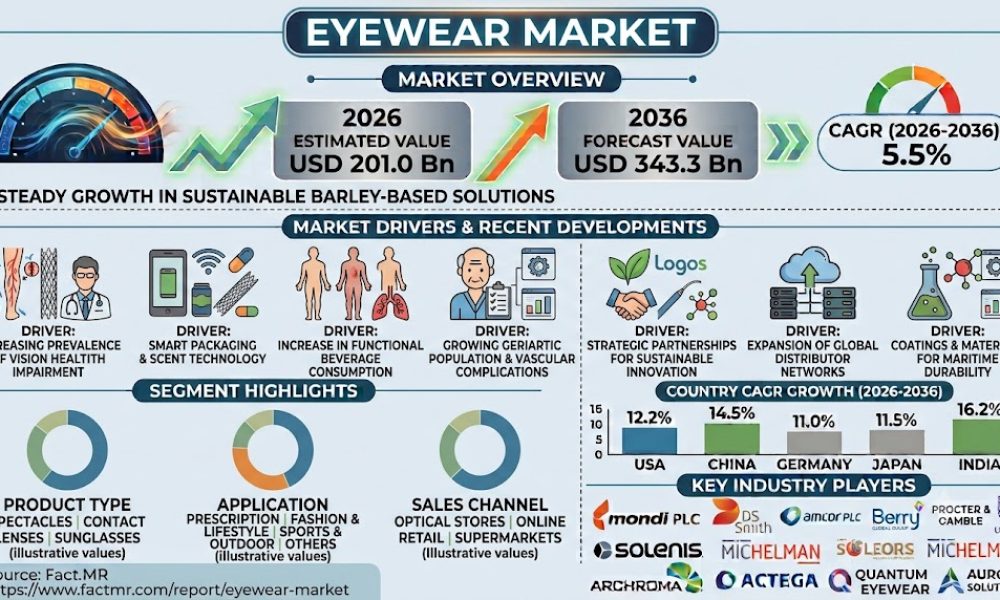
The global Eyewear Market was valued at USD 190.5 billion in 2025 and is estimated to reach USD 201.0 billion in 2026. Fact.MR projects the market to reach USD 343.3 billion by 2036, expanding at a 5.5% CAGR during the forecast period. The market is expected to create an additional USD 142.3 billion in revenue opportunities between 2026 and 2036.
The market covers spectacles, sunglasses, contact lenses, and smart eyewear used for vision correction, UV protection, fashion, and connected applications. Rising global myopia prevalence is increasing demand for corrective eyewear, while ageing populations are supporting the use of progressive and bifocal lenses. Fashion-led purchases are also supporting demand for premium sunglasses and designer frames.
Get Detailed Market Forecasts, Competitive Benchmarking, and Pricing Trends: https://www.factmr.com/connectus/sample?flag=S&rep_id=9975
Global Segment Leaders
- Sunglasses account for approximately 74% of the product-type segment in 2026. Demand is supported by UV protection requirements and fashion-led purchases across mass-market and premium channels.
- Women represent approximately 64% of the end-user segment. Higher purchase frequency and stronger fashion-related eyewear spending support the segment’s share.
- Specialty optical stores hold approximately 45% of the sales-channel segment. Eye examinations, professional fitting, and prescription services continue to support the channel despite growing online sales.
Country-Level Performance
- China: The market is projected to expand at a 7.5% CAGR through 2036. Updated national myopia-control guidelines recommend orthokeratology and clinical monitoring for children. JINS has expanded to nearly 400 stores in China, while Hoya reported 11% growth in lens revenue.
- India: Eyewear demand is forecast to grow at a 7.0% CAGR. The National Programme for Control of Blindness received INR 1,850 crore in funding, supporting school vision screening and spectacle distribution. Lenskart has surpassed 2,500 stores, while VisionSpring distributed about 2.4 million reading glasses in rural areas during 2024.
- Germany: The market is projected to rise at a 6.8% CAGR. A January 2025 GKV reimbursement revision increased children’s spectacle coverage by about 12%. Fielmann and Specsavers continue to expand their optical retail presence, while Carl Zeiss reported 8% consumer optics revenue growth.
- United States: The market is expected to advance at a 6.0% CAGR through 2036. Vision insurance plans covered about 230 million people in 2024, supporting regular spectacle and contact lens purchases. Johnson & Johnson Vision Care reported 7% growth in Acuvue lens revenue.
- United Kingdom: The market is forecast to grow at a 5.8% CAGR. NHS optical voucher values increased by roughly 6% in 2024 for complex prescriptions. Specsavers recorded 9% growth in contact lens subscription services, while Boots Opticians partnered with Essilor to expand Varilux progressive lens availability.
Regional Context
Asia Pacific remains a major eyewear demand center, supported by rapid urbanisation, increasing screen exposure, high myopia prevalence, and optical retail expansion. China and India show the highest country growth rates among the markets profiled by Fact.MR, at 7.5% and 7.0%, respectively.
Europe combines mature optical retail infrastructure with strong designer eyewear demand and advanced lens adoption. Germany is projected to grow at 6.8%, while the United Kingdom is forecast at 5.8%. Reimbursement policies and premium lens adoption remain relevant market factors.
North America has high per-consumer eyewear spending, supported by insurance coverage and premium product adoption. The United States is projected to expand at 6.0% CAGR through 2036.
Fact.MR’s analysis covers 40+ countries across Asia Pacific, Europe, North America, Latin America, and the Middle East & Africa.
Market Drivers and Opportunities
Rising myopia prevalence is a major demand driver for spectacles and contact lenses. China, in particular, is seeing greater focus on childhood myopia management, including orthokeratology and clinical monitoring.
Ageing populations are increasing demand for progressive and bifocal lenses as consumers seek solutions for age-related vision changes. This supports opportunities for lens manufacturers offering advanced prescription technologies.
Premiumisation of sunglasses and designer frames is another growth factor. Luxury branding and social media exposure are encouraging consumers to treat eyewear as a fashion accessory in addition to its protective function.
Several technology and channel opportunities are also emerging:
- Myopia-management contact lenses and orthokeratology.
- Progressive, photochromic, and blue-light filtering lenses.
- AI-powered virtual try-on platforms.
- Direct-to-consumer contact lens subscription models.
- Online frame trial and digital optical retail programmes.
- Sustainable and bio-based frame materials.
- Smart connected glasses with AI-enabled features.
At the same time, online direct-to-consumer platforms are increasing price competition and putting pressure on optical retail margins. Fragmented reimbursement frameworks can also limit spectacle and contact lens coverage in emerging markets, while concentration of lens manufacturing creates supply-chain exposure.
Competitive Landscape
The global market has a mixed competitive structure. Large companies have significant positions in premium prescription eyewear and contact lenses, while fashion and value-oriented eyewear remains more fragmented across regional brands and online retailers.
Key companies profiled by Fact.MR include EssilorLuxottica, Johnson & Johnson Vision Care, Bausch & Lomb, Carl Zeiss, Hoya Corporation, Alcon, CooperCompanies, Specsavers, Fielmann Group, Safilo Group, Lenskart, Warby Parker, and Kering Eyewear.
EssilorLuxottica reported in February 2025 that its Sunglass Hut and OPSM network had expanded to more than 4,600 stores globally. Its Ray-Ban and Oakley brands also recorded growth across Asia Pacific and travel retail channels.
In October 2024, Meta and EssilorLuxottica launched the third generation of Ray-Ban Meta smart glasses, adding improved AI voice-assistant and live-streaming capabilities.
Specsavers launched a women’s designer frame collection with Karen Millen in November 2024 across more than 2,300 stores in Europe and Australia. Alcon introduced TOTAL30 Multifocal silicone hydrogel lenses in September 2024 for presbyopic users seeking alternatives to progressive spectacles.
Analyst Perspective
Shambhu Nath Jha, Principal Consultant at Fact.MR, notes that the report provides strategic insight into growth opportunities across premium lenses, myopia-management contact lenses, and digital optical retail models.
The report evaluates eyewear by product type, end user, sales channel, material, application, and region. Its market sizing uses eyewear unit sales, vision impairment prevalence, average prices, reimbursement data, retail sales, OEM financial disclosures, and primary interviews with optometrists, optical retailers, brand managers, contact lens distributors, and e-commerce category managers.
About Fact.MR
Fact.MR is a market research and consulting firm providing syndicated and customized research across consumer goods, healthcare, technology, industrial goods, chemicals and materials, and other major industries. Its research combines primary interviews, secondary research, market sizing, competitive analysis, and industry data validation.



