
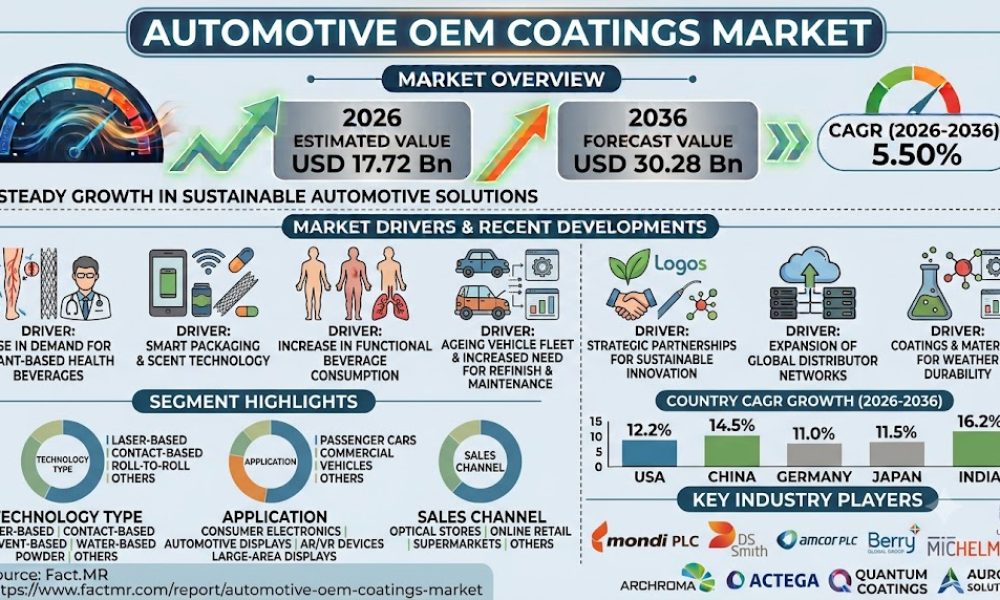
The global Automotive OEM Coatings Market was valued at USD 16.80 billion in 2025 and is estimated at USD 17.72 billion in 2026. Fact.MR projects the market to reach USD 30.28 billion by 2036, expanding at a 5.5% CAGR from 2026 to 2036. This represents an absolute dollar opportunity of approximately USD 12.56 billion during the forecast period.
Automotive OEM coatings are factory-applied multilayer paint systems used to provide corrosion protection, color consistency, surface finish, and weathering resistance on passenger cars and commercial vehicles. The market covers primer, base coat, clear coat, e-coat, and specialty layers across epoxy, acrylic, polyurethane, and other resin systems.
Vehicle production volumes remain a key demand factor. At the same time, environmental requirements are pushing automotive paint shops toward water-based and other lower-emission coating technologies. The report also identifies electric vehicle production and lightweight materials as areas increasing the need for specialized coating systems.
Get Detailed Market Forecasts, Competitive Benchmarking, and Pricing Trends: https://www.factmr.com/connectus/sample?flag=S&rep_id=12208
Global Segment Leaders
- Primer accounts for 37.8% of the market by product in 2025. Primer provides substrate adhesion and corrosion protection and forms a critical layer in the standard automotive paint process.
- Epoxy resin represents 33.4% of demand by resin type in 2025. Its adhesion, corrosion resistance, and suitability for electrocoat applications support its use across automotive manufacturing.
- Water-based technology contributes 37.6% of the market in 2025. Lower solvent emissions and tighter VOC requirements are supporting its use in automotive paint shops.
- The market is also segmented by passenger cars and commercial vehicles, with demand influenced by vehicle production volumes, coating specifications, and manufacturing requirements.
Country-Level Performance
- China: The market is projected to grow at a 5.2% CAGR through 2036. High vehicle production volumes, EV manufacturing expansion, and growing investment in coating infrastructure are supporting demand for OEM coating systems.
- India: The market is forecast to expand at a 5.0% CAGR based on the country comparison table. Domestic vehicle production, foreign investment, manufacturing infrastructure, and adoption of modern coating technologies are supporting demand.
- USA: A 4.7% CAGR is projected through 2036. Automotive manufacturing reshoring and EV factory development are supporting demand for advanced coating systems.
- Japan: The market is expected to grow at a 4.5% CAGR. Established automotive production, quality-focused manufacturing, robotic application systems, and demand for high-finish coatings support the market.
- Germany: A 4.3% CAGR is forecast through 2036. Premium vehicle manufacturing, environmental compliance requirements, and advanced coating capabilities are shaping demand.
- South Korea: The market is projected to advance at a 4.1% CAGR. Export-oriented vehicle manufacturing and established coating technology capabilities support continued demand.
- Brazil: The market is expected to grow at a 3.9% CAGR. Its established automotive manufacturing base and role in regional vehicle production support coating consumption.
Regional Context
Asia Pacific represents an important growth area for automotive OEM coatings, supported by vehicle production expansion, EV manufacturing, and investment in modern assembly infrastructure. China and India record the highest CAGRs among the countries listed in the report.
North America benefits from established automotive manufacturing infrastructure, vehicle production, reshoring initiatives, and new EV manufacturing facilities. The USA is projected to expand at 4.7% CAGR through 2036.
Europe is supported by premium vehicle production, stringent environmental requirements, and established coating technology capabilities. Germany remains the largest country market within the region, accounting for 38.6% of the European market in 2026.
The report covers 40+ countries across North America, Latin America, Europe, East Asia, South Asia, Oceania, and the Middle East & Africa.
Market Drivers and Opportunities
Growth in global vehicle production is supporting recurring demand for primer, base coat, clear coat, and e-coat systems across automotive assembly plants. Higher vehicle output directly expands the volume of factory-applied coating required.
Stricter VOC requirements are encouraging paint shops to adopt water-based and other lower-emission technologies. Automotive manufacturers are seeking formulations that reduce solvent emissions while maintaining finish quality and production performance.
Electric vehicle manufacturing is creating additional requirements for coatings used with new vehicle architectures and lightweight materials. The report identifies EV battery enclosures, sensor housings, and specialized composite substrates as emerging application areas.
Digital color matching and quality control are also becoming more relevant. Spectrophotometers, automated defect detection, and digital color-formulation systems can help paint shops identify color deviations and application defects earlier in production.
The report identifies several opportunity pathways, including:
- Advanced primer systems for corrosion protection and adhesion.
- Epoxy resin systems for electrocoat and primer applications.
- Water-based coatings designed around VOC reduction requirements.
- Advanced color matching and clearcoat formulations.
- Technical support and supply-chain services for OEM paint shops.
- Coatings for EV battery enclosures, sensor housings, and lightweight vehicle components.
Market participants also face challenges. Raw material price volatility can affect coating economics, while water-based systems may require specialized application equipment. Maintaining color consistency across multiple manufacturing plants is another operational challenge identified by Fact.MR.
Competitive Landscape
The competitive landscape includes BASF SE, PPG Industries, Nippon Paint Holdings, Akzo Nobel, Axalta Coating Systems, Berger Paints India, Kansai Paint, The Sherwin-Williams Company, KCC Corporation, and Covestro.
BASF SE is identified in the report with a 12.7% market share, supported by its automotive OEM coating portfolio and integrated coating-system capabilities. PPG Industries focuses on automotive coating platforms, color innovation, and application solutions across international automotive markets.
Nippon Paint Holdings has a strong focus on Asian automotive markets, while Akzo Nobel maintains a broad coating portfolio with significant European exposure. Axalta Coating Systems focuses on automotive coating technologies for global OEM applications.
Berger Paints India provides automotive coating solutions with an emphasis on emerging markets. Kansai Paint focuses on Asian automotive coatings and Japanese quality requirements, while Sherwin-Williams, KCC, and Covestro participate through automotive coating technologies, specialized chemistry, and technical support.
Analyst Perspective
The current Fact.MR page does not publish a direct analyst quotation for the Automotive OEM Coatings Market. The report instead identifies finish quality, environmental compliance, water-based technology, digital color management, and EV-related coating requirements as important areas for suppliers and automotive manufacturers.
The research covers primer, base coat, clear coat, e-coat, and other coating layers, along with epoxy, acrylic, polyurethane, and other resin categories. Technology analysis includes water-based, solvent-based, powder-based, and other systems, while applications cover passenger cars and commercial vehicles.
Fact.MR uses a hybrid top-down and bottom-up methodology, cross-validated against primary research, public financial disclosures, and independent industry association data.
Explore More Related Studies Published by Fact.MR Research:
Gate Docking Radar Market
Shore Power Connection Boxes Market
About Fact.MR
Fact.MR is a market research and consulting firm providing syndicated and customized research across automotive, chemicals and materials, technology, industrial goods, healthcare, and consumer markets. Its research combines primary interviews, secondary research, market sizing, competitive analysis, and industry data validation.



