
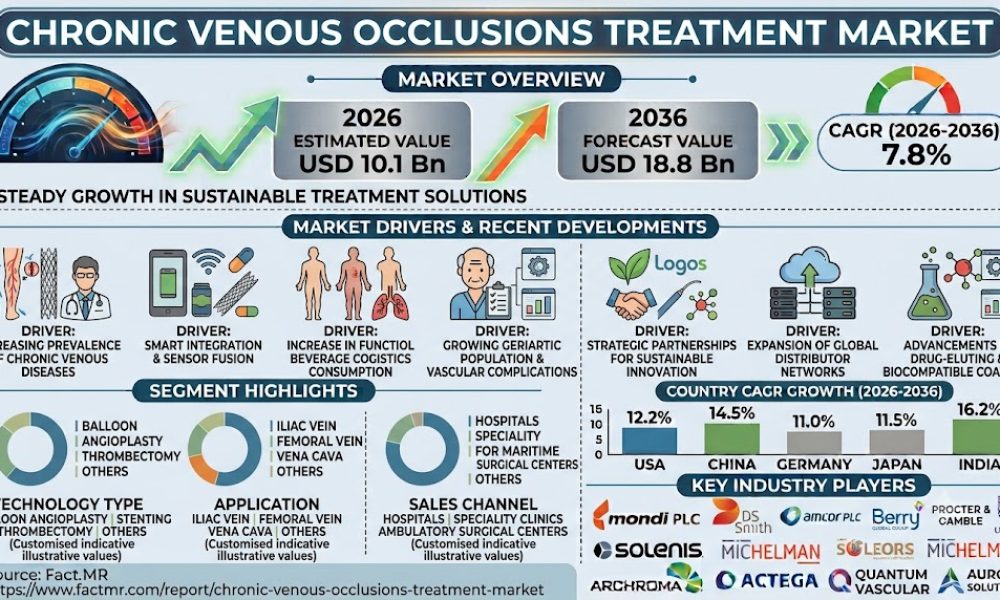
The global Chronic Venous Occlusions Treatment Market was valued at USD 9.5 billion in 2025 and is estimated to reach USD 10.1 billion in 2026. Fact.MR forecasts the market to reach USD 18.8 billion by 2036, expanding at a 7.8% CAGR during the forecast period. This represents an absolute dollar opportunity of USD 8.7 billion between 2026 and 2036.
The market includes devices, drugs, and clinical procedures used to treat chronic venous insufficiency, deep vein thrombosis, and venous occlusions. Key treatment categories include endovenous laser ablation, radiofrequency ablation, sclerotherapy, compression therapy, and anticoagulant medication.
Get Detailed Market Forecasts, Competitive Benchmarking, and Pricing Trends: https://www.factmr.com/connectus/sample?flag=S&rep_id=14527
A major change is the movement of venous procedures from hospital settings toward ambulatory surgical centers (ASCs) and specialty clinics. Fact.MR notes that reimbursement support for minimally invasive procedures and outpatient economics are encouraging this transition. CMS maintained separate reimbursement for endovenous thermal ablation procedures in ASC settings in its 2025 payment update.
Global Segment Leaders
- Endovenous laser ablation leads the treatment-type segment with approximately 35% share in 2026. The segment benefits from clinical adoption, long-term evidence, and reimbursement support across hospital and outpatient settings.
- Devices account for approximately 54% of the market in 2026. Single-use ablation fibers, catheters, and venous stent procedures contribute to the strong position of device-based treatment.
- Hospitals hold approximately 47% share among end users in 2026. However, ambulatory surgical centers are identified as the fastest-growing end-user segment as treatment moves toward outpatient settings.
Country-Level Performance
- China: The market is projected to expand at a 7.8% CAGR through 2036. Expansion of vascular surgery capacity at county hospitals and wider reimbursement coverage for endovenous laser ablation are supporting procedure volumes.
- India: A 7.0% CAGR is forecast through 2036. Private hospital networks are expanding vascular surgery services, while improving insurance coverage for radiofrequency and laser ablation is supporting access to minimally invasive treatment.
- Germany: The market is expected to grow at a 6.7% CAGR. Reimbursement updates for endovenous ablation are encouraging migration toward accredited outpatient vascular clinics.
- France: A 6.0% CAGR is projected through 2036. Expanded reimbursement for sclerotherapy and thermal ablation in outpatient centers is supporting adoption.
- United States: The market is forecast to advance at a 5.7% CAGR. CMS reimbursement support and increasing office-based ablation procedures are sustaining demand for venous treatment devices.
- United Kingdom: The market is expected to register a 5.5% CAGR. NHS guidelines prioritizing endovenous ablation as first-line therapy are supporting procedure volumes across public and private treatment centers.
- Brazil: The market is projected to grow at a 5.0% CAGR. Private insurance coverage for endovenous ablation and investment in specialty clinics are gradually increasing adoption of minimally invasive treatments.
Regional Context
Asia Pacific is identified as the fastest-growing regional market, supported by vascular specialty hospital expansion in China and increasing minimally invasive procedures in India. China and India are projected to grow at 7.8% and 7.0%, respectively.
Europe represents a mature reimbursement-led market. Germany, France, and the United Kingdom are being influenced by national reimbursement frameworks, outpatient treatment coverage, and EU MDR requirements for medical devices.
North America remains the largest revenue market. The region benefits from high treatment volumes, established reimbursement frameworks, and migration of venous procedures toward ambulatory surgical centers.
The report analyzes 40+ countries across Asia Pacific, Europe, North America, Latin America, and the Middle East & Africa.
Market Drivers and Opportunities
The increasing prevalence of chronic venous disease is a central demand driver. Aging populations are expanding the treatment-eligible patient pool, while obesity and sedentary lifestyles are contributing to venous disease incidence among younger populations.
Another major factor is the shift from open surgery toward minimally invasive treatment. Endovenous ablation can support shorter procedures and faster recovery, helping drive procedure migration into outpatient care.
Fact.MR identifies several opportunities for market participants:
- Compact ablation systems designed for ASCs and specialty clinics.
- Next-generation venous stent technologies for chronic iliofemoral occlusion.
- Expansion of anticoagulant market access in China and India.
- Single-use endovenous ablation platforms designed for office-based procedures.
- Drug-coated balloon and other minimally invasive venous treatment programs.
Limited access to specialist vascular care in lower-income markets remains a structural constraint. Price sensitivity in public hospital procurement can also restrict adoption of premium single-use ablation devices.
Competitive Landscape
The competitive landscape includes Boston Scientific, Medtronic, AngioDynamics, Gore, Cook Medical, Cardinal Health, Bayer, Sanofi, Stryker, and Edwards Lifesciences. Device manufacturers compete across venous stents, ablation systems, catheter-based technologies, and related vascular treatment products, while pharmaceutical companies participate through anticoagulant therapies.
AngioDynamics expanded distribution of its VenaCure EVLT laser ablation system in 2025 with a new fiber designed to reduce bruising and improve patient comfort. Boston Scientific received FDA clearance in 2024 for an upgraded ClosureFast radiofrequency ablation catheter designed to improve thermal energy delivery during venous procedures.
W. L. Gore expanded European availability of its VIABAL venous stent following CE mark renewal under EU MDR requirements in 2025. Bayer also received updated EU approval for Xarelto in 2024 covering extended prevention of recurrent venous thromboembolism.
Analyst Perspective
Shambhu Nath Jha, Principal Consultant at Fact.MR, states:
“The market’s growth through 2036 will be driven by procedure migration to ASCs and specialty clinics, benefiting manufacturers offering office-based treatment platforms.”
The report evaluates treatment types including endovenous laser ablation, radiofrequency ablation, sclerotherapy, and compression therapy, along with devices and drugs across hospitals, ambulatory surgical centers, specialty clinics, and other care settings.
The research uses a hybrid market-sizing approach based on venous disease prevalence, treatment procedure volumes, device and drug revenue per procedure, reimbursement coverage timelines, and primary interviews with vascular surgeons and interventional radiologists.
Explore More Related Studies Published by Fact.MR Research:
Beverage Carrier Rings Market
Paper Straw Market
About Fact.MR
Fact.MR is a market research and consulting firm providing syndicated and customized research across healthcare, technology, industrial goods, chemicals and materials, consumer products, and other major industries. Its research combines primary interviews, secondary research, market sizing, competitive analysis, and validation of industry developments.



