
The global polyolefin odor neutralizers market is projected to increase from USD 290.0 million in 2026 to USD 720.0 million by 2036, registering a 9.5% CAGR during the forecast period, according to Fact.MR. The market was valued at USD 264.8 million in 2025.
Demand is being supported by increasing qualification work around recycled polypropylene (rPP), packaging applications, and odor performance after extrusion and storage. Recyclers, compounders, and packaging manufacturers are evaluating additive systems that can reduce unwanted odor without requiring major changes to established processing and dosing systems.
The market is expected to create an absolute opportunity of USD 430.0 million between 2026 and 2036, with rPP, Packaging, and Zeolite emerging as important areas of demand.
Get detailed market forecasts, competitive benchmarking, and pricing trends: https://www.factmr.com/connectus/sample?flag=S&rep_id=15581
Recycled Polyolefin Applications Shape Market Demand
Recycled PE and PP materials can retain odors from previous use, collection, storage, and repeated thermal processing. This creates a technical challenge for recyclers and downstream manufacturers seeking to use recycled materials in packaging and finished products.
Odor neutralizers are being evaluated as part of qualification programs where customers assess odor reduction, processing performance, storage behavior, and compatibility with existing extrusion and compounding systems.
Packaging is an important application because recycled-content programs require finished materials to meet performance expectations beyond material recovery. Automotive interiors and household products also contribute to demand where odor can influence acceptance of molded PE and PP components.
Technical teams are increasingly focused on repeatable test results before replacing an approved additive package. This is encouraging suppliers to provide application-specific testing, documentation, and technical support alongside odor-control products.
rPP and Packaging Lead Key Segments
By polymer type, rPP is expected to account for 38% share in 2026, making it the leading segment. Recycled polypropylene can exhibit odor variation related to prior use and heat history, increasing the need for odor-control solutions in packaging and molded goods.
By application, Packaging is projected to hold 31% share in 2026. Recycled-content qualification and odor checks in finished packaging are supporting demand for additives that remain effective during storage and downstream processing.
By chemistry, Zeolite is anticipated to capture 30% share in 2026. Its role in odor adsorption and process-friendly additive routes supports adoption during technical evaluation.
By form, Masterbatch is estimated to represent 30% share in 2026, supported by familiar pellet-handling and dosing practices used by compounders. Powder, liquid additive, concentrate, and custom compound formats remain relevant for specific processing requirements.
By end user, Recyclers are forecast to account for 35% share in 2026. These companies face an early quality challenge when recycled PE and PP carry unwanted odor and therefore have a direct need for effective odor-control solutions.
Country Growth Reflects Recycling and Packaging Requirements
China is projected to record the highest country CAGR at 12.9% from 2026 to 2036 among the countries covered in the report. India follows at 11.9%, while Germany is forecast to expand at 10.9%.
Germany represents a significant European market, with demand supported by packaging review, recycling-focused technical validation, and qualification requirements around recycled polyolefin use. The United States is projected to record a 9.0% CAGR through 2036, supported by recycled packaging programs and additive testing across polyolefin applications.
The country-level outlook also includes Brazil at 10.0%, the United Kingdom at 8.1%, and Japan at 7.1%.
Qualification Requirements Influence Supplier Strategy
Fact.MR analysis indicates that flake quality control in rPP is a major demand driver. Recycled polypropylene can experience odor changes across multiple processing stages, making consistent feedstock quality important for downstream applications.
Label release testing and rPP application approval programs are also supporting demand. Packaging producers need to confirm that odor-control additives do not negatively affect handling, labeling, washing, sealing, color, or other downstream requirements.
At the same time, qualification costs and process-fit limitations can slow adoption. Changing an additive package may require repeated odor and processing tests, while commercial-scale trials can expose differences between laboratory and plant conditions.
Suppliers can address these barriers by developing grades tailored to rPP applications, establishing application laboratories, and providing safety and technical documentation before customer qualification begins.
Competitive Landscape
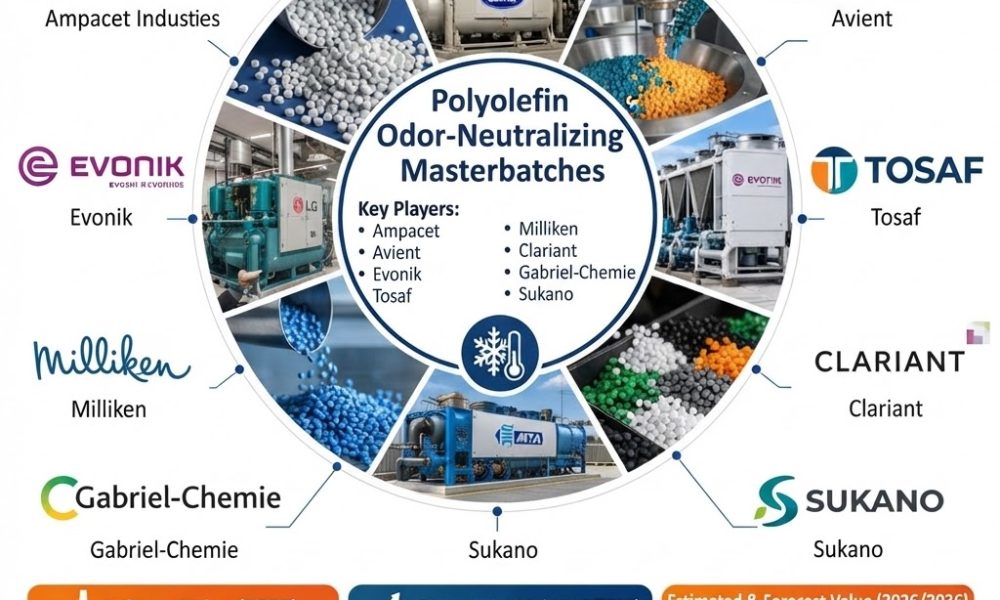
The competitive environment includes Ampacet, Avient, Evonik, and Tosaf. These companies compete across odor reduction, additive formulation, masterbatch solutions, dosing accuracy, processing stability, and technical support.
Ampacet and Avient provide direct coverage of polyolefin additive applications, while Evonik and Tosaf contribute odor-absorbing and masterbatch capabilities. Competition through 2036 is expected to focus on demonstrated performance after extrusion and storage, application fit, documentation, and support during laboratory and plant qualification.
Senior Analyst Shambhu Nath Jha at Fact.MR states, “Polyolefin odor neutralizers are moving into a stricter qualification cycle. Adoption is expected to favor providers that prove odor reduction after processing and storage.”
Top Trending Reports:
Premium Beauty and Personal Care Products Market
Market Outlook
The polyolefin odor neutralizers market is positioned around the technical requirements of recycled and virgin PE and PP materials. Growth opportunities extend across Packaging, Automotive interiors, Trash bags, Housewares, and Building products.
The market study evaluates polymer type, application, chemistry, form, end user, and regional demand across North America, Europe, Asia Pacific, Central and South America, and the Middle East and Africa. Country coverage includes Germany, Brazil, the United States, China, India, the United Kingdom, Japan, and other major markets.
The Fact.MR analysis is based on 120+ sources, 40+ company portfolios, 25+ countries, and 20+ interviews, combining primary research, desk research, market sizing, forecasting, and data validation.
About Fact.MR
Fact.MR is a global market research and consulting firm, trusted by Fortune 500 companies and emerging businesses for reliable insights and strategic intelligence. With a presence across the U.S., UK, India, and Dubai, we deliver data-driven research and tailored consulting solutions across 30+ industries and 1,000+ markets. Backed by deep expertise and advanced analytics, Fact.MR helps organizations uncover opportunities, reduce risks, and make informed decisions for sustainable growth.



