
The global recyclable lidding coatings market is projected to expand from USD 170.0 million in 2026 to USD 420.0 million by 2036, registering a 9.5% CAGR during the forecast period, according to Fact.MR. The market crossed USD 155.0 million in 2025, with demand increasingly shaped by packaging producers seeking coatings that combine reliable sealing performance with compatibility with established recycling routes.
The market is expected to create an absolute opportunity of USD 250.0 million between 2026 and 2036. PET-based lids, peelable seal technologies, dairy cup applications, mono-material recyclability routes, and lidding film producers represent key areas of commercial activity.
Get detailed market forecasts, competitive benchmarking, and pricing trends: https://www.factmr.com/connectus/sample?flag=S&rep_id=15584
Recyclability Requirements Reshape Coating Qualification
Packaging converters and film producers are placing greater emphasis on coating performance after the package enters recycling streams. Coatings that allow PET flakes to remain cleaner after washing are gaining attention as packaging companies assess the complete lifecycle of trays and lids.
Peelable coatings are also being evaluated for their ability to open cleanly without leaving excessive residue on the tray rim. This requirement is particularly relevant to dairy cups, ready meals, and other chilled food applications where seal integrity and consumer opening performance must work together.
Food companies are increasingly assessing mono-material structures as packaging specifications incorporate recycling considerations. Healthcare packaging manufacturers face additional validation requirements because coating changes must preserve sterile-pack performance while meeting documentation and review requirements.
Test laboratories are becoming more involved in commercial qualification. Plant trials can expose sealing and processing problems that may not appear during laboratory testing or through product data sheets alone.
PET and Peelable Coatings Lead Key Segments
PET is estimated to account for 36% of the market by lid substrate in 2026, supported by its use across tray and cup recycling programs. PP follows in applications where converters seek heat resistance and lower-density structures, while PE remains relevant to film formats emphasizing mono-material designs.
By seal type, peelable coatings are projected to hold 36% share in 2026. Converters favor peelable grades when lids need to separate cleanly from trays while maintaining sufficient seal strength during chilled storage and transport.
Dairy cups are anticipated to account for 32% share by application in 2026. These packaging formats provide coating suppliers with established trial conditions involving familiar pack geometry and filling requirements. Ready meals require greater thermal stability, while meat trays place emphasis on seal integrity under chilled display conditions.
By recyclability route, mono-material structures are estimated to represent 39% share in 2026. Simplifying material interfaces can help converters address recycling requirements while minimizing changes across existing packaging lines.
Lidding film producers are forecast to account for 40% share by buyer type in 2026, reflecting their direct influence over coating selection before final packaging specifications are reviewed by tray converters and food brands.
Germany Records the Highest Country CAGR
Germany is projected to expand at a 10.9% CAGR from 2026 to 2036, making it the fastest-growing country profiled in the report. Packaging companies are expected to place greater emphasis on recyclability evidence, material compatibility, wash behavior, and technical documentation during supplier qualification.
Brazil follows with a projected 9.9% CAGR, supported by food production and plastic-packaging conversion. Growth opportunities are associated with dairy cups and meat trays, where local testing can help identify coating performance issues under chilled storage and transportation conditions.
The United States is forecast to record a 9.0% CAGR during the same period. The country’s large tray and container industry supports demand for PET qualification programs and packaging reviews focused on peel strength, wash behavior, recycling guidance, and production-line compatibility.
Qualification Costs Remain a Market Restraint
Despite favorable demand conditions, qualification costs may slow adoption. Packaging changes can require multiple trial runs, technical validation, and additional documentation before a coating grade receives commercial approval.
Peel force can also become a constraint when the lid and tray materials are poorly matched. Small changes in coating weight or sealing temperature can affect opening performance, particularly after chilled storage.
Documentation requirements represent another consideration for food and healthcare packaging companies. Projects may face delays when recycling information, food-contact details, or testing records are incomplete.
At the same time, opportunities exist for suppliers developing coating grades optimized for mono-material structures. Application laboratories for peelable coatings could help converters adjust coat weight and sealing conditions before commercial production.
Competition Centers on Coating and Recycling Performance
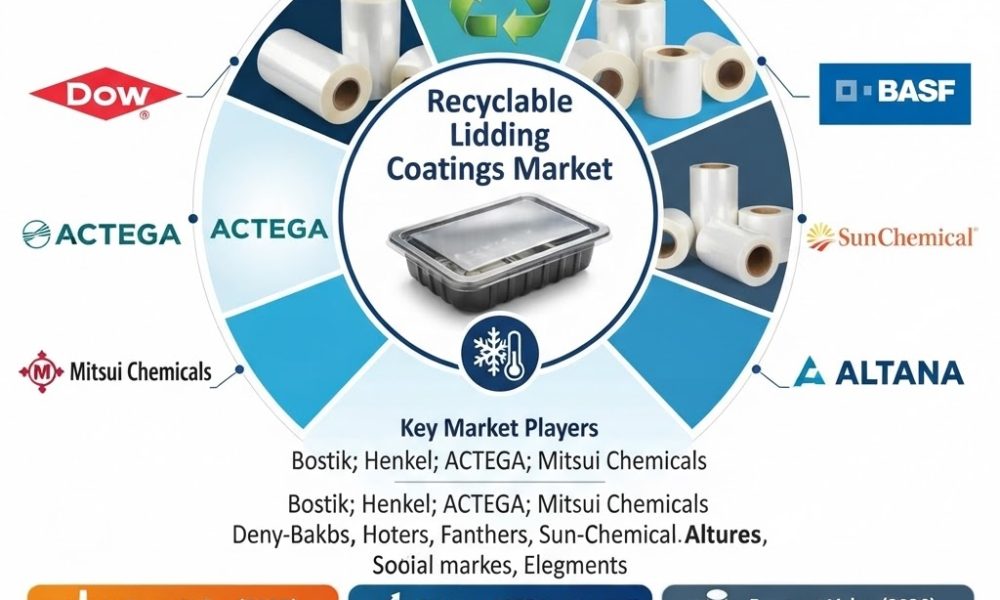
The competitive landscape includes Bostik, Henkel, ACTEGA, and Mitsui Chemicals. These companies participate across heat-seal coatings, packaging materials, specialty resins, adhesives, and related technologies.
Bostik has capabilities in heat-seal and reseal products for trays and lidding films. Henkel participates in packaging coatings and heat-seal technologies, including solutions serving food-contact packaging requirements. ACTEGA supplies coatings, sealants, inks, and adhesives across flexible and rigid packaging applications. Mitsui Chemicals adds capabilities in packaging films and specialty resin products.
Competition is expected to increasingly involve both sealing performance and recycling compatibility as packaging companies expand qualification programs.
Strategic Outlook
The recyclable lidding coatings market is moving toward qualification processes that evaluate sealing, peel behavior, wash performance, recyclability, and production-line compatibility together.
For coating suppliers, application testing on actual PET trays and lids can provide stronger evidence for commercial approval. Film producers can evaluate peelable seals following chilled storage and at normal packing speeds, while packaging companies can compare mono-material and wash-off routes before modifying approved structures.
As packaging regulations and recycling requirements influence procurement decisions, technical documentation and local trial support are expected to remain important commercial considerations through 2036.
Top Trending Reports:
Network Function Virtualization Market
Medical Case Management Service Market
About Fact.MR
Fact.MR is a global market research and consulting firm, trusted by Fortune 500 companies and emerging businesses for reliable insights and strategic intelligence. With a presence across the U.S., UK, India, and Dubai, we deliver data-driven research and tailored consulting solutions across 30+ industries and 1,000+ markets. Backed by deep expertise and advanced analytics, Fact.MR helps organizations uncover opportunities, reduce risks, and make informed decisions for sustainable growth.



