
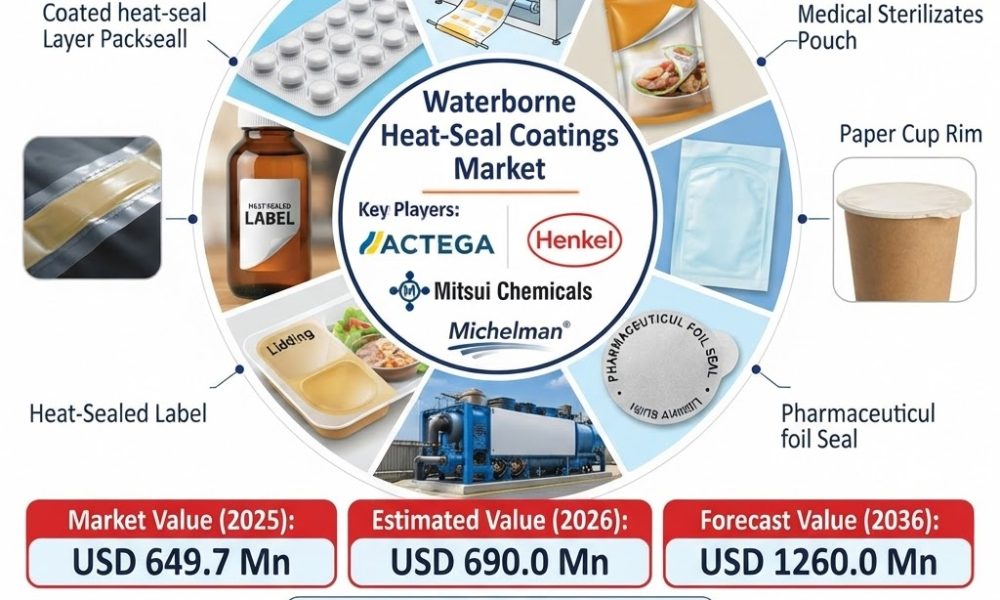
September 29, 2026 — The global Waterborne Heat-Seal Coatings Market is projected to increase from USD 690.0 million in 2026 to USD 1,260.0 million by 2036, expanding at a 6.2% CAGR during the forecast period, according to Fact.MR analysis. The market was valued at USD 649.7 million in 2025, with demand supported by growing qualification of water-based coatings for paper, films, foil, and other packaging structures.
The market is expected to create an absolute opportunity of USD 570.0 million between 2026 and 2036. Packaging converters are evaluating waterborne heat-seal coatings as they seek sealing performance, food-contact compliance, controlled opening, and compatibility with existing production lines.
Get detailed market forecasts, competitive benchmarking, and pricing trends: https://www.factmr.com/connectus/sample?flag=S&rep_id=15580
Low-Temperature Sealing Supports Market Expansion
Packaging manufacturers are increasingly evaluating coatings that can provide reliable heat sealing without exposing sensitive products or substrates to excessive temperatures. Lower sealing temperatures can help protect coated paper, thin films, and heat-sensitive packaged products while supporting established packaging line speeds.
Waterborne conversion from solvent-based coating systems is another factor supporting demand. Packaging plants are assessing water-based alternatives based on drying behavior, adhesion, seal strength, and compatibility with existing equipment.
Food packaging qualification programs are also contributing to adoption. Coatings used for food applications require documented performance and food-contact checks before they can move into regular commercial production. These requirements create opportunities for coating suppliers that can provide technical support throughout laboratory and plant trials.
Paper and Acrylic Lead Key Market Segments
By substrate, paper is expected to account for 30% of the market in 2026. Waterborne heat-seal coatings can provide paper and fiber-based packaging with a sealable surface, potentially reducing the need for an additional plastic sealing layer in selected applications.
Foil remains relevant where barrier performance is a primary requirement, while PET and OPP support clear packaging formats and high-speed production environments. PE-based films continue to serve converters using established polyolefin packaging equipment.
By chemistry, acrylic is projected to hold a 31% share in 2026. Acrylic systems offer a balance of water-based application, adhesion, drying, and heat-seal performance. Their use across paper and board packaging supports their leading position.
EVA is used where greater flexibility is required, while polyurethane and polyester address applications with more demanding adhesion or heat requirements. Bio-based dispersions are also considered where renewable content forms part of packaging specifications.
Lidding Applications Maintain Leading Position
By seal performance, low-temperature seal is anticipated to capture 28% share in 2026. Lower sealing temperatures can reduce heat exposure during packaging formation while supporting sealing of thin films and coated paper.
By application, lidding is estimated to represent 31% share in 2026. Trays and cups require coatings that deliver dependable closure while allowing controlled opening. Sachets and flow wraps place additional emphasis on sealing speed and leak prevention.
By end use, food is forecast to account for 44% share in 2026. Food packaging requires consistent package integrity during filling, transportation, storage, and opening. Food-contact review is an additional consideration during coating qualification.
Healthcare, personal care, and industrial packaging represent other application areas where controlled sealing performance is required.
Germany Leads Country Growth
Germany is projected to expand at a 7.1% CAGR from 2026 to 2036, making it the fastest-growing country market covered in the report. Growth is associated with packaging regulation, technical evaluation, and demand for documented material and recycling information.
European packaging companies are reviewing coating materials and packaging records in response to evolving regulatory requirements. Regulation (EU) 2025/40 entered into force in February 2025 and generally applies from August 2026, increasing the importance of technical documentation for packaging materials.
Brazil is forecast to record a 6.5% CAGR through 2036. The country’s paper and chemical industries provide a base for local coating trials across food packaging and film applications.
The United States is projected to expand at a 5.9% CAGR during the same period. Demand is supported by continued evaluation of water-based coatings for paper and film packaging, alongside recycling considerations and compatibility with existing manufacturing lines.
Technical Qualification Remains Central to Adoption
Waterborne heat-seal coating suppliers face qualification requirements related to seal strength, drying, substrate compatibility, storage performance, and food-contact documentation. Results can vary according to coating amount, drying temperature, line speed, and substrate type.
Shambhu Nath Jha, Senior Analyst at Fact.MR, states, “Water-based heat-seal coatings must perform well beyond the lab. The seal should stay strong after drying and storage. The coating must also run well on current production lines.”
Companies are also evaluating the cost and time associated with qualification before replacing established solvent-based products. Scale-up and drying risks can create additional challenges when laboratory conditions differ from full production environments.
Competitive Landscape
Key companies profiled in the Waterborne Heat-Seal Coatings Market include ACTEGA, Henkel, Mitsui Chemicals, and Michelman.
ACTEGA markets ACTEseal systems in water-based and solvent-based formats for food and pharmaceutical packaging. Henkel supplies functional coatings for OPP, PE, and BOPET films used in lidding and flow-wrap structures.
Mitsui Chemicals offers CHEMIPEARL, a water-based polyolefin dispersion positioned for use on paper, foil, and resin films. Michelman has introduced water-based barrier and functional coating solutions for flexible and rigid packaging applications.
Fact.MR’s analysis covers the market across North America, Europe, Asia Pacific, Central and South America, and the Middle East and Africa. The study evaluates substrate, chemistry, seal performance, application, and end-use segments, with country-level analysis covering Germany, Brazil, and the United States.
Top Trending Reports:
Disposable EEG Electrode Market
The report incorporates primary and secondary research, including 120+ sources, 40+ company portfolios, 25+ countries, and 20+ interviews, to assess market sizing, competitive activity, technical requirements, adoption trends, and growth opportunities through 2036.
About Fact.MR
Fact.MR is a global market research and consulting firm, trusted by Fortune 500 companies and emerging businesses for reliable insights and strategic intelligence. With a presence across the U.S., UK, India, and Dubai, we deliver data-driven research and tailored consulting solutions across 30+ industries and 1,000+ markets. Backed by deep expertise and advanced analytics, Fact.MR helps organizations uncover opportunities, reduce risks, and make informed decisions for sustainable growth.



