
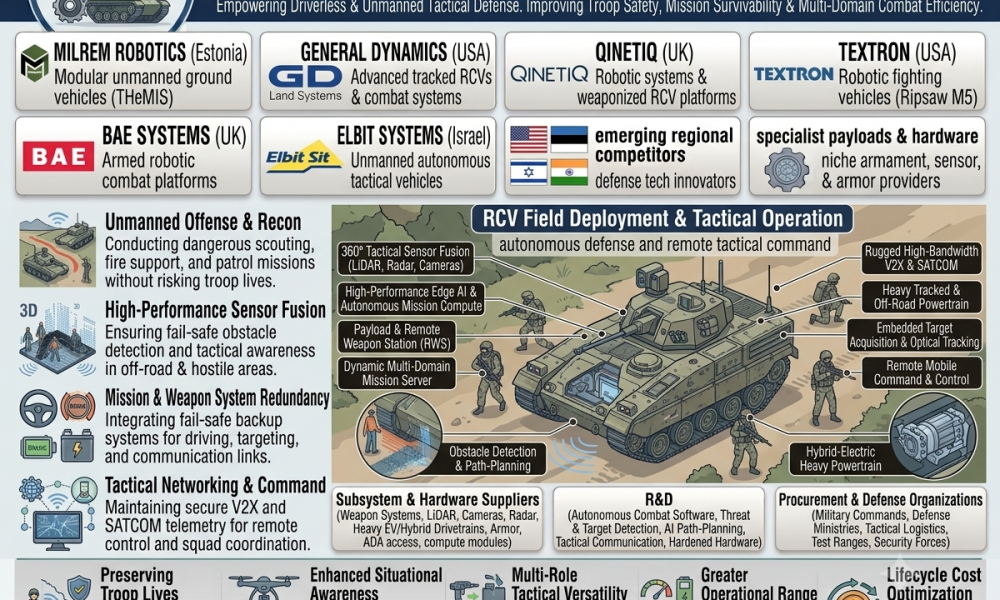
The global robotic combat vehicles (RCV) market is projected to expand at a 25.0% CAGR between 2026 and 2036, increasing from USD 938.0 million in 2026 to USD 8,736.0 million by 2036. Armed forces are increasingly evaluating unmanned ground platforms to extend forward sensing and mission reach while reducing direct crew exposure in contested environments.
Military modernization programs are placing greater emphasis on autonomous mobility, modular payloads, and integration with command networks. The ability to coordinate multiple robotic platforms during active missions remains an important development challenge. In October 2024, the USA Army reported that RCV Pilot-24 used two control vehicles to navigate four robots during July exercises before moving to three control vehicles for four RCVs during a September National Training Center rotation to improve platoon control.
Continuous field trials are helping defense organizations evaluate how robotic vehicles interact with autonomy software, command systems, payloads, and human operators. These trials provide important evidence for determining whether platforms can transition from experimentation into procurement and recurring deployment.
What Are the Key Segments in the Robotic Combat Vehicles (RCV) Market?
The RCV market is being shaped by platform requirements, mission roles, component integration, defense users, and procurement structures.
- Platforms – 52.0%: Platforms represent the leading component category in 2026, reflecting spending on armored mobility systems, vehicle structures, propulsion, and associated hardware.
- Development Contracts – 52.0%: Development contracts hold the leading business-model share as defense organizations continue prototype development, experimentation, testing, and system maturation.
- US Army Programs – 46.0%: US Army programs represent the leading end-user category, supported by sustained experimentation with robotic ground platforms and autonomous teaming.
- Light RCVs, Medium RCVs, and Heavy Optionally Manned Vehicles: Different vehicle classes allow defense organizations to align platform size and protection with reconnaissance, escort, direct-fire, and support missions.
- Autonomy and Teaming Software: Software remains an important component of robotic combat vehicle development as military users seek coordinated operation between multiple platforms and human controllers.
Get detailed market forecasts, competitive benchmarking, and pricing trends:
https://www.futuremarketinsights.com/reports/sample/rep-gb-33988
Which Countries Are Showing the Strongest Growth in Robotic Combat Vehicles?
USA: The United States is projected to grow at a 26.0% CAGR between 2026 and 2036, making it the fastest-growing country in the supplied market comparison. US Army experimentation emphasizes modular designs, soldier feedback, and field validation before larger purchasing decisions. The October 2024 RCV Pilot-24 exercises demonstrate the continuing effort to understand how control vehicles can coordinate multiple robotic combat platforms.
The Defense Innovation Unit reported in April 2024 that it received 110 responses across two Ground Vehicle Autonomous Pathways solicitations, highlighting substantial industry participation in autonomous ground vehicle development pathways.
South Korea: South Korea is projected to expand at a 25.0% CAGR through 2036. Defense modernization and investment in unmanned systems are supporting interest in robotic ground platforms. Defense teams are also evaluating field evidence and interoperability requirements when considering autonomous systems for future operations.
European Union: EU demand is projected to grow at a 24.0% CAGR through 2036. European defense organizations are examining collaborative unmanned ground vehicle programs while emphasizing alliance interoperability, field validation, and compatibility with broader defense architectures.
How Is Regional Demand Shaping the Robotic Combat Vehicles Market?
Regional procurement priorities differ according to operational requirements, military modernization plans, and local technology ecosystems. The United States is emphasizing experimentation and soldier feedback, while European programs place substantial attention on interoperability and collaborative defense requirements.
South Korea is also developing interest around unmanned system modernization and local technology capabilities. Across these markets, the transition from prototype assessment to repeat procurement depends on evidence demonstrating mission endurance, payload readiness, autonomous navigation, and reliable command integration.
What Is Changing the Competitive Landscape?
The competitive landscape includes established defense contractors, specialized robotic vehicle developers, autonomy technology companies, and suppliers participating in government experimentation programs. Platform ruggedness and demonstrated field performance are becoming important considerations as defense customers move from concept evaluation toward operational procurement.
General Dynamics Land Systems and Textron Systems Corporation are expected to compete based on tracked platform expertise and prototype development experience. Their participation reflects the role of established defense vehicle manufacturers in emerging robotic combat vehicle programs.
American Rheinmetall Vehicles and Hanwha Aerospace Co., Ltd. are anticipated to compete through unmanned ground system development and defense alliance relationships. Their positioning reflects growing demand for robotic platforms that can operate within broader military vehicle ecosystems.
Milrem Robotics and Forterra are projected to attract evaluation attention through mission systems, autonomy capabilities, and support software. Their participation illustrates the expanding role of specialized robotics companies alongside traditional defense manufacturers.
What Does the Analyst Say About the Robotic Combat Vehicles Market?
According to Nikhil Kaitwade, Principal Consultant for Automotive at Future Market Insights, robotic combat vehicles are developing into a specification-led defense mobility segment linked to payload reach and soldier protection. Supplier progress is expected to depend increasingly on field evidence and integration support aligned with defense program requirements.
Defense accounts prioritize evidence connecting vehicle architecture with mission endurance and payload readiness. Suppliers that combine autonomy partnerships with established platform records can strengthen their position during program evaluations, while local technical support can become increasingly important once buyers move from prototype trials toward repeat awards.
What Is Driving Demand for Robotic Combat Vehicles?
Soldier Protection Supports Unmanned Ground Vehicle Adoption
Reducing direct exposure to contested environments is a central motivation for robotic combat vehicle development. Unmanned platforms can undertake reconnaissance, screening, escort, and selected support missions while allowing personnel to remain at a greater distance from potential threats.
Autonomous Teaming Expands Mission Capabilities
Military users are evaluating how multiple robotic vehicles can operate under coordinated control. RCV Pilot-24 demonstrated the practical importance of control-to-vehicle ratios during field exercises. Such trials help defense organizations determine the command structures required for effective multi-vehicle operations.
Modular Payloads Increase Platform Utility
Robotic combat vehicles can support different mission packages depending on platform class and operational requirements. Modular payload architecture allows military users to evaluate reconnaissance, direct-fire, escort, breaching, and support roles without relying on a single fixed configuration.
Field Trials Support Procurement Decisions
Defense organizations require evidence that autonomous systems can perform consistently outside controlled demonstrations. Continuous exercises allow military teams to evaluate navigation, communications, payload integration, command systems, and human-machine interaction before making broader procurement commitments.
What Are the Key Market Restraints?
Coordinating multiple robotic combat vehicles during active missions remains technically and operationally demanding. Defense teams must establish reliable control links, autonomous navigation processes, human oversight procedures, and contingency responses before platforms can be deployed at scale.
Integration also creates procurement complexity. Robotic vehicles must work with existing command networks, payload systems, communications architectures, and military workflows. Different defense organizations may require distinct interfaces and operational configurations, increasing development and qualification requirements.
Drive Your Business Growth Strategy: Checkout the Report for Key Insights!
https://www.futuremarketinsights.com/checkout/33988
What Opportunities Exist for Robotic Combat Vehicle Manufacturers?
The transition from experimentation toward recurring procurement creates opportunities for manufacturers that can demonstrate reliable platform performance and integration readiness. Defense buyers increasingly require field evidence that connects autonomy performance with mission endurance, payload capacity, and command-network compatibility.
There is also an opportunity for suppliers to provide integrated solutions rather than standalone vehicle hardware. Combining platforms with autonomy software, teaming capabilities, mission systems, training, maintenance, and local technical support can address more of the requirements faced by defense programs.
How Is the Robotic Combat Vehicles Market Segmented?
The robotic combat vehicles industry is segmented by class, role, component, end user, business model, and region.
By Class: Light RCVs, medium RCVs, and heavy optionally manned vehicles.
By Role: Direct fire and escort, reconnaissance and screening, and breaching and support.
By Component: Platforms, autonomy and teaming software, payloads, and services.
By End User: US Army programs, European programs, and Asia-Pacific programs.
By Business Model: Development contracts, low-rate production, and experimentation.
By Region: North America, Latin America, Europe, East Asia, South Asia, Oceania, and the Middle East and Africa.
The segmentation enables defense stakeholders to compare robotic vehicle requirements according to platform class, mission role, procurement model, and regional modernization priorities.
What Are the Drivers, Restraints and Opportunities in the Robotic Combat Vehicles Market?
The commercial and defense procurement case for robotic combat vehicles increasingly depends on validated autonomy, payload integration, and reliable coordination with human operators.
- Unmanned ground platforms can extend sensing and mission capabilities while reducing direct crew exposure.
- Field trials provide evidence for evaluating multi-vehicle control, autonomy, payload integration, and command-network compatibility.
- Suppliers with platform expertise, autonomy partnerships, and local support can address multiple stages of defense program development.
What Is the Robotic Combat Vehicles Market Demand Outlook?
Demand for robotic combat vehicles is expected to remain connected to military modernization programs seeking greater autonomy and reduced personnel exposure. The market’s projected 25.0% CAGR from 2026 to 2036 reflects increasing attention to unmanned ground systems across reconnaissance, escort, direct-fire, breaching, and support missions.
The market is projected to increase from USD 938.0 million in 2026 to USD 8,736.0 million by 2036. As defense organizations move beyond individual technology demonstrations, procurement decisions are expected to increasingly depend on field validation, interoperability, mission endurance, and sustainment requirements.



