
The global autonomous shuttles & public transit pods market is projected to increase from USD 563.0 million in 2026 to USD 5,243.0 million by 2036, expanding at a 25.0% CAGR between 2026 and 2036. Demand is being supported by transit agencies seeking smaller vehicles for lightly used routes where operating a full-size bus can create unnecessary capacity and higher service costs.
According to APTA, USA bus operating expenses reached USD 31.9 billion in report year 2024, providing a substantial cost base for agencies evaluating alternative transit models. Smaller autonomous vehicles can help agencies maintain route coverage while matching vehicle capacity more closely with passenger demand. Road automation is therefore becoming relevant not only as a technology upgrade but also as part of efforts to improve the economics of recurring passenger transportation.
Public agencies are adopting autonomous shuttles at different rates based on local transportation challenges. USA programs increasingly examine rural access and mixed-traffic operation, while Japan uses compact local routes to maintain community mobility amid a shortage of qualified bus drivers. In April 2025, the USA Department of Transportation launched a USD 25 million rural autonomous vehicle research program, including USD 15 million for passenger transport research covering digital maps and shared-road operation.
What Are the Key Segments in the Autonomous Shuttles & Public Transit Pods Market?
The market is developing around vehicle configurations and operating environments that allow autonomous mobility providers to match capacity, route complexity, and service requirements.
- 8-15 Seat Shuttle Pods – 46.0%: Smaller shuttle pods account for the leading vehicle-type share in 2026, reflecting their suitability for lightly used routes and controlled passenger environments.
- Campus Circulation – 30.0%: Campus circulation represents the leading application, providing operators with repeatable routes where stop locations, operating hours, and passenger flows can be closely managed.
- Vehicles – 52.0%: Vehicles represent the leading component category, highlighting the importance of accessible cabins, autonomous-ready hardware, sensors, and vehicle platforms in overall spending.
- Autonomous Mini-buses and Micro-pods: These vehicle formats provide additional options for operators seeking greater capacity than compact pods while retaining easier maneuverability than conventional buses.
- Managed Operations and Pilot Programs: Service-based models allow agencies and private operators to evaluate autonomous passenger transportation before committing to broader fleet ownership.
Get detailed market forecasts, competitive benchmarking, and pricing trends:
https://www.futuremarketinsights.com/reports/sample/rep-gb-33979
Which Countries and Regions Are Showing Strong Demand for Autonomous Shuttles?
United States: The United States represents 26.0% of the market based on the supplied regional comparison. Public-sector programs are examining autonomous passenger transportation for rural communities, mixed-traffic routes, and locations where conventional service can be difficult to sustain economically. The April 2025 USD 25 million rural autonomous vehicle research program provides evidence of continued public-sector interest in testing autonomous mobility alongside digital mapping and shared-road operation.
European Union: The European Union accounts for 24.0% in the supplied regional comparison. European deployments require safety evidence that can support operations across different road authorities and operating environments. This makes documented vehicle oversight, route performance, accessibility, and operational accountability important considerations when pilots transition into regular passenger services.
Japan: Japan represents 22.0% of the market based on the supplied comparison. Compact routes provide an opportunity to use autonomous shuttles for community transportation where a shrinking pool of qualified bus drivers creates operational challenges. Smaller vehicles can align passenger capacity with local demand while supporting scheduled service on defined routes.
How Is Regional Demand Shaping the Autonomous Shuttles & Public Transit Pods Market?
Regional demand is closely connected to the ability of transit authorities to turn pilot projects into recurring passenger operations. A successful demonstration provides technical evidence, but long-term commercial value depends on whether agencies can allocate operating budgets, define responsibility for vehicle performance, and maintain the infrastructure required for daily service.
Accessibility and charging also influence route economics. Electric autonomous platforms are particularly suited to campuses, airports, and other fixed-route environments because operators can plan charging around predictable service schedules. However, charging infrastructure, battery reserves, roadside support, and remote supervision remain part of the operating model.
What Is Changing the Competitive Landscape?
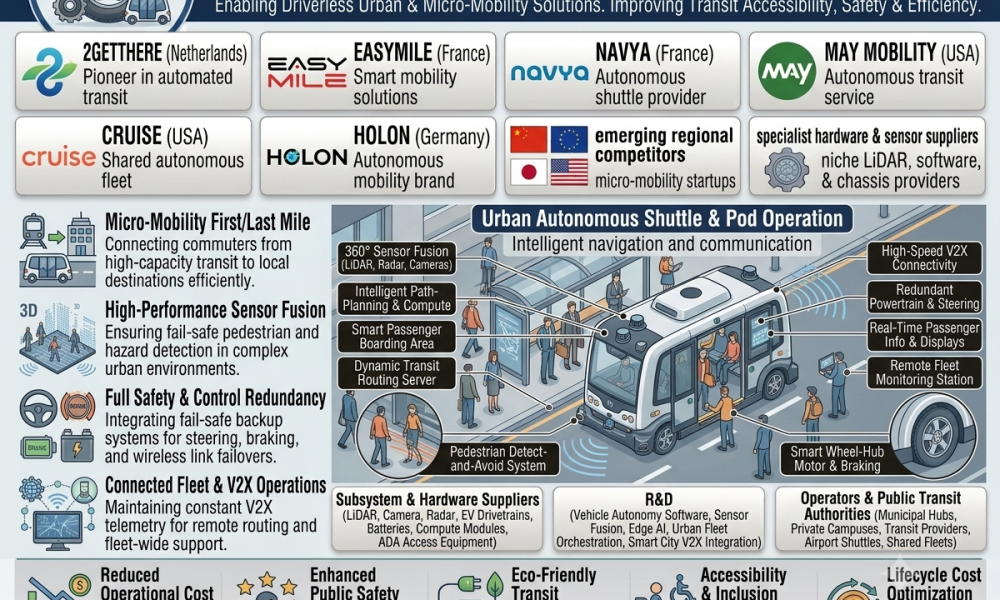
Competition increasingly involves partnerships between vehicle manufacturers, autonomous-driving technology companies, and fleet operators. Transit agencies evaluating autonomous shuttles need a coordinated passenger service rather than an isolated automated vehicle, making responsibility for software, vehicles, maintenance, remote supervision, and incident response commercially important.
Beep competes through fleet operations and command-center management, giving public programs a service structure that can consolidate daily operational responsibilities.
Karsan and HOLON combine accessible passenger cabins with sensor-ready vehicle platforms designed for repeatable transit applications. Their positioning reflects the growing importance of vehicle accessibility alongside autonomous functionality.
ADASTEC and Oxa provide automated-driving systems that can be integrated with bus platforms and adapted to different vehicle programs and route requirements.
Ohmio and MOIA combine autonomous vehicle capabilities with operating support for airports and controlled urban environments, demonstrating how the market is moving toward integrated mobility services rather than standalone vehicle sales.
What Does the Analyst Say About the Autonomous Shuttles & Public Transit Pods Market?
According to Nikhil Kaitwade, Principal Analyst at Future Market Insights, a single successful autonomous trip does not establish that a route is ready for regular passenger service. Consistent operation across changing passenger demand and road conditions is the more important commercial test.
NHTSA activity highlights the importance of documented vehicle oversight and clear responsibility when autonomous vehicles operate on public roads. Fleet operators can also benefit from service models that reduce coordination gaps between vehicle and software providers. Over time, route data can support decisions on service expansion, operating performance, and cost management.
What Is Driving Demand for Autonomous Shuttles & Public Transit Pods?
Low Passenger Loads Create a Clear Use Case
Lightly used transit routes can be expensive when served by full-size buses. Autonomous shuttles provide agencies with the opportunity to deploy smaller vehicles while maintaining scheduled transportation access. Neighborhood feeder routes, campuses, business parks, and other controlled environments can therefore become practical early applications.
Driver Shortages Increase Interest in Automation
The availability of qualified bus drivers affects the ability of transit operators to maintain scheduled service. Japan’s use of compact autonomous routes illustrates how driver availability can influence technology adoption. Automation can reduce onboard driver requirements, although remote supervision and roadside response continue to require personnel and operating budgets.
Electric Platforms Fit Fixed-Route Applications
Autonomous shuttles frequently operate over predictable distances, allowing charging schedules to be incorporated into daily service plans. Electric platforms can also provide quieter transportation for campuses, airports, and other environments where noise levels influence operating decisions.
Pilot Programs Are Becoming Commercial Gateways
Pilot programs give transit agencies an opportunity to assess route performance, passenger interaction, safety procedures, charging requirements, and remote supervision. The commercial opportunity expands when successful pilots transition into recurring service contracts and funded fleet programs.
What Are the Key Market Restraints?
Autonomous passenger transportation requires more than automated driving technology. Agencies must establish procedures for remote intervention, roadside response, passenger assistance, charging, maintenance, and incident management. These additional requirements can increase the complexity of deployment compared with conventional shuttle services.
Regulatory and operational requirements also differ by geography. A route approved for autonomous operation in one jurisdiction may require different safety evidence, infrastructure, or oversight procedures elsewhere. Operators therefore need localized deployment strategies rather than relying on a single standardized rollout model.
Drive Your Business Growth Strategy: Checkout the Report for Key Insights!
https://www.futuremarketinsights.com/checkout/33979
What Opportunities Exist for Autonomous Shuttle Manufacturers and Transit Operators?
The strongest opportunities are emerging in environments where routes are predictable, passenger demand is measurable, and service boundaries can be clearly defined. Campuses, airports, business parks, rural feeder routes, and other controlled or semi-controlled environments can provide practical conditions for scaling autonomous passenger services.
Service-based commercial models also create opportunities beyond vehicle sales. Fleet management, remote supervision, software updates, mapping, maintenance, and recurring operations support can become important revenue streams as autonomous shuttle fleets expand.
How Is the Autonomous Shuttles & Public Transit Pods Market Segmented?
The autonomous shuttles & public transit pods market is segmented by vehicle type, application, component, end-use, business model, and region.
By Vehicle Type: 8-15 seat shuttle pods, autonomous mini-buses, micro-pods, and retrofit vans.
By Application: Campus circulation, city feeder routes, airport circuits, and business park shuttles.
By Component: Vehicles, autonomy software, and operations services.
By End-use: Municipal transit, universities, airports, and private estates.
By Business Model: Direct sales, leases, pilot programs, and managed operations.
By Region: North America, Latin America, Europe, East Asia, South Asia, Oceania, and the Middle East and Africa.
This segmentation helps stakeholders compare vehicle capacity with route requirements, passenger demand, service ownership, and deployment conditions.
What Are the Drivers, Restraints and Opportunities in the Autonomous Shuttles & Public Transit Pods Market?
The commercial case for autonomous shuttles depends on matching vehicle capacity, route economics, and operational reliability rather than automation alone.
- Smaller autonomous vehicles can address lightly used routes where full-size buses may carry excess capacity.
- Remote supervision, charging, maintenance, and roadside intervention remain important parts of total service economics.
- Recurring service contracts can create a path from autonomous shuttle pilots to larger commercial deployments.
What Is the Autonomous Shuttles & Public Transit Pods Market Demand Outlook?
The market outlook is closely tied to the transition from technology demonstrations to dependable passenger services. Transit authorities are likely to assess autonomous shuttles through measurable route performance, passenger accessibility, operating cost, vehicle uptime, and incident response.
The projected increase from USD 563.0 million in 2026 to USD 5,243.0 million by 2036 reflects the potential for autonomous shuttles to become part of broader public and private transportation networks. The 25.0% CAGR indicates strong expansion as operators investigate smaller vehicle formats for routes where conventional buses can be economically difficult to justify.



