
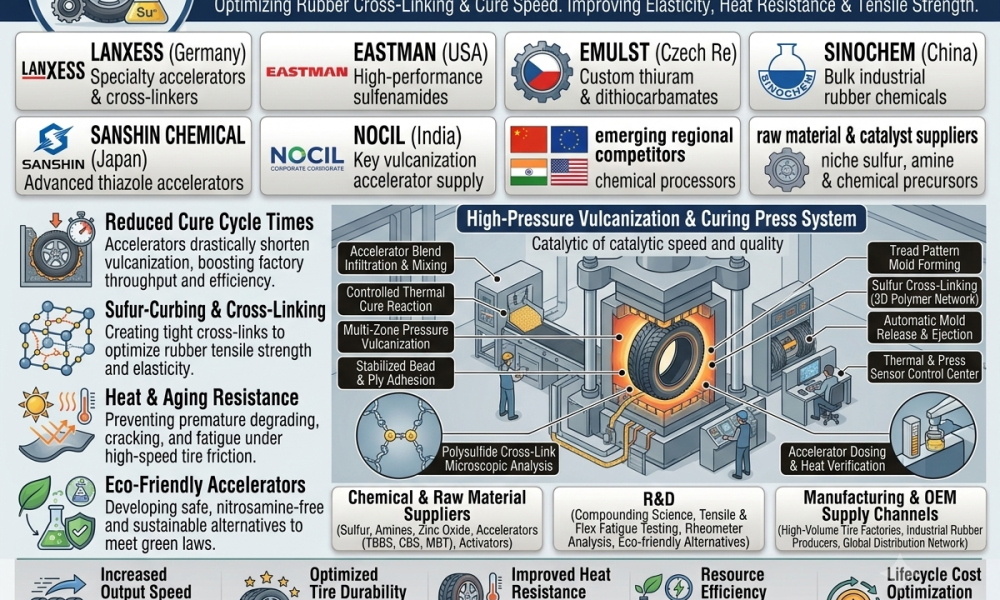
The global tire vulcanization accelerators market is projected to grow from USD 3,240.7 million in 2026 to USD 5,749.1 million by 2036, expanding at a 5.9% CAGR during the forecast period. Tire vulcanization accelerators are increasingly moving beyond routine rubber chemicals into formulation tools that support cure control, scorch safety, and consistent plant performance.
Tire compounders are evaluating accelerator grades according to their ability to connect cure behavior with production consistency. Scorch safety, rubber compatibility, cure speed, and formulation repeatability are becoming important considerations before an accelerator is introduced into commercial tire programs.
Global vehicle production provides a broad manufacturing base for recurring rubber-processing demand. The Organisation Internationale des Constructeurs d’Automobiles (OICA) reported global vehicle production of 96.4 million units in 2025, supporting continued tire manufacturing activity and associated requirements for vulcanization chemicals.
Regional purchasing priorities are also shaping supplier selection. India is expected to review accelerator suppliers according to compound evidence and local service capabilities, while Japan is projected to place greater emphasis on specification records and documented performance before approving alternative suppliers. In the United States, the USTMA projected total tire shipments of 338.9 million units in 2026, keeping rubber chemical planning closely connected to tire production and replacement demand.
What Are the Key Segments in the Tire Vulcanization Accelerators Market?
- Direct chemical supply accounts for 58.5% share in 2026, reflecting the importance of technical support, supplier accountability, and direct formulation engagement in tire chemical procurement.
- Passenger tires represent 43.6% share in 2026, supported by recurring tire production and the need for repeatable curing across passenger tire compounds.
- Sulfenamides hold 38.0% share in 2026, supported by their delayed-action curing characteristics and application in formulations where scorch safety and controlled cure behavior are important.
- Natural rubber and SBR/BR systems remain important rubber categories for accelerator qualification, requiring suppliers to demonstrate compatibility across different compound formulations.
- Tire OEMs and compounders remain important end-use groups as manufacturers evaluate accelerator performance through laboratory trials and plant-scale qualification programs.
Get detailed market forecasts, competitive benchmarking, and pricing trends:
https://www.futuremarketinsights.com/reports/sample/rep-gb-33943
Which Countries Are Showing the Strongest Growth in Tire Vulcanization Accelerators?
India is projected to grow at a 7.8% CAGR through 2036, the highest rate among the profiled countries. Vehicle production scale and tire manufacturing expansion are supporting requirements for rubber-processing chemicals. Local service capabilities and formulation evidence are expected to remain important as tire plants review accelerator suppliers.
China is forecast to expand at a 7.0% CAGR during the forecast period. Automotive output and a deep rubber-chemical supply base support continued accelerator demand. Suppliers able to combine production capacity with technical support can address the requirements of large-scale tire manufacturing programs.
South Korea is expected to record a 5.8% CAGR through 2036. Export-linked automotive production and strict supplier qualification records are influencing chemical sourcing. Consistent accelerator grades and documented formulation behavior remain important considerations for tire producers.
The United States is projected to register a 4.8% CAGR. The country’s substantial tire shipment base supports recurring demand for rubber chemicals, while supplier technical support remains relevant for formulation qualification and plant consistency.
The United Kingdom is forecast to grow at a 4.6% CAGR, with demand influenced by tire manufacturing requirements and chemical supplier qualification practices.
Japan is expected to expand at a 4.4% CAGR. Tire producers are projected to emphasize specification records, batch consistency, and documented accelerator performance when evaluating suppliers.
Germany is anticipated to record a 4.3% CAGR. Rubber processors are expected to maintain strong focus on formulation documentation, cure control, and reliable chemical supply as they evaluate accelerator grades.
How Is Regional Demand Shaping the Tire Vulcanization Accelerators Market?
Regional demand is increasingly shaped by tire manufacturing scale, rubber-chemical capacity, plant modernization, and supplier qualification requirements. India and China are expected to maintain strong demand as vehicle and tire production expands, while local technical support becomes more relevant to compound-trial programs.
Japan and Germany place greater emphasis on documented specifications and batch consistency. Across mature tire markets, chemical suppliers increasingly need to demonstrate how accelerator performance translates into stable cure behavior and repeatable factory output.
What Is Changing the Competitive Landscape?
Competition is increasingly focused on accelerator grade depth, rubber-chemical production capabilities, and plant-ready technical support.
Eastman and LANXESS are expected to compete through specialty chemical capabilities and tire-compound service continuity. Their positioning reflects the importance of reliable chemical supply combined with formulation expertise.
NOCIL, Shandong Yanggu Huatai Chemical, and Kemai Chemical are likely to compete through rubber chemical production and Asia-centered supply capabilities. Their regional positioning can support tire manufacturers seeking consistent accelerator availability across production programs.
China Sunsine Chemical Holdings, Vanderbilt Chemicals, and OUCHI SHINKO CHEMICAL INDUSTRIAL are projected to gain attention through accelerator portfolios and rubber-processing support. Their competitive relevance is linked to the technical requirements associated with controlled vulcanization.
Arkema and BASF are expected to support tire accounts requiring formulation evidence and regional technical continuity. The competitive environment increasingly rewards suppliers capable of supporting qualification, documentation, and plant-level implementation rather than supplying chemicals alone.
Drive Your Business Growth Strategy: Checkout the Report for Key Insights!
https://www.futuremarketinsights.com/checkout/33943
What Is Driving Demand for Tire Vulcanization Accelerators?
Tire Production Creates Recurring Cure-Chemical Demand
Global vehicle production provides a broad base for tire manufacturing and recurring requirements for vulcanization chemicals. As tire plants maintain continuous production schedules, accelerator consistency becomes important for repeatable curing performance.
Scorch Safety Gains Importance in Formulation Decisions
Compounders are increasingly reviewing scorch safety alongside cure speed and rubber compatibility. The ability to control premature vulcanization while maintaining the required cure profile can influence accelerator selection.
Supplier Documentation Supports Plant Approval
Tire manufacturers increasingly require evidence before introducing new accelerator grades into production. Trial files, formulation records, specification documentation, and compatibility data can support approval decisions and reduce uncertainty during scale-up.
Passenger Tire Production Sustains Application Demand
Passenger tires account for 43.6% share in 2026, making this application a significant source of accelerator demand. High-volume passenger tire production requires repeatable compound processing and controlled vulcanization across production cycles.
What Are the Key Market Restraints?
Accelerator supplier qualification can require extensive formulation and plant trials. Tire manufacturers need to confirm cure behavior, scorch safety, rubber compatibility, and batch consistency before approving alternative chemical grades.
Established tire formulations can also make supplier switching difficult. Changes to accelerator chemistry may require additional validation because variations in cure behavior can affect production consistency and downstream tire performance.
Chemical handling and specification requirements add another layer of operational complexity. Suppliers therefore need to provide appropriate documentation and technical support alongside accelerator products.
What Opportunities Exist for Tire Vulcanization Accelerator Manufacturers?
Technical formulation services provide an opportunity for accelerator suppliers to differentiate beyond chemical supply. Compatibility testing across natural rubber, SBR, BR, butyl rubber, and specialty elastomers can help tire producers evaluate alternative grades more efficiently.
Direct relationships with tire OEMs and compounders also provide opportunities for recurring business. Suppliers that support laboratory trials, plant-scale validation, and approved-grade reviews can become more closely integrated into customers’ production processes.
Sulfenamides represent another important opportunity, accounting for 38.0% share in 2026. Their delayed-action curing characteristics make them relevant to formulations requiring controlled cure behavior and scorch safety.
How Is the Tire Vulcanization Accelerators Market Segmented?
The tire vulcanization accelerators market is segmented by accelerator type, tire type, rubber type, end use, sales channel, and region.
By Accelerator Type: Sulfenamides, Thiazoles, Thiurams, Dithiocarbamates, Others.
By Tire Type: Passenger Tires, Truck and Bus Tires, Off-the-Road Tires, Two-wheeler Tires.
By Rubber Type: Natural Rubber, SBR or BR, Butyl or Halobutyl, Specialty Elastomers.
By End Use: Tire OEMs, Retreaders, Industrial Rubber, Compounders.
By Sales Channel: Direct Chemical Supply, Distributors, Compounder Bundled Routes.
By Region: North America, Latin America, Europe, East Asia, South Asia and Pacific, Middle East and Africa.
What Are the Drivers, Restraints and Opportunities in the Tire Vulcanization Accelerators Market?
“Tire vulcanization accelerators are developing into a performance-validation segment linked to cure control and tire compound reliability.”
— Nikhil Kaitwade, Principal Consultant for Automotive at Future Market Insights
- Drivers: Recurring tire production, cure-control requirements, scorch-safety considerations, and demand for consistent rubber compound processing.
- Restraints: Lengthy supplier qualification, formulation switching requirements, and the need for plant-scale validation.
- Opportunities: Direct chemical supply, formulation services, compound testing, technical documentation, and specialty accelerator development.
What Is the Tire Vulcanization Accelerators Demand Outlook?
Demand for tire vulcanization accelerators is expected to remain closely tied to tire production and the need for predictable rubber curing. Compounders are increasingly assessing accelerator performance through measurable cure behavior and production consistency rather than relying solely on standard chemical specifications.
The growing emphasis on trial files and formulation evidence creates opportunities for suppliers that can support customers throughout the qualification process. Plant-level technical assistance can help reduce formulation uncertainty and strengthen relationships with tire manufacturers.



