
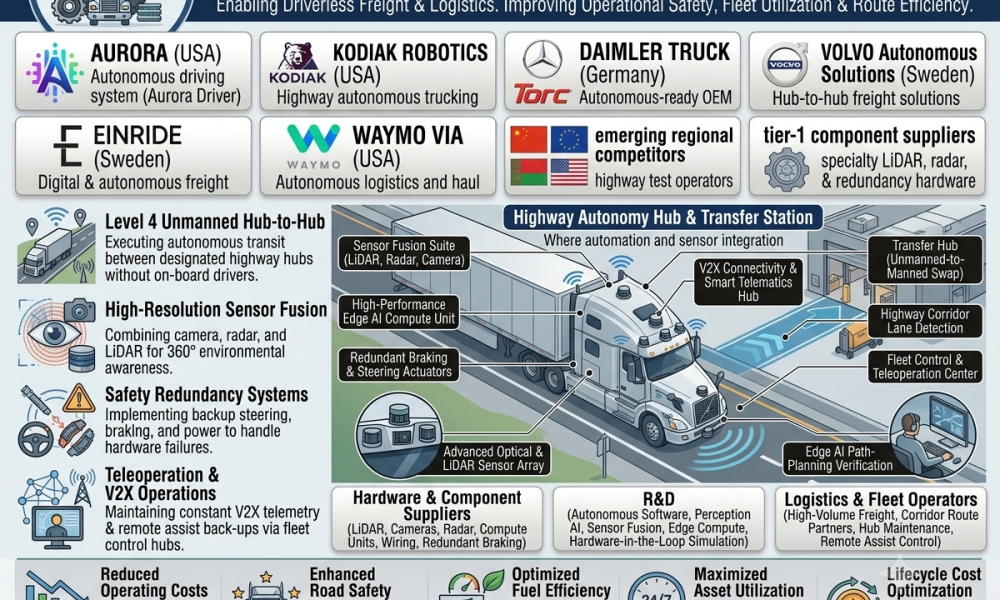
The global autonomous long-haul trucking market is projected to grow from USD 1.2 billion in 2026 to USD 29.0 billion by 2036, expanding at a 37.5% CAGR during the forecast period. Growth is being supported by driver-out service across repeatable highway lanes, where predictable road conditions can provide a practical operating environment for Level 4 autonomous freight systems.
Commercial deployment is increasingly moving beyond demonstration mileage. Aurora Innovation reported in May 2025 that its Dallas-to-Houston operation had completed more than 6,000 driverless miles under commercial conditions. Such operating experience gives freight carriers a basis for evaluating route economics, vehicle utilization, remote assistance requirements, and terminal performance under recurring service conditions.
Commercial value depends on more than autonomous driving software. Freight operators need coordinated fleet management covering dispatch, remote assistance, maintenance planning, roadside response, and terminal reliability. Hub-to-hub operations can help separate highway autonomy from the more complex local pickup and delivery environment, allowing early deployments to focus on defined operating domains.
Regional deployment pathways differ significantly. The United States provides long interstate corridors and state-level permitting pathways for defined highway operations, while Germany places greater emphasis on type approval and coordinated engineering evidence. Transfer hubs remain important in both operating models because they provide a controlled transition between autonomous highway movement and conventional local freight handling.
Capital investment is also moving toward commercialization. Waabi reported in January 2026 that it closed a USD 750 million Series C financing round to accelerate autonomous trucking commercialization. The development reflects increasing emphasis on software validation, vehicle integration, and scalable operating systems. Connected vehicle technology is becoming an important part of this infrastructure by enabling route status and exception data to move between trucks and operating centers.
What Are the Key Segments in the Autonomous Long-Haul Trucking Market?
- Level 4 Full-Stack Autonomy accounts for 44.0% share in 2026, reflecting the focus on highly automated systems operating within defined highway conditions where the operational domain can be tightly controlled.
- Hub-to-Hub Highway Corridors represent 52.0% share in 2026, supported by transfer hubs that separate highway autonomy from urban pickup and delivery activities.
- Per-Mile Autonomous Freight Service holds 46.0% share in 2026, reflecting freight customers’ interest in autonomous capacity without assuming ownership and management responsibilities for the complete autonomy stack.
- General freight applications provide an important operating environment because repeatable loads, established routes, and scheduled terminal movements can support autonomous service validation.
- Hardware, software, and fleet-orchestration solutions work together to provide the sensing, driving, supervision, and operational capabilities required for regular autonomous freight operations.
Get detailed market forecasts, competitive benchmarking, and pricing trends:
https://www.futuremarketinsights.com/reports/sample/rep-gb-33896
Which Countries Are Showing the Strongest Growth in Autonomous Long-Haul Trucking?
China is projected to expand at a 40.0% CAGR through 2036, the highest among the profiled countries. High freight volumes, domestic truck manufacturing, and operational datasets from assisted-autonomy fleets are supporting the development of autonomous line-haul operations. Cross-provincial logistics routes provide potential environments for validating autonomous freight under repeatable conditions.
The United States is forecast to grow at a 39.0% CAGR. Long interstate corridors and established freight flows provide a practical foundation for hub-to-hub autonomous trucking. State-level permitting pathways and commercial operations on defined routes are also shaping the development of driver-out freight services.
South Korea is projected to record a 38.5% CAGR. The country’s established commercial-vehicle engineering base and logistics requirements are supporting autonomous freight development. Integration between vehicle platforms, autonomy software, and commercial logistics operations remains an important consideration.
Germany is expected to grow at a 37.0% CAGR. Deployment is influenced by coordinated engineering programs, legal compliance, and type-approval requirements. These conditions encourage developers to build evidence around vehicle safety and operating performance before broader hub-to-hub commercialization.
Canada is forecast to register a 36.5% CAGR, supported by long-distance freight requirements and the potential application of autonomous systems to repeatable highway routes.
Japan is projected to expand at a 36.0% CAGR. Logistics constraints, established commercial-vehicle engineering, and the need for reliable freight movement are supporting interest in autonomous trucking solutions.
The United Kingdom is expected to record a 35.5% CAGR, with development shaped by freight-network requirements, regulatory considerations, and the operational economics of autonomous highway service.
How Is Regional Demand Shaping the Autonomous Long-Haul Trucking Market?
Regional demand is increasingly determined by the interaction between freight density, road approval, vehicle manufacturing capabilities, and operating infrastructure. The United States provides long interstate routes that can support defined commercial operating domains, while China combines large freight volumes with domestic vehicle and technology capabilities.
European markets place greater emphasis on regulatory evidence and coordinated engineering. Germany’s type-approval requirements create a different commercialization pathway from the state-level operating frameworks used in the United States.
Japan and South Korea are connecting autonomous trucking programs with domestic logistics requirements and established commercial-vehicle engineering capabilities. Across markets, transfer hubs remain an important component because they help separate autonomous highway operations from complex urban freight movements.
What Is Changing the Competitive Landscape?
Competition is increasingly focused on combining autonomous driving software, redundant vehicle systems, fleet management, and commercial freight operations under a reliable service model.
Aurora Innovation and Kodiak AI have moved driverless systems into paid freight activity on defined operating lanes. Their commercial activity highlights the shift from controlled demonstrations toward recurring freight operations where route economics and service reliability can be evaluated.
Torc Robotics and PlusAI emphasize integration with truck manufacturers as they prepare factory-built autonomous platforms for highway freight programs. Factory integration can reduce retrofit requirements and support more consistent vehicle deployment as commercial fleets expand.
Waabi combines simulation-led autonomous driving software with Volvo vehicle engineering. Its commercialization strategy highlights the importance of validating autonomous systems before they are deployed across increasingly complex freight networks.
Inceptio Technology draws on commercial datasets from China and line-haul operations, while Pony AI contributes autonomous trucking and platooning experience in China. Volvo Autonomous Solutions adds purpose-built vehicle platforms and freight-service integration to the competitive landscape.
The competitive environment is therefore moving toward complete operating models in which vehicle availability, software readiness, remote assistance, maintenance, and freight-service performance must work together.
What Is Driving Demand for Autonomous Long-Haul Trucking?
Repeatable Highway Routes Support Early Commercialization
Long-haul freight lanes concentrate autonomous driving activity on highways with predictable geometry and fewer urban interactions than point-to-point delivery. This operating environment can simplify early validation and help carriers compare performance across repeated routes.
Driver Availability Pressures Encourage Automation
Freight carriers can use autonomous capacity to address periods of limited driver availability and sustained service requirements. The commercial benefit depends on achieving reliable truck utilization rather than simply removing the driver from the cab.
Remote Assistance Enables Operational Continuity
Autonomous trucks still require operational support for exceptions, roadside events, and unusual route conditions. Remote assistance therefore becomes an important component of the overall service model and must be coordinated with dispatch and maintenance systems.
Commercial Freight Generates Practical Performance Data
Paid freight operations provide information that demonstrations cannot fully replicate. Repeated service cycles allow carriers to assess route completion, utilization, delays, intervention requirements, and terminal performance.
What Are the Key Market Restraints?
Autonomous long-haul trucking requires substantial coordination between vehicle hardware, autonomous software, fleet systems, freight terminals, and remote operating centers. A limitation in any one component can affect the reliability of an entire commercial route.
Regulatory requirements also vary by country and operating jurisdiction. Developers must establish safety evidence, approval documentation, and operational procedures that can differ significantly between markets.
Vehicle availability can represent another constraint. Factory-built redundant autonomous trucks can reduce retrofit complexity, but commercial expansion may slow when vehicle production schedules do not match software readiness or customer demand.
What Opportunities Exist for Autonomous Trucking Providers?
Per-mile autonomous freight services provide an opportunity for carriers and technology providers to commercialize autonomous capacity without requiring every customer to own the complete autonomy stack. Such models can simplify adoption while placing greater responsibility on service providers for vehicle availability and operating performance.
Hub-to-hub networks also provide opportunities for targeted corridor expansion. Once a route demonstrates repeatable freight performance, operators can extend autonomous service to additional lanes with similar operating characteristics.
Software validation and fleet orchestration represent another opportunity. Autonomous freight networks require systems capable of coordinating dispatch, route status, remote assistance, maintenance, and exception handling across multiple vehicles.
Drive Your Business Growth Strategy: Checkout the Report for Key Insights!
https://www.futuremarketinsights.com/checkout/33896
How Is the Autonomous Long-Haul Trucking Market Segmented?
The autonomous long-haul trucking market is segmented by automation level, solution type, route type, business model, application, and region.
By Automation Level: Level 4 Full-Stack Autonomy, Level 2 Driver Assistance, Level 3 Conditional Automation.
By Solution Type: Hardware and Sensor Systems, Automotive Software, Fleet Orchestration.
By Route Type: Hub-to-Hub Highway Corridors, Point-to-Point Operations.
By Business Model: Per-Mile Autonomous Freight Service, Vehicle Sales, Technology Sales.
By Application: General Freight, Energy Logistics, Retail Distribution.
By Region: North America, Europe, East Asia, and other regional markets.
What Are the Drivers, Restraints and Opportunities in the Autonomous Long-Haul Trucking Market?
“Commercial success depends on repeatable freight service rather than a single driverless demonstration on one controlled route over time.”
— Nikhil Kaitwade, Principal Analyst at Future Market Insights
- Drivers: Repeatable highway freight routes, driver availability pressures, commercial driver-out operations, and growing investment in autonomous trucking technology.
- Restraints: Regulatory differences, vehicle availability, remote assistance costs, and terminal integration requirements.
- Opportunities: Per-mile freight services, hub-to-hub corridor expansion, software validation, and factory-integrated autonomous truck platforms.
What Is the Autonomous Long-Haul Trucking Demand Outlook?
Demand is expected to increasingly depend on whether autonomous trucks can deliver consistent freight performance across recurring commercial routes. Freight carriers are evaluating autonomous technology according to truck utilization, route completion, service reliability, and total operating requirements.
The shift from demonstration mileage toward paid freight creates a stronger basis for comparing operating economics. As more routes generate repeated performance data, carriers can assess whether autonomous capacity can be incorporated into regular freight schedules without compromising terminal operations or maintenance planning.
Hub-to-Hub Corridors Provide a Defined Commercial Operating Model
Hub-to-hub highway corridors account for 52.0% share in 2026. Transfer hubs can reduce exposure to complex urban routes while allowing autonomous trucks to concentrate on predictable highway segments. This operating model provides a structured pathway for expanding commercial service.
Per-Mile Services Reduce Technology Ownership Requirements
Per-mile autonomous freight service represents 46.0% share in 2026. The model can allow freight customers to purchase transportation capacity while autonomous technology providers retain responsibility for vehicle systems, software, supervision, and operational support.



