
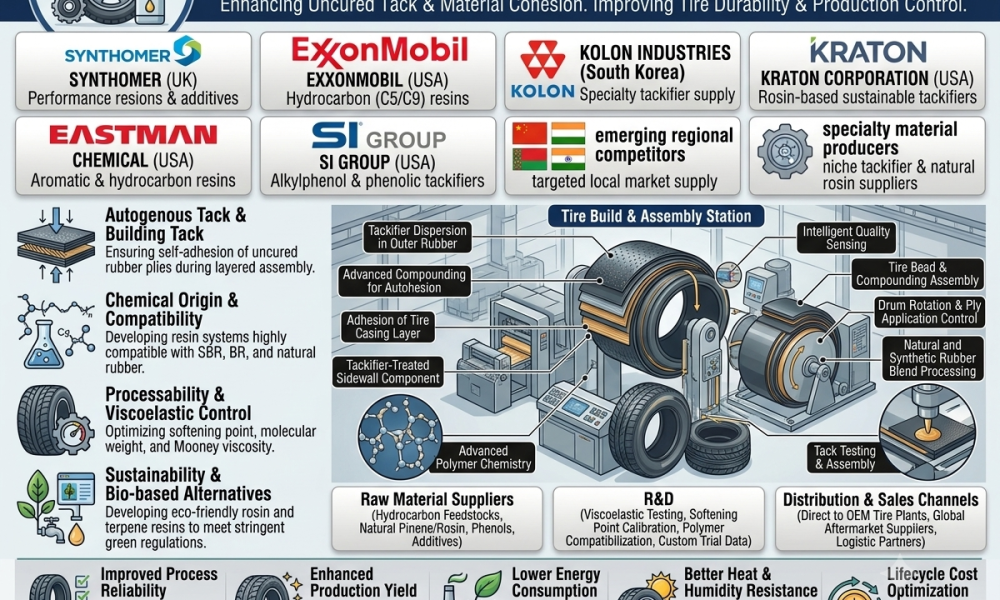
The global tire tackifier resins market is projected to grow from USD 1,480.6 million in 2026 to USD 2,753.3 million by 2036, expanding at a 6.4% CAGR during the forecast period. Tire producers are increasingly using tackifier resins to maintain green tack during calendaring, bead assembly, and tread preparation while improving processing consistency across recurring production cycles.
Global vehicle production is reinforcing the underlying demand for tire compounds and related materials. The Organisation Internationale des Constructeurs d’Automobiles (OICA) reported global vehicle production of 96,383,650 units in 2025, keeping resin qualification and compound-trial activity closely connected to recurring tire output. Compound teams increasingly assess compatibility across natural rubber and SBR/BR blends before approving tackifier formulations for broader plant use.
Regional procurement practices are also influencing supplier selection. India and China are expected to place greater emphasis on local resin availability as production scale increases the number of compound trials. Japan and Germany are projected to prioritize batch consistency, resin identity, and material documentation when evaluating suppliers. In the United States, the USTMA projected total tire shipments at 338.9 million units in 2026, highlighting the continued importance of technical support and reliable material supply.
What Are the Key Segments in the Tire Tackifier Resins Market?
- Direct to Tire OEM accounts for 59.5% share in 2026, reflecting the importance of qualification control, direct technical engagement, and supplier accountability in tire manufacturing programs.
- Passenger tires represent 45.1% share in 2026, supported by recurring demand for tread and sidewall compounds and the need for consistent green tack during tire component preparation.
- C5 hydrocarbon resins hold 38.0% share in 2026, supported by their role in tack control and compatibility with rubber compound systems.
- Tread compounds remain an important application area as manufacturers evaluate tackifier performance alongside processing behavior and final tire requirements.
- Natural rubber and SBR/BR systems remain key rubber categories where suppliers must demonstrate compatibility and consistent compound behavior before wider adoption.
Get detailed market forecasts, competitive benchmarking, and pricing trends:
https://www.futuremarketinsights.com/reports/sample/rep-gb-33939
Which Countries Are Showing the Strongest Growth in Tire Tackifier Resins?
India is projected to record an 8.3% CAGR through 2036, the highest among the profiled countries. Expanding vehicle production and tire manufacturing activity are increasing requirements for rubber-processing materials. Local supply availability and technical support are expected to remain important as tire producers conduct repeated compound trials and qualification programs.
China is forecast to expand at a 7.5% CAGR during the forecast period. The country’s automotive manufacturing scale and rubber tire casing output support continued demand for tackifier resins. Suppliers able to support formulation trials and maintain consistent material documentation can address procurement requirements across large-scale tire manufacturing operations.
South Korea is expected to grow at a 6.3% CAGR through 2036. Export-oriented tire production and technical sourcing requirements are influencing resin procurement. Tire producers are likely to continue evaluating material consistency and compound compatibility when selecting tackifier suppliers.
The United States is projected to register a 5.3% CAGR. The country’s substantial tire shipment base supports recurring material requirements, while direct technical support remains relevant for supplier qualification and compound optimization.
The United Kingdom is forecast to grow at a 5.1% CAGR, with demand shaped by tire-material sourcing requirements and the need for documented compound performance.
Germany is anticipated to record a 4.9% CAGR. Tire manufacturers are expected to maintain strong emphasis on batch consistency, material files, and repeatable processing behavior when assessing tackifier resin suppliers.
Japan is projected to expand at a 4.8% CAGR. Procurement decisions are expected to remain closely connected to resin identity, batch consistency, compatibility records, and documented processing performance.
How Is Regional Demand Shaping the Tire Tackifier Resins Market?
Regional tire manufacturing structures are creating different procurement priorities for tackifier resin suppliers. India and China are expected to place greater emphasis on local supply and production support as expanding manufacturing activity generates more compound-trial requirements.
In Japan and Germany, technical documentation and batch consistency remain important considerations in supplier approval. Across the United States, tire shipment volumes support recurring demand while direct technical engagement can help suppliers navigate qualification requirements.
What Is Changing the Competitive Landscape?
The competitive environment is increasingly centered on resin chemistry, hydrocarbon resin portfolios, and the ability to support tire-compound development.
Synthomer and ExxonMobil are expected to compete through hydrocarbon resin portfolios and application support. Their positioning reflects the growing importance of resin selection as part of compound-development programs rather than a simple material purchase.
Kolon Industries and Kraton are likely to compete through polymer and resin chemistry capabilities. Tire producers evaluating alternative tackifiers can compare compatibility, processing behavior, and documentation across different compound formulations.
Neville Chemical, Arakawa Chemical, and Yasuhara Chemical are projected to receive attention for specialty tackifier expertise. Their competitive relevance is connected to applications where tire producers require specific resin characteristics and formulation support.
Rain Carbon and TotalEnergies are expected to address customers seeking continuity across resin-adjacent material supply. Supplier reliability and technical responsiveness can become increasingly important as tire manufacturers reduce avoidable formulation disruptions.
Drive Your Business Growth Strategy: Checkout the Report for Key Insights!
https://www.futuremarketinsights.com/checkout/33939
What Is Driving Demand for Tire Tackifier Resins?
Growing Tire Production Supports Recurring Resin Requirements
The continued scale of global vehicle production supports recurring tire manufacturing and compound demand. As tire plants maintain high-volume production schedules, tackifier resin qualification becomes an ongoing consideration for maintaining compound consistency.
Compound Compatibility Gains Procurement Importance
Tire producers increasingly assess how resins interact with natural rubber and SBR/BR blends. Softening point, resin identity, and Mooney-viscosity behavior can influence whether a tackifier progresses from laboratory or plant trials to approved production use.
Direct Technical Support Strengthens Supplier Relationships
Tire manufacturers increasingly require suppliers to provide more than catalog specifications. Compatibility records, trial assistance, batch documentation, and plant-level support can influence supplier approval and repeat purchasing.
Passenger Tire Manufacturing Maintains Application Demand
Passenger tires account for 45.1% share in 2026, making passenger-tire compounds an important demand center for tackifier resins. Repeated tread and sidewall production creates ongoing requirements for predictable compound processing.
What Are the Key Market Restraints?
Supplier qualification can require extensive testing before a new tackifier resin is introduced into production. Tire producers must evaluate material compatibility, processing behavior, batch consistency, and potential effects on compound performance before expanding a supplier’s approved status.
Material substitution can also be limited when tire manufacturers have established formulations and validated production processes. Switching suppliers may require additional trials and documentation, increasing the importance of technical evidence and reliable batch performance.
Price competition represents another consideration, particularly where multiple resin suppliers can offer broadly comparable material categories. Suppliers therefore need to demonstrate measurable application value rather than competing solely on catalog breadth.
What Opportunities Exist for Tire Tackifier Resin Manufacturers?
Suppliers have opportunities to expand through application-specific technical support. Providing compatibility data for natural rubber, SBR, BR, and blended systems can help tire producers reduce trial uncertainty and accelerate qualification decisions.
There is also potential for suppliers to strengthen direct relationships with tire OEMs through plant-level service. Technical assistance during formulation trials, consistent material documentation, and responsive support can create differentiation beyond resin availability.
C5 hydrocarbon resins also represent an important opportunity, with the segment accounting for 38.0% share in 2026. Suppliers can use formulation expertise and application support to address specific tack and processing requirements across tire compounds.
How Is the Tire Tackifier Resins Market Segmented?
The tire tackifier resins market is segmented by resin type, application, rubber type, tire type, sales channel, and region.
By Resin Type: C5 Hydrocarbon Resins, C9 Hydrocarbon Resins, Terpene Phenolic Resins, Rosin Ester Resins.
By Application: Tread Compounds, Sidewall Compounds, Bead Compounds, Retreading Compounds.
By Rubber Type: Natural Rubber, SBR and BR, Butyl Rubber, Specialty Elastomers.
By Tire Type: Passenger Tires, Truck and Bus Tires, OTR Tires, Two-wheeler Tires.
By Sales Channel: Direct to Tire OEM, Compounders, Distributors.
By Region: North America, Latin America, Europe, East Asia, South Asia and Pacific, Middle East and Africa.
What Are the Drivers, Restraints and Opportunities in the Tire Tackifier Resins Market?
“Tire tackifier resins are developing into a performance-validation segment linked to resin compatibility and tire compound control.”
— Nikhil Kaitwade, Principal Consultant for Automotive at Future Market Insights
- Drivers: Recurring tire production, demand for green tack, compound compatibility requirements, and passenger-tire manufacturing.
- Restraints: Supplier qualification requirements, formulation switching costs, and the need for extensive trial data.
- Opportunities: Direct OEM supply, application-specific technical support, compound testing services, and specialty resin development.
What Is the Tire Tackifier Resins Demand Outlook?
Demand for tire tackifier resins is expected to remain connected to the operational requirements of tire compound production. Manufacturers are increasingly evaluating resins according to how consistently they support green tack, processing behavior, and compound performance rather than simply comparing product catalogs.
The shift toward evidence-based qualification creates an opportunity for suppliers that can provide material files, compatibility records, and compound-trial support. Direct engagement with tire producers can strengthen supplier relationships as manufacturers seek to limit rework and maintain repeatable production.



