
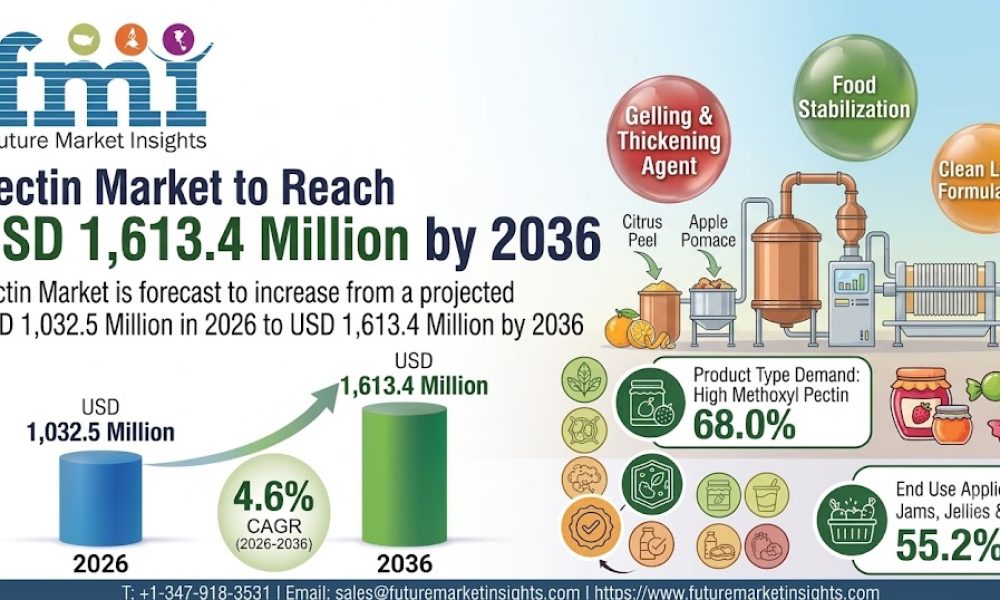
The global pectin market is forecast to increase from USD 1,029.0 million in 2026 to USD 1,613.4 million by 2036, expanding at a 4.6% CAGR during the 2026-2036 forecast period, according to Future Market Insights. The market stood at USD 983.7 million in 2025. Growth is being supported by continued demand for pectin across food and beverage applications, increasing use in lower-sugar formulations, and the need for ingredients that provide consistent gel strength, thickness, particle suspension, and texture stability.
Get detailed market forecasts, competitive benchmarking, and pricing trends: https://www.futuremarketinsights.com/reports/sample/rep-gb-3041
Regional Segment Leaders
As this is a global Pectin Market report, the segment analysis reflects product types and application categories across key food-processing markets.
- High Methoxyl (HM) Pectin – 68.0% of Product Type demand in 2026: High methoxyl pectin fits acidic, high-solids recipes where sugar and acid conditions support gel formation, making it widely used across established food formulations.
- Food & Beverages – 71.0% of Application demand in 2026: Pectin remains widely used across fruit products, dairy foods, beverages, confectionery, bakery fillings, and other everyday food formats where controlled texture and stability are required.
Country-Level Performance
The report examines pectin demand across major food-processing markets, where formulation requirements, ingredient regulations, production scale, and export standards influence purchasing and grade qualification.
- USA: A large food-production base creates diverse applications for pectin across beverages, fruit preparations, dairy products, confectionery, and bakery products. Food manufacturers test formulations before changing approved pectin grades.
- UK: Food manufacturers use E 440 pectin across multiple food applications, with formulation and labeling requirements influencing ingredient selection.
- Germany: Processors operate multiple recipes across shared production lines, increasing the importance of consistent pectin performance and reliable ingredient specifications.
- Japan: Detailed ingredient records and destination-market requirements influence how food manufacturers qualify pectin grades for domestic and export products.
- South Korea: Export-oriented food production and destination-market checks encourage detailed ingredient documentation and consistent formulation performance.
Regional Context
The pectin market is developing around the commercial need for reliable texture control across a wide range of food and beverage formulations. Food manufacturers use pectin to create gels, control thickness, maintain particle suspension, and improve texture stability.
Recipe conditions can significantly influence pectin performance. Sugar concentration, acidity, calcium levels, processing temperature, and storage conditions can all affect the final gel structure. As a result, formulation teams frequently adjust pectin selection when recipe conditions change.
Lower-sugar food development is creating additional opportunities for specialized pectin grades. Reducing sugar can alter the conditions required to form and maintain a stable gel, encouraging manufacturers to evaluate alternative pectin specifications before moving formulations into full-scale production.
Pectin also remains important across fruit preparations, dairy foods, beverages, confectionery, bakery fillings, and functional food formats. The broad range of applications provides a stable demand base while requiring suppliers to demonstrate consistent performance across different processing environments.
Raw-material and manufacturing consistency remain important commercialization considerations. Pectin performance can vary according to fruit source and extraction processes, while changes in pectin chemistry can influence gel behavior. Buyers therefore require technical specifications, application testing, and plant-scale validation before approving a grade for regular production.
In May 2025, Tate & Lyle reported 8% volume growth at CP Kelco and cited strong pectin performance. This reflects continued commercial interest in pectin grades that can maintain predictable texture performance from laboratory development through full-scale food production.
Competitive Landscape
The competitive landscape includes global ingredient suppliers and specialty pectin producers participating across food additives, hydrocolloids, texturizing ingredients, and functional food solutions.
- Pectin and Hydrocolloid Platforms: CP Kelco (Tate & Lyle), Herbstreith & Fox GmbH & Co KG, Yantai Andre Pectin Co. Ltd., and Compañía Española de Algas Marinas (CEAMSA) participate through pectin production and ingredient technologies.
- Global Food Ingredient Providers: DuPont de Nemours, Inc. (IFF), Cargill, Incorporated, and Naturex (Givaudan) participate through broader food-ingredient and formulation portfolios that include texturizing and functional ingredients.
- Specialty Ingredient Suppliers: Silvateam S.p.A. contributes through natural ingredient and hydrocolloid-related capabilities serving food and industrial applications.
Competitive differentiation depends on pectin grade consistency, gel performance, extraction technology, formulation support, application expertise, production capacity, technical documentation, and the ability to meet requirements across different food-processing markets.
Analyst Perspective
“Lower-sugar foods are opening a clear pectin opportunity because less sugar changes how a stable gel forms. Producers need plant-scale texture and heat-stability data so buyers can approve one grade across bakery, dairy, or fortified gummy lines.” – Nandini Roy Choudhury, Principal Consultant, Future Market Insights
About Future Market Insights (FMI)
Future Market Insights, Inc. (FMI) is an ESOMAR-certified, ISO 9001:2015 market research and consulting organization, trusted by Fortune 500 clients and global enterprises. With operations in the U.S., UK, India, and Dubai, FMI provides data-backed insights and strategic intelligence across 30+ industries and 1200 markets worldwide.
For Press & Corporate Inquiries
Rahul Singh
AVP – Marketing and Growth Strategy
Future Market Insights, Inc.
+91 8600020075
For Sales: [email protected]
For Media: [email protected]
For Web: https://www.futuremarketinsights.com/



