
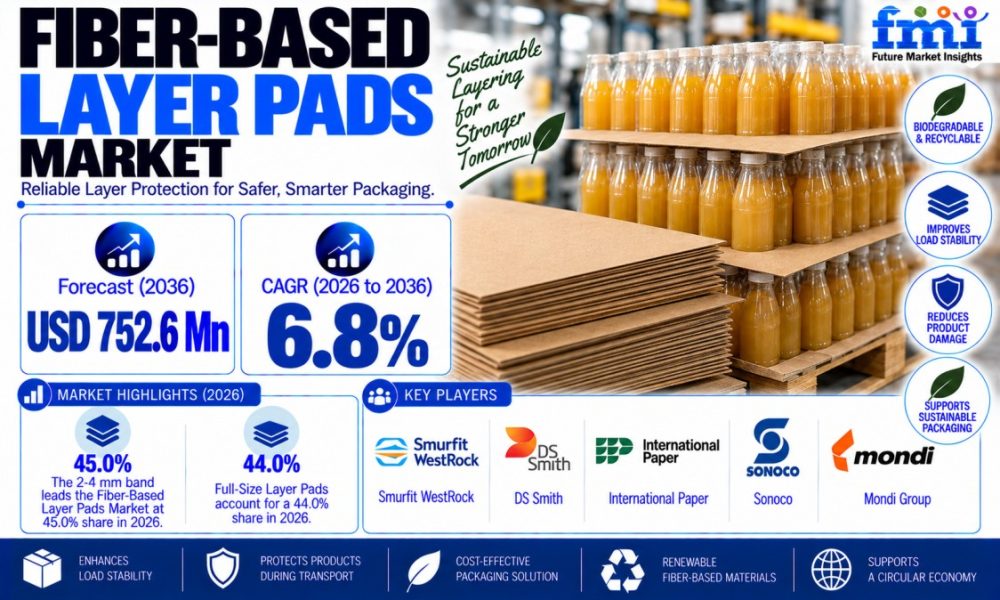
The global Fiber–Layer Pads Market is projected to reach USD 2.73 billion by 2036, rising from USD 1.58 billion in 2026 at a 5.6% CAGR, according to Future Market Insights (FMI).
The market is being shaped by growing logistics efficiency requirements, load-protection specifications, warehouse automation, e-commerce fulfillment, and packaging sustainability mandates.
Layer pads are used to separate products, distribute loads, improve stacking stability, and protect packaged goods during storage and transportation. As supply chains become more automated, dimensional consistency and machine compatibility are becoming increasingly important purchasing considerations.
>> Get Detailed Market Forecasts, Competitive Benchmarking, and Pricing Trends: https://www.futuremarketinsights.com/reports/sample/rep-gb-34220
Plastic Currently Leads the Material Category
Plastic is projected to account for 63.0% of material demand in 2026.
Established procurement patterns, broad application coverage, and consistent performance continue to support plastic layer pad adoption across logistics and distribution operations.
However, packaging waste regulations, extended producer responsibility requirements, retailer sustainability targets, and recycled-content expectations are influencing material decisions.
This is creating a more complex procurement environment in which suppliers need to balance performance, cost, recyclability, and regulatory compliance.
Food and Agro Products Represent the Leading End-Use Base
Food and Agro Products are projected to account for 34.0% of demand in 2026, making the segment the leading end-use base.
Layer pads are used across fresh produce packaging, fruit layer protection, and vegetable transport applications.
The requirement is particularly relevant where products need stable separation and protection during palletization and distribution.
For food and agro-product supply chains, dimensional consistency and material suitability are important because pad performance can influence stacking stability and product protection.
Die-Cut Shapes Lead the Shape Segment
Die-cut shapes account for 31.2% of demand in 2026.
Custom-designed and precision-fit formats allow manufacturers to match layer pads to specific product and pallet configurations.
This becomes increasingly relevant as automated palletizing and warehouse systems place greater emphasis on standardized dimensions.
A pad that varies significantly in size or shape can create handling and positioning problems in automated environments.
For suppliers, consistent production and dimensional accuracy are therefore becoming important competitive factors.
Warehouse Automation Is Changing Specifications
The expansion of warehouse automation and robotic palletizing is increasing demand for machine-compatible packaging components.
Automated systems require predictable dimensions and repeatable handling characteristics.
Layer pads therefore need to perform consistently across high-volume production and distribution environments.
E-commerce fulfillment is another source of demand. As distribution networks process greater order volumes, standardized packaging components can support faster and more repeatable handling.
Sustainability Requirements Are Influencing Procurement
Packaging waste regulations and recyclability mandates are creating additional pressure on layer pad suppliers.
Extended producer responsibility obligations, plastics taxes, and retailer recycled-content targets are encouraging manufacturers to evaluate recyclable and reusable formats.
Returnable layer pads can be particularly relevant to closed-loop logistics systems where packaging components are collected and reused.
At the same time, the cost of recycled and biodegradable materials remains an important consideration.
Raw-material price volatility and availability of recycled content can affect manufacturing economics.
Germany Leads the Country Growth Outlook
Germany is projected to grow at a 6.4% CAGR through 2036, the highest among the key country markets covered by FMI.
The country’s market is being influenced by EU packaging requirements, extended producer responsibility obligations, retailer sustainability commitments, and demand for reusable die-cut layer pads.
Other country growth rates include:
- USA: 5.1% CAGR
- South Korea: 4.9%
- United Kingdom: 4.7%
- Japan: 4.6%
In the United States, warehouse automation, e-commerce fulfillment, labor-cost pressures, and retailer packaging requirements are supporting demand for standardized layer pads.
Reusable Formats Create Opportunities
The transition toward reusable packaging systems creates opportunities for layer pad suppliers.
Reusable pads can support returnable packaging programs and closed-loop logistics, particularly where packaging components can be collected and returned efficiently.
Longer product life can also change the purchasing model from repeated single-use consumption toward durability and total cost of ownership.
However, reusable systems require appropriate reverse-logistics infrastructure and consistent cleaning, inspection, and handling procedures.
Competitive Landscape
Key companies profiled in the broader Layer Pads Market include Smurfit Kappa Group, DS Smith Plc, International Paper, WestRock Company, Mondi Group, Packaging Corporation of America, Nefab Group, Sonoco Products Company, Cartonplast Group, and Huhtamaki Oyj.
Competition is increasingly focused on dimensional precision, recyclable materials, distribution capabilities, and long-term supply relationships.
FMI notes that companies with established distribution networks and multi-regional presence are positioned to strengthen their market position as procurement becomes more specification-led.
Analyst Perspective
“Companies that combine cost-effective production with dimensional precision, recyclable materials compliance, and multi-channel logistics partnerships are likely to strengthen their market position over the forecast period.”
— Nandini Roy Choudhury, Principal Consultant, Future Market Insights
About the Layer Pads Market Report
The FMI study covers layer pads across material type, end-user base, shape type, thickness, usage, distribution channel, printing, and region.
Material categories include plastic and paperboard formats, while end users include food and agro
To explore how FMI Custom Research can support your strategic priorities, connect with our team at – [email protected]
About Future Market Insights (FMI)
Future Market Insights, Inc. is an ESOMAR-certified, ISO 9001:2015 market research and consulting organization trusted by Fortune 500 companies. With a global presence across the U.S., UK, India, and Dubai, FMI delivers data-driven insights across 30+ industries and 1200 markets worldwide.



