
The global tire curing bladders market is projected to grow from USD 980.7 million in 2026 to USD 1,789.7 million by 2036, advancing at a 6.2% CAGR during the forecast period. Tire curing bladders are increasingly moving beyond their traditional role as press consumables and becoming production-control inputs that help tire manufacturers manage cure consistency, pressure transfer, mold compatibility, and plant continuity.
Tire manufacturers are evaluating bladder contour, release behavior, compound traceability, and technical support before products enter repeated curing cycles. The United States Tire Manufacturers Association (USTMA) projected total USA tire shipments at 338.9 million units in 2026, providing a measurable demand base across original-equipment and replacement tire programs.
India’s tire plants are expected to seek faster bladder access as localized tire production and replacement cycles expand, while Japanese manufacturers are expected to place greater emphasis on contour control and release quality during plant approval. Tire OEMs and retread operators increasingly require curing bladders that connect pressure transfer and mold compatibility with measurable plant outcomes. Continental reports annual production of more than 750,000 ContiBladders used across customer plants worldwide, highlighting the scale of recurring bladder demand across tire manufacturing operations.
What Are the Key Segments in the Tire Curing Bladders Market?
- Direct OEM is projected to account for 61.2% share in 2026, reflecting the importance of technical support, supplier accountability, and direct engagement with tire manufacturing plants.
- Tire OEMs are expected to represent 46.0% share in 2026, supported by high-volume production and the need for consistent curing performance.
- Passenger Tire Bladders are forecast to hold 44.5% share in 2026, driven by frequent curing cycles and substantial passenger tire output.
- Butyl and halobutyl rubber remain important material categories where durability, pressure retention, release behavior, and curing compatibility influence product selection.
- Radial tire curing and retread curing create recurring requirements for bladder designs aligned with different tire sizes, molds, and production conditions.
Get detailed market forecasts, competitive benchmarking, and pricing trends:
https://www.futuremarketinsights.com/reports/sample/rep-gb-33783
Which Countries Are Showing the Strongest Growth in Tire Curing Bladders?
India is projected to be the fastest-growing country in the tire curing bladders market, registering an 8.1% CAGR through 2036. Expanding vehicle production, localized tire manufacturing, and replacement requirements are increasing the need for reliable curing components. Suppliers with local availability and application support can address plant requirements where production delays can affect press utilization.
China is forecast to expand at a 7.3% CAGR during the forecast period. Integrated tire production and new-energy vehicle output are supporting demand for curing solutions that can accommodate evolving tire structures. Manufacturers are increasingly connecting bladder selection with process quality, repeatability, and production documentation.
South Korea is expected to register a 6.1% CAGR through 2036. Its concentrated automotive manufacturing base supports demand for curing components that meet established plant specifications and quality requirements.
How Is Regional Demand Shaping the Tire Curing Bladders Market?
Regional demand is increasingly influenced by tire manufacturing capacity, vehicle production, replacement requirements, and production modernization. Established tire-producing markets are placing greater emphasis on supplier qualification, technical documentation, compound traceability, and repeat curing performance.
Emerging manufacturing centers are creating additional opportunities as tire producers localize supply chains and seek faster access to replacement components. For bladder suppliers, the commercial opportunity is therefore expanding beyond product availability toward application support, inventory planning, and evidence of consistent performance across curing cycles.
What Is Changing the Competitive Landscape?
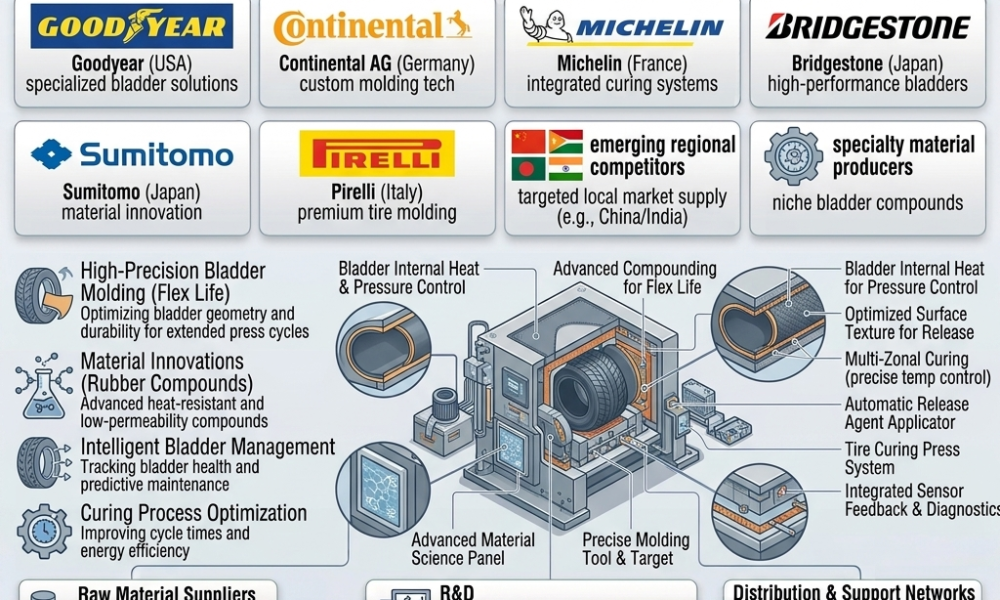
Competition in the tire curing bladders market is increasingly linked to tire manufacturing expertise and plant-level process knowledge. Bridgestone and Michelin are expected to compete through their extensive tire manufacturing capabilities and understanding of curing processes.
Continental brings its ContiBladders offering and reported annual production of more than 750,000 units across customer plants worldwide. This scale highlights the role of application experience and supply availability in recurring curing operations.
LANXESS Rhein Chemie and Shandong Yanggu Huatai Chemical are expected to attract attention through rubber additive and compound-support pathways. Their positioning reflects the relationship between rubber materials, curing performance, and broader tire manufacturing requirements.
Yokohama Rubber is also expected to support tire programs where production quality and specification continuity remain important. Across the competitive landscape, buyers are increasingly comparing suppliers based on documentation, application support, and the ability to maintain consistent performance rather than evaluating bladder products only on initial purchase price.
What Does the Analyst Say About the Tire Curing Bladders Market?
According to Nikhil Kaitwade, Principal Consultant for Automotive at Future Market Insights, the tire curing bladders market is developing into a performance-validation segment linked to cure quality and press efficiency.
“Tire curing bladders are developing into a performance-validation segment linked to cure quality and press efficiency.”
Tire buyers increasingly prioritize evidence connecting bladder material behavior with repeat curing outcomes. Suppliers that combine documentation with application service can strengthen their position during plant approval, while plant-level technical support can provide greater value beyond basic bladder supply.
Drive Your Business Growth Strategy: Checkout the Report for Key Insights!
https://www.futuremarketinsights.com/checkout/33783
What Is Driving Demand for Tire Curing Bladders?
Rising Focus on Cure Quality and Press Stability
Tire plants are increasingly evaluating curing bladders according to their contribution to consistent production outcomes. Bladder contour and release behavior can affect pressure transfer, mold interaction, and the repeatability of curing operations. As manufacturers seek to reduce avoidable production interruptions, bladder performance is becoming part of broader process-control discussions.
Expansion of Tire Manufacturing and Replacement Activity
Growing tire shipments create recurring demand for curing bladders across original-equipment and replacement programs. High-volume plants require dependable access to replacement bladders to maintain established curing routines. Retread operators and mold or press service providers add another demand channel as repeat curing activity requires consistent component availability.
Electric Vehicle Tire Development
Changing vehicle architectures are influencing tire requirements and creating additional validation considerations for manufacturers. The VDA reported 864,000 electric cars produced in Germany during the first half of 2025, with electric vehicles accounting for 40.0% of domestic car production during that period. As tire structures evolve for electric vehicles, manufacturers have additional reasons to evaluate EV tire specifications alongside curing bladder performance.
Increasing Importance of Technical Documentation
Buyers are comparing curing bladders based on compound traceability, release characteristics, technical support, and production records. Documentation can help plants assess whether a bladder is suitable for repeated curing cycles and established mold configurations.
What Are the Key Market Restraints?
The market faces challenges associated with application-specific performance requirements. Bladders must operate consistently across different tire sizes, rubber compounds, molds, temperatures, and curing conditions. A product validated for one production environment may require additional testing before deployment in another plant.
Supplier qualification can also lengthen replacement decisions. Tire manufacturers may prefer established products with documented plant performance, making it more difficult for new suppliers to enter without technical evidence and application support.
What Opportunities Exist for Tire Curing Bladder Manufacturers?
Manufacturers can create additional value by combining bladder supply with technical documentation, compound traceability, application guidance, and replacement planning. These capabilities can support procurement decisions where plant continuity and repeat curing performance are more important than product availability alone.
Localization also creates opportunities in markets such as India and China. Suppliers able to provide faster replacement access and plant-level technical assistance can address the operational requirements of expanding tire manufacturing bases.
How Is the Tire Curing Bladders Market Segmented?
The tire curing bladders market is segmented by bladder type, material, mold process, end use, sales channel, and region.
By Bladder Type: Passenger Tire Bladders, Truck Tire Bladders, OTR Tire Bladders, and Specialty Tire Bladders.
By Material: Butyl Rubber, Halobutyl Rubber, EPDM or Specialty Rubber, and Composite Bladders.
By Mold Process: Radial Tire Curing, Bias Tire Curing, Retread Curing, and Specialty Curing.
By End Use: Tire OEMs, Retreaders, and Mold or Press Service Providers.
By Sales Channel: Direct OEM, Aftermarket Replacement, and Distributors.
By Region: North America, Latin America, Europe, East Asia, South Asia and Pacific, and the Middle East and Africa.
Which Bladder Type Accounts for Significant Demand?
Passenger tire bladders represent the leading bladder type focus, with a projected 44.5% share in 2026. Their position reflects the scale of passenger tire production and the frequency of curing cycles across high-volume plants.
Why Does Direct OEM Supply Lead the Sales Channel?
Direct OEM is projected to hold 61.2% share in 2026. Direct relationships allow tire manufacturers to assess supplier accountability, technical support, product documentation, and application performance within established production programs.
How Are Tire OEMs Influencing Demand?
Tire OEMs are expected to account for 46.0% share in 2026. Their demand is linked to press continuity, batch quality control, curing repeatability, and the need to maintain consistent production specifications.
What Are the Drivers, Restraints and Opportunities in the Tire Curing Bladders Market?
The tire curing bladders market is increasingly influenced by tire production scale, cure consistency requirements, material traceability, and the need for documented supplier support.
- Rising tire production and replacement activity are creating recurring requirements for curing bladders.
- Tire manufacturers are giving greater importance to contour control, release behavior, compound traceability, and curing documentation.
- Localized tire production and evolving EV tire programs are creating opportunities for suppliers offering reliable availability and application support.
What Is the Tire Curing Bladders Market Demand Outlook?
The tire curing bladders market is expected to remain closely connected to global tire production, replacement demand, and manufacturing-process requirements. As tire plants increase their focus on production control, curing bladders are being assessed as components that can influence consistency and press efficiency.
Direct OEM procurement is expected to remain important because tire manufacturers require supplier accountability and technical support during product qualification. Meanwhile, aftermarket replacement, retreading, and service providers offer additional demand opportunities.
Production Evidence Becomes More Important
The increasing focus on repeat curing outcomes is encouraging buyers to examine bladder performance through measurable evidence. Contour stability, release behavior, compound traceability, and technical records can therefore influence supplier approval.
Localization Strengthens Replacement Demand
Tire production expansion in India and China can increase demand for locally accessible curing components. Suppliers combining availability with technical support can address procurement requirements linked to production continuity and replacement planning.
Which Countries Are Growing Fastest in the Tire Curing Bladders Market?
India is projected to record an 8.1% CAGR, followed by China at 7.3% and South Korea at 6.1% through 2036. Growth reflects tire production expansion, vehicle manufacturing activity, localization, replacement requirements, and increasing emphasis on curing-process consistency.
About Future Market Insights
Future Market Insights (FMI), a Future Market Insights Group company, is a leading provider of market intelligence and consulting services. FMI delivers syndicated research reports, custom research, and consulting solutions across automotive, industrial, technology, chemicals, energy, and other industries. Its research supports business leaders, investors, and decision-makers with market forecasts, competitive intelligence, and strategic insights.



