
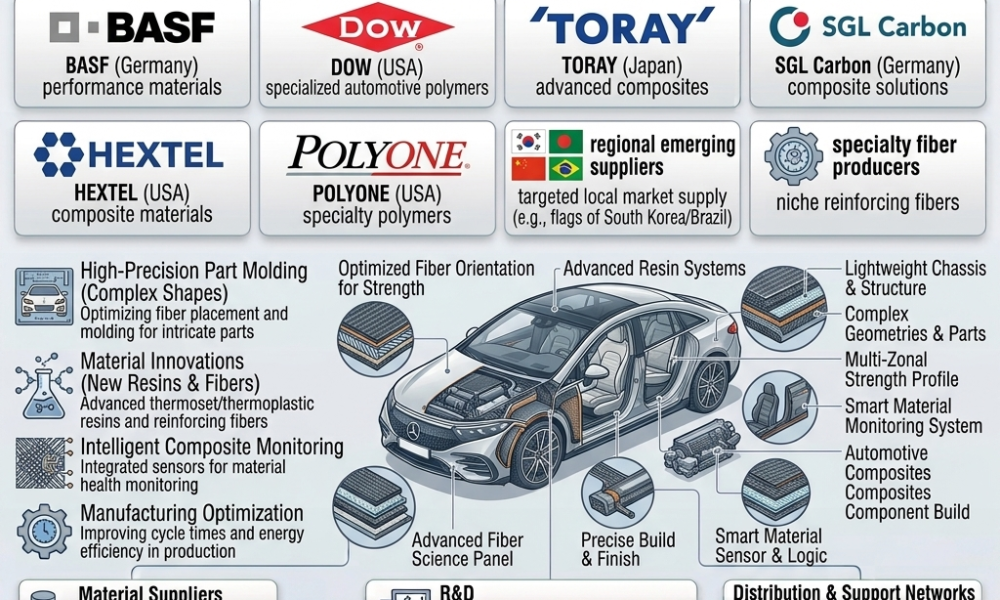
The global automotive composites market is estimated at USD 11.7 billion in 2026 and is forecast to reach USD 37.4 billion by 2036, expanding at a 12.3% CAGR during the forecast period. The market was valued at USD 10.4 billion in 2025. Automotive composites are moving from niche structural applications toward mainstream vehicle lightweighting as automakers seek to reduce vehicle mass, support electric-vehicle range, meet emissions targets, and maintain structural performance.
Composite materials are increasingly being specified for interior systems, structural components, and under-hood applications where manufacturers seek alternatives to conventional metal parts. Glass Fiber Composites account for 56.0% of material demand in 2026, while Thermoplastic resins hold a 55.0% share, reflecting growing interest in materials that support efficient molding processes and recyclability.
The shift toward composite materials is being reinforced by OEM platform redesigns. Automotive manufacturers and tier-1 suppliers are evaluating composite components according to part cost, molding cycle time, weight reduction, structural requirements, and end-of-life considerations. As these factors become part of vehicle platform engineering, composites are gaining relevance across a broader range of passenger vehicle applications.
What Are the Key Segments in the Automotive Composites Market?
- Glass Fiber Composites are projected to account for 56.0% of material demand in 2026, supported by their application across structural and interior automotive components.
- Thermoplastic resins hold a 55.0% share, reflecting demand for faster molding cycles and materials with improved recyclability characteristics.
- Interior applications are becoming important targets for composite adoption as OEMs redesign vehicle cabins around lower weight and integrated component systems.
- Structural applications are expanding as manufacturers seek lightweight alternatives to metal while maintaining required mechanical performance.
- Under-hood components represent another area of adoption where composite materials can support weight reduction and platform-level component redesign.
Get detailed market forecasts, competitive benchmarking, and pricing trends:
https://www.futuremarketinsights.com/reports/sample/rep-gb-1216
How Is Vehicle Lightweighting Driving Automotive Composites Demand?
Vehicle lightweighting remains a central factor behind automotive composites adoption. Automakers are evaluating composite materials as they redesign platforms to reduce vehicle mass while maintaining required structural performance.
The requirement is particularly relevant to electric vehicles, where lower vehicle weight can support range objectives. Composite components can replace selected metal parts in interior, structural, and under-hood applications, creating opportunities for manufacturers to reduce mass at the component and vehicle-platform levels.
For procurement teams, however, lightweighting is only one consideration. Composite materials must also satisfy cost, production speed, durability, tooling, and recyclability requirements. This is shifting material-selection discussions from simple weight reduction toward total component economics.
Why Are Thermoplastic Resins Gaining Attention?
Thermoplastic resins account for 55.0% share in 2026, supported by their suitability for faster molding cycles and their recyclability characteristics. These attributes are relevant as automotive manufacturers seek production processes that can support higher volumes while addressing material-efficiency objectives.
Thermoplastic composites can also support platform redesigns where manufacturers require repeatable processing and scalable production. As OEMs increase composite content, material suppliers and tier-1 component manufacturers are being evaluated on their ability to deliver consistent parts within established manufacturing cycles.
What Is Changing the Competitive Landscape?
The automotive composites market is becoming increasingly connected to OEM and tier-1 sourcing decisions. Rather than treating composites as specialized materials for limited structural applications, vehicle manufacturers are evaluating their use across multiple component categories.
Material suppliers and component manufacturers must therefore address several purchasing criteria simultaneously. Part cost remains important, but molding cycle time, weight reduction, structural performance, and recyclability are also becoming part of the sourcing discussion.
The growing use of glass fiber composites demonstrates the importance of scalable material solutions. With 56.0% of material demand in 2026, glass fiber composites have a significant role in applications where manufacturers require lightweighting without moving entirely toward higher-cost reinforcement systems.
Thermoplastic resins are similarly gaining relevance because their processing characteristics can support manufacturing efficiency. Suppliers that can connect material performance with production economics are positioned to participate in broader OEM platform redesign programs.
What Is Driving Demand for Automotive Composites?
Electric-Vehicle Lightweighting
The continued development of electric vehicles is strengthening the need to manage vehicle mass. Automakers are assessing composite components as part of broader engineering strategies designed to support vehicle efficiency and range.
Emissions and Efficiency Requirements
Reducing vehicle weight can contribute to efficiency objectives across both electrified and conventional powertrains. This gives composites a wider application opportunity as automakers seek material solutions that balance structural requirements with lower component mass.
Faster Molding Cycles
Thermoplastic resin adoption is being supported by the need for efficient production processes. Faster molding cycles can improve manufacturing throughput and make composite components more practical for higher-volume vehicle platforms.
Platform Redesigns
OEM platform redesigns are creating opportunities for composites in interior, structural, and under-hood applications. Engineers can reconsider component architecture during platform development rather than treating composite materials solely as replacement parts for existing metal components.
What Are the Key Market Restraints?
Automotive composite adoption remains influenced by component economics and manufacturing requirements. While weight reduction can provide engineering benefits, manufacturers must ensure that composite components meet cost targets and production requirements.
Manufacturing teams must also consider molding cycle time, tooling requirements, structural performance, and recyclability. These considerations can create additional validation requirements before composites are adopted across high-volume vehicle platforms.
What Opportunities Exist for Automotive Composite Manufacturers?
The expansion of composite applications across passenger vehicles creates opportunities for suppliers that can provide materials combining lightweight characteristics with efficient manufacturing and recyclability.
Thermoplastic composite development offers another opportunity as OEMs seek faster molding cycles and greater material recovery potential. Suppliers able to support tier-1 manufacturers with scalable processing solutions can participate in platform programs where manufacturing efficiency is a key sourcing criterion.
Glass fiber composites also offer opportunities across applications requiring a balance between weight, structural performance, and material economics. Their 56.0% share of material demand in 2026 indicates the importance of scalable reinforcement systems in the current market.
How Is the Automotive Composites Market Segmented?
The automotive composites market is analyzed across material and application categories, with demand shaped by OEM platform requirements and tier-1 supplier sourcing decisions.
By Material: Glass Fiber Composites, Carbon Fiber Composites, and other composite material categories.
By Resin: Thermoplastic Resins and Thermoset Resins.
By Application: Interior Components, Structural Components, Under-Hood Components, and other automotive applications.
By Vehicle Type: Passenger Vehicles and other vehicle categories.
By Sales Channel: OEM and Tier-1 Supplier sourcing channels.
Why Are Glass Fiber Composites Leading Material Demand?
Glass Fiber Composites account for 56.0% of material demand in 2026. Their use is supported by the need for lightweight materials that can serve structural and non-structural automotive applications while maintaining practical cost considerations.
Why Are Thermoplastic Resins Important?
Thermoplastic resins hold 55.0% share in 2026. Their position reflects the importance of faster molding cycles and recyclability as automakers integrate composites into larger-volume production programs.
Drive Your Business Growth Strategy: Checkout the Report for Key Insights!
https://www.futuremarketinsights.com/checkout/1216
Which Applications Are Creating New Demand?
Interior systems, structural components, and under-hood parts are key areas where composite materials can replace metal components. OEM platform redesigns are expanding the number of components evaluated for lightweighting opportunities.
What Are the Drivers, Restraints and Opportunities in the Automotive Composites Market?
The automotive composites market is being shaped by vehicle lightweighting, electric-vehicle efficiency requirements, faster molding processes, and increasing attention to material recyclability.
- OEMs are increasing composite use as they redesign vehicle platforms around lower weight and improved efficiency.
- Glass fiber composites and thermoplastic resins are gaining importance because of their combination of performance, processing, and material characteristics.
- Tier-1 suppliers and material manufacturers can capture new opportunities by connecting composite performance with cost, production cycle time, and recyclability.
What Is the Automotive Composites Market Demand Outlook?
Automotive composites are expected to become increasingly integrated into mainstream vehicle development as automakers pursue lightweighting across multiple component categories. The market’s projected increase from USD 11.7 billion in 2026 to USD 37.4 billion by 2036 reflects the broader movement toward composite materials in automotive engineering.
The transition is particularly relevant to electric vehicles, where weight management is closely connected with efficiency and range considerations. However, demand is not limited to EVs. Passenger vehicle platform redesigns, emissions objectives, and manufacturing efficiency requirements are also expanding the addressable application base.
OEM Sourcing Moves Toward Total Component Economics
Automotive manufacturers increasingly assess composites through a combination of material cost, component weight, molding cycle time, structural performance, and recyclability. This creates a broader sourcing framework in which suppliers must demonstrate value beyond material substitution.
Recyclability Becomes Part of Material Selection
The increasing use of thermoplastic resins highlights the importance of recyclability in automotive material decisions. As OEMs consider material efficiency and end-of-life requirements during platform development, composite suppliers with scalable processing and recycling-compatible solutions can address evolving sourcing criteria.
About Future Market Insights
Future Market Insights (FMI), a Future Market Insights Group company, is a leading provider of market intelligence and consulting services. FMI delivers syndicated research reports, custom research, and consulting solutions across automotive, industrial, technology, chemicals, energy, and other industries. Its research supports business leaders, investors, and decision-makers with market forecasts, competitive intelligence, and strategic insights.



