
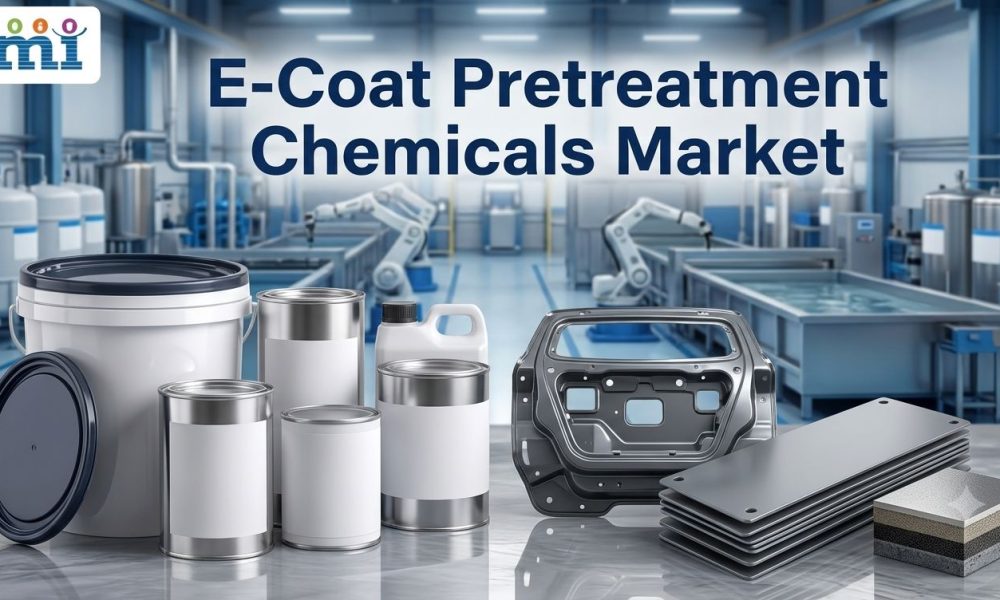
The global E-Coat Pretreatment Chemicals Market is projected to grow from USD 1,460.6 million in 2026 to USD 2,448.0 million by 2036, expanding at a 5.3% CAGR during the forecast period. The market was valued at USD 1,387.1 million in 2025. Demand is being supported by growing vehicle production, mixed-metal body structures, and the need for consistent surface preparation before e-coat application.
Paint shops use cleaning, activation, conversion coating, and rinsing processes to prepare metal surfaces. The pretreatment stage helps control corrosion and supports paint adhesion, while bath chemistry must remain stable across steel, galvanized steel, aluminum, and mixed-metal bodies.
E-Coat Pretreatment Chemicals Market: Key Growth Drivers
Mixed-metal vehicle programs are increasing the need for surface-preparation systems that can treat multiple substrates without affecting corrosion protection or e-coat adhesion.
By chemistry, zinc phosphate pretreatments are expected to hold 34.0% share in 2026, supported by established specifications and corrosion-control requirements. By substrate, steel is expected to account for 38.0% share, while vehicle OEMs are projected to represent 47.0% of end-use demand in 2026.
Get detailed market forecasts, competitive benchmarking, and pricing trends: https://www.futuremarketinsights.com/reports/sample/rep-gb-35462
Zinc Phosphate Maintains Chemistry Leadership
Zinc phosphate remains widely used because its conversion film supports paint adhesion and corrosion resistance. Plants are familiar with its bath-control requirements, making established formulations easier to integrate into existing production systems.
By process stage, conversion coating is expected to account for 33.0% share in 2026. The conversion layer provides an interface between prepared metal and the e-coat layer, making bath control important for consistent surface performance.
Vehicle OEMs Drive End-Use Demand
Vehicle OEM paint shops operate large-volume coating lines under strict corrosion and finish requirements. Model changes can introduce new metal combinations, lubricants, and surface conditions that require additional bath testing.
Vehicle OEMs are projected to account for 47.0% of end-use demand in 2026. Automotive chemical suppliers are expected to lead the sales channel category with 41.0% share, supported by concentrate supply, bath monitoring, technical assistance, and line support.
Mixed-Metal Processing Creates New Opportunities
Surface-preparation suppliers are developing zirconium, silane, titanium, and phosphate-free technologies to address mixed-metal bodies and resource-efficiency requirements. Lower-temperature systems can also create opportunities for plants seeking to reduce energy consumption without changing the complete coating line.
However, chemistry switching can require corrosion testing, adhesion validation, wastewater reviews, and planned production shutdowns. These requirements can extend qualification periods for new pretreatment systems.
Access the Complete Report in PDF Format: https://www.futuremarketinsights.com/reports/brochure/rep-gb-35462
Country Markets Show Different Growth Patterns
Country growth varies across the profiled markets. Mexico is projected to record a 6.0% CAGR, followed by Brazil at 5.7%, Canada at 5.3%, the USA at 5.0%, Germany at 4.7%, France at 4.3%, and Japan at 4.0% through 2036.
Differences reflect automotive production, metal-finishing activity, environmental requirements, and investment in surface-treatment systems. These CAGR figures indicate forecast growth rates and do not represent current revenue size.
Competitive Landscape
The competitive landscape includes Henkel, PPG, Chemetall / Surventis, Nippon Paint Surf Chemicals, Nihon Parkerizing, DuBois Chemicals, Quaker Houghton, Atotech / MKS, SurTec, and Chemische Werke Kluthe.
Competition centers on multi-metal compatibility, corrosion protection, bath stability, e-coat adhesion, wastewater management, and technical support.
“How can a paint shop use less energy without raising corrosion risk? The bath must still meet corrosion limits. Lower-temperature chemistry can cut utility use without adding more process variation.”
— Nikhil Kaitwade, Principal Consultant, Future Market Insights
E-Coat Pretreatment Chemicals Market: Report Scope
The report covers the market by chemistry, substrate, end use, process stage, sales channel, and region. Chemistry includes zinc phosphate, zirconium, titanium, silane, and cleaner-conditioner packages. Substrates include steel, galvanized steel, aluminum, mixed-metal bodies, and light alloys.
The forecast period extends from 2026 to 2036, with market values presented in USD million.
Business Impact
FMI helps organizations transform market complexity into strategic clarity, enabling leadership teams to identify growth opportunities faster, optimize resource allocation, strengthen competitive positioning, and make high-stakes business decisions with confidence.
To explore how FMI Custom Research can support your strategic priorities, please connect with our team at – [email protected]
About Future Market Insights (FMI)
Future Market Insights, Inc. (FMI) is an ESOMAR-certified, ISO 9001:2015 market research and consulting organization, trusted by Fortune 500 clients and global enterprises. With operations in the U.S., UK, India, and Dubai, FMI provides data-backed insights and strategic intelligence across 30+ industries and 1200 markets worldwide.



