
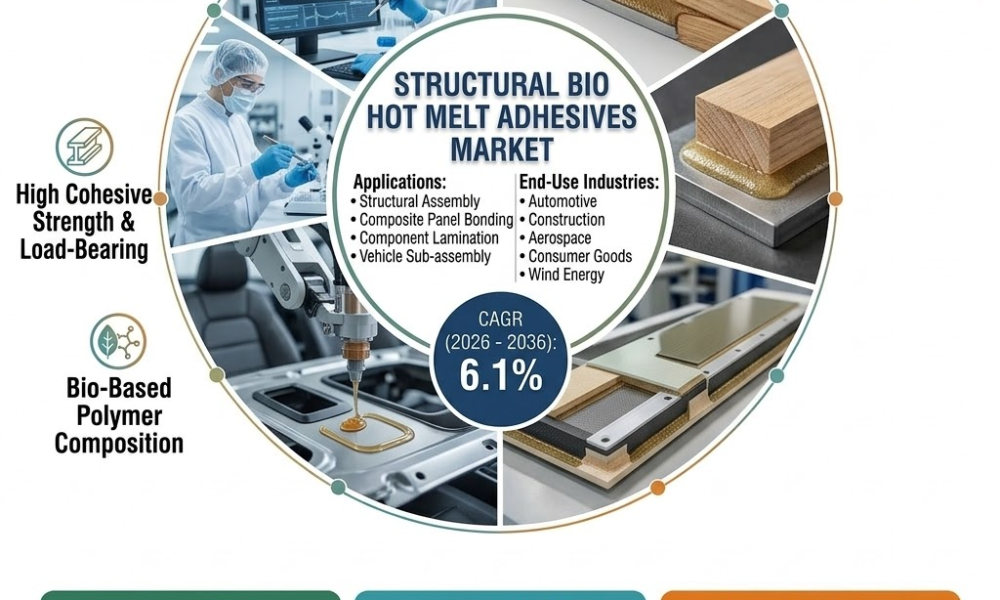
The global Structural Bio Hot Melt Adhesives Market is projected to increase from USD 359.0 million in 2026 to USD 647.8 million by 2036, registering a 6.1% CAGR during the forecast period. The market reached USD 338.4 million in 2025, with an absolute opportunity of USD 288.8 million expected between 2026 and 2036.
Demand is being shaped by manufacturers qualifying renewable-content reactive hot melts for structural bonding lines. Electronics, furniture and woodworking, automotive interiors, footwear and textiles, and packaging are among the applications covered in the market analysis.
Get detailed market forecasts, competitive benchmarking, and pricing trends: https://www.factmr.com/connectus/sample?flag=S&rep_id=16545
Fast-setting performance remains central to adoption
Electronics manufacturers require structural hot melts that provide fast initial setting while continuing to cure after parts are assembled. This combination is relevant for thin devices and automated production lines where limited bond movement and controlled processing are required.
Furniture and woodworking producers use reactive PUR systems where fast handling strength and later heat resistance are important. Profile wrapping and panel bonding are key application areas.
Automotive interior suppliers require bonding solutions for textiles, foams, and plastics. Low-monomer grades may see increased use where plants place greater emphasis on worker exposure and process control.
Footwear and textile manufacturers are also testing bio-based or mass-balance feedstocks. For these applications, adhesives need to maintain flexibility and wash resistance while keeping production line speed close to existing processes.
Packaging represents another important application base. The U.S. Census Bureau reported that seasonally adjusted shipments of paperboard containers reached USD 7.73 billion in January 2026, providing a broad market base for fast-set carton and board bonding.
Reactive PUR leads the PUR platform segment
Reactive PUR is projected to account for 65.0% of the market in 2026, making it the leading PUR platform analyzed by Fact.MR.
Reactive PUR provides initial handling strength as the adhesive cools, followed by moisture-driven crosslinking that produces the final bond. This two-stage process supports durable assembly lines that require parts to move quickly after bonding.
Bio-polyol reactive PUR can introduce bio-based feedstock while retaining a familiar PUR curing route. Other analyzed platforms include low-monomer PUR, polyester-rich PUR, and specialty electronics PUR.
Packaging and paper-board leads structural bonding use
Packaging / paper-board is projected to hold 31.0% share in 2026 within Structural Bonding Use.
Hot melts provide fast-setting bonds on high-speed packaging lines and can bond porous fiber surfaces without a lengthy drying stage. Wood / furniture follows, supported by profile wrapping and panel bonding applications that require heat resistance.
Automotive interiors, electronics assembly, and textiles / footwear represent additional application areas, each with different requirements for flexibility, process control, temperature, and final bond performance.
Moisture cure remains the leading process route
Moisture cure is anticipated to account for 58.0% share in 2026.
One-component reactive polyurethane hot melts can develop handling strength as they cool before continuing to cure after assembly. This makes moisture-cure systems relevant to applications requiring short cycle times.
Fast-set reactive, low-temperature application, micro-emission, and dual-cure / specialty systems are also covered in the market analysis.
Bio-based content adoption is gradual
The <10% bio-based content segment is estimated to hold 30.0% share in 2026.
The report indicates that a modest renewable-content change can be easier to introduce while retaining familiar PUR processing conditions. Higher-content categories, including 10-25%, 26-40%, 41-60%, and >60% / mass-balance, provide pathways for manufacturers seeking greater renewable input and traceable sourcing.
The commercial test for these systems remains whether bio-based content can fit within the same approval window as conventional PUR. According to Shambhu Nath Jha, Principal Consultant at Fact.MR, demand is expected to favor formulations that maintain line speed and bond life close to existing grades.
Country growth varies across key markets
Brazil is forecast to register the highest CAGR among the five profiled countries at 8.2% through 2036, supported by footwear, furniture, and industrial assembly.
Portugal follows at 7.3%, with footwear and textile bonding supporting specialist hot-melt applications.
The United States is expected to record 6.3% CAGR, supported by packaging, electronics, and product assembly. Germany is projected to grow at 5.5%, with automotive interiors and woodworking contributing to reactive PUR demand.
Japan is estimated to register 4.8% CAGR, with precision electronics and automotive assembly supporting controlled hot-melt applications.
Qualification remains a key consideration
Long customer qualification cycles for structural bonds are identified as a restraint, with an estimated -0.5% impact on CAGR. Bio-feedstock variability and formulation control represent another challenge, while heat-sensitive substrates can restrict application temperatures in textiles and electronics.
Opportunities include bio-polyol reactive PUR for qualified assemblies, micro-emission PUR for furniture and automotive interiors, and higher renewable-content textile and footwear laminates.
Competitive landscape
Companies profiled in the report include Henkel, H.B. Fuller, Bostik / Arkema, and KLEIBERIT.
Henkel supplies reactive polyurethane hot-melt adhesives for electronics and industrial assembly. H.B. Fuller offers reactive hot-melt solutions for woodworking, packaging, technical textiles, automotive, and electronics. Bostik / Arkema supplies reactive polyurethane hot-melt systems for textile and flexible-substrate lamination. KLEIBERIT has documented PUR hot-melt adhesives containing non-petroleum-based raw materials.
Report scope
The Structural Bio Hot Melt Adhesives Market covers renewable-content, bio-attributed, or mass-balance hot-applied systems used for durable assembly. Analysis includes PUR Platform, Structural Bonding Use, Cure / Process, Bio-Based Content, and regional markets.
The report covers North America, Latin America, Western Europe, Eastern Europe, East Asia, South Asia & Pacific, and Middle East & Africa. Country-level analysis includes the United States, Germany, Japan, Brazil, and Portugal.
The study uses a hybrid top-down and bottom-up approach based on application demand, reactive PUR use, country manufacturing indicators, segment mix, and provider portfolio review. The analysis draws on 120+ sources, 35+ company portfolios, 25+ countries, and more than 20 industry interviews.
Top Other Reports:
Matrix LED Headlamp Modules Market Forecast 2026-2036: Global Market to Reach 17.4 Billion by 2036 at ~ 9.2 % CAGR
Fire Resistant Glass Market Forecast 2026-2036: Global Market to Reach USD 8.0 million by 2035 at ~ 4.4% CAGR
About (Fact MR)
Fact MR provides market research and business intelligence covering industry trends, demand analysis, market sizing, competitive landscapes, and forecasts across global markets.



