
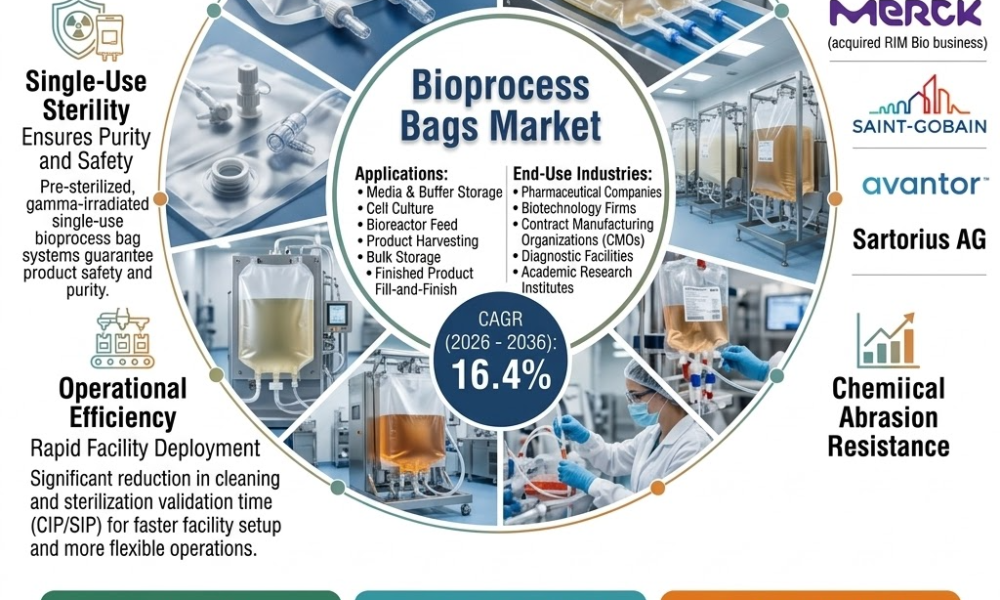
The global bioprocess bags market is projected to reach USD 21.9 billion by 2036, up from USD 4.8 billion in 2026, according to Fact.MR analysis. The market, valued at USD 4.1 billion in 2025, is forecast to expand at a 16.4% CAGR from 2026 to 2036.
An absolute opportunity of USD 17.1 billion is expected during the forecast period. Growth is being supported by the wider use of single-use systems in biologics manufacturing, increasing requirements for sterile fluid storage and transfer, and the need for flexible processing solutions across clinical and commercial production.
Get detailed market forecasts, competitive benchmarking, and pricing trends: https://www.factmr.com/connectus/sample?flag=S&rep_id=3926
Biopharmaceutical manufacturers require sterile bag systems for buffer and media storage, particularly where multi-product facilities frequently change batches. Development teams also need flexible containers for clinical-scale production, while cell therapy operations require closed bags for harvest and hold steps within short manufacturing windows.
The regulatory and manufacturing environment is also supporting demand. The U.S. Food and Drug Administration’s March 2026 therapy-approval report stated that the Center for Drug Evaluation and Research approved 46 novel drugs in 2025. Separately, the European Medicines Agency’s June 2026 annual report stated that the agency recommended 104 human medicines in 2025.
2D Bioprocess Bags Maintain a Major Share
By product, 2D Bioprocess Bags are expected to account for 68.20% of the market in 2026. Their flat format supports storage, freezing and transfer workflows, making them suitable for recurring buffer and media requirements.
Sartorius expanded cleanroom space to around 9,000 square meters at Aubagne in June 2025 for 2D and 3D single-use bags, according to the supplied report material.
By capacity, Small bags are projected to hold 45.20% share in 2026. Their position is linked to research, seed-train and lower-volume clinical applications. Medium and larger formats remain important as production scales, while extra-large bags support bulk holding and transport.
Application demand is led by Buffer and Media Storage, which is anticipated to account for 36.50% share in 2026. Prepared liquids are required across bioprocessing runs, making storage a recurring application.
Within end-use industries, Biotechnology is estimated to represent 35.00% share in 2026. Biologic, vaccine and cell-therapy programs rely on closed liquid-handling systems during development and production.
Qualification and Supply Considerations Remain Important
While closed processing is supporting adoption, suppliers and users continue to face qualification and supply considerations.
Film qualification is identified as a restraint, with a stated -0.8% impact on CAGR. Component supply is another concern, with a -0.6% impact on CAGR. Large-bag handling and disposal pressure also remain relevant considerations.
Shambhu Nath Jha, Principal Consultant at Fact.MR, states:
“The commercial test for bioprocess bags is wider than availability. Users want film qualification and extractables documentation before platform approval. Demand is expected to favor suppliers that connect sterile-bag depth with upstream and downstream support.”
For manufacturers, the report recommends mapping product-contact fluid paths before replacing stainless-steel hold vessels with disposable bags. Suppliers can address qualification requirements by providing film, weld, connector and sterilization documentation in audit-ready formats.
CMOs may also need to qualify alternate film families where material shortages could affect batch schedules. Process engineers can select capacity ranges around actual batch volumes and site handling limitations.
Germany Records the Highest Stated Country CAGR
Germany is expected to record an 18.0% CAGR through 2036, supported by pharmaceutical manufacturing depth and single-use qualification.
Brazil follows with a projected 16.4% CAGR, while the USA is anticipated to advance at 14.8% CAGR. The U.K. is estimated to reach 13.3% CAGR, and Japan is forecast to post 11.7% CAGR.
The report covers North America, Latin America, Western Europe, Eastern Europe, East Asia, South Asia and Pacific, and the Middle East and Africa.
Competitive Landscape
The competitive landscape includes Thermo Fisher Scientific, Sartorius AG, Corning Incorporated, Saint-Gobain, Charter Medical Ltd., Danaher Corporation, Entegris Inc., Merck KGaA and Avantor, Inc. through its acquired RIM Bio business.
These companies participate across single-use bags, films, assemblies, connectors and related bioprocessing systems. Product documentation, material performance, traceability, customization and supply support are among the factors considered within their offerings.
Report Scope
The Bioprocess Bags Market covers sterile single-use flexible bags used to store, transfer, freeze, mix or hold fluids across biopharmaceutical and biotechnology workflows.
The study analyzes the market by product, capacity, application, end-use industry, material, workflow and region. Product categories include 2D and 3D Bioprocess Bags. Capacity categories include Small, Medium, Large and Extra Large.
Applications include Buffer and Media Storage, Cell Culture, Cell Separation and Harvest, Ultrafiltration and Diafiltration, Intermediate and Final Product Hold, and Others.
The analysis is based on 120+ sources, 35+ company portfolios, 25+ countries and more than 20 interviews, covering biopharmaceutical manufacturers, CDMOs, single-use system providers, quality teams and process engineers.
Top Trending Reports:
Asphalt Additives Market Forecast 2026-2036: Global Market to Reach USD 7.0 Bn by 2035 at ~ 3.0 % CAGR
Thermoplastic Vulcanizate Market Forecast 2026-2036: Global Market to Reach USD 3.2 Bn by 2035 at ~ 4.9% CAGR
About (Fact MR)
Fact MR provides market research and business intelligence covering industries, technologies, products and evolving market trends. Its research combines primary interviews, secondary research, company analysis and market forecasting to support business planning and strategic decision-making.



