
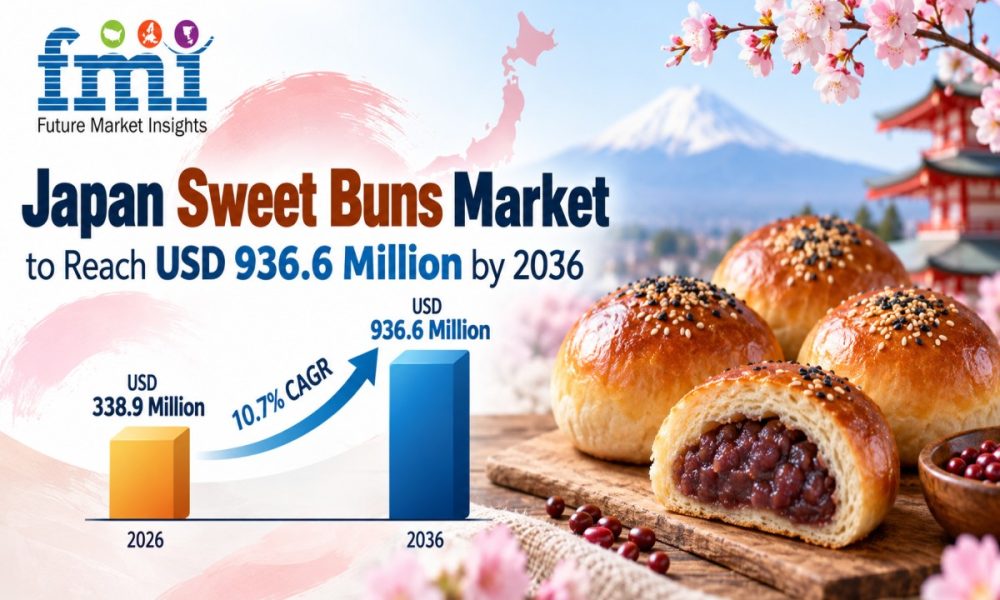
Japan sweet buns market projected to grow from USD 338.9 million in 2026 to USD 936.6 million by 2036 at a 10.7% CAGR, according to Future Market Insights
The Japan Sweet Buns Market is projected to reach USD 936.6 million by 2036, up from approximately USD 338.9 million in 2026, expanding at a 10.7% CAGR during the forecast period, according to the latest analysis by Future Market Insights (FMI).
The market is being supported by sweet buns’ established role in breakfast and snack occasions, continued demand for familiar taste and texture, and the expansion of frozen formats that allow retailers and foodservice operators to manage inventory and production timing more efficiently.
Get Detailed Market Forecasts, Competitive Benchmarking, and Pricing Trends:
https://www.futuremarketinsights.com/reports/sample/rep-gb-34892
Classic – Original Products Anchor the Market
Classic – original sweet buns are projected to account for 37.0% of product type demand in 2026, making them the leading product category.
Familiar dough and filling combinations reduce consumer trial risk and allow retailers to maintain established price points while introducing seasonal or limited-edition variations.
The category benefits from broad usage across breakfast and snack occasions. Manufacturers can also refresh the category through changes in fillings and flavors without fundamentally changing the product format.
Conventional Products Hold the Largest Claim-Nature Share
Conventional products are expected to account for 55.0% of the claim-nature segment in 2026.
Conventional formulations provide manufacturers with greater flexibility in ingredient sourcing and allow products to maintain mainstream pricing.
Frozen Formats Gain Importance
Frozen sweet buns are projected to account for 30.0% of the format segment in 2026, making frozen the leading format.
Frozen products provide retailers and foodservice operators with greater control over inventory and production timing. The format can help separate manufacturing schedules from daily point-of-sale demand.
Supermarkets and Hypermarkets Lead Sales Channels
Supermarkets and hypermarkets are expected to account for 32.0% of sales channel demand in 2026.
Large grocery retailers provide broad assortment depth and allow sweet buns to be merchandised alongside packaged bread, filled bakery products and other everyday food items.
The Japan Chain Stores Association counted 9,479 member stores during 2025, highlighting the scale of organized retail distribution.
Familiar Breakfast and Snack Occasions Support Demand
Sweet buns benefit from established consumption occasions in Japan, particularly breakfast and snack purchasing.
Manufacturers can introduce different fillings, seasonal varieties and package sizes while maintaining a familiar core bakery format.
The continued importance of food in Japanese chain-store purchasing provides a broad retail environment for bakery products. Familiar products can also reduce the consumer education required when launching new variants.
Value-Conscious Consumers Limit Premium Pricing
Household value considerations remain an important market factor.
Higher bakery ingredient and production costs can put pressure on manufacturers’ margins while consumers compare pack sizes and prices more closely.
Frozen and Portion-Controlled Products Create Opportunities
Frozen and portion-controlled formats provide opportunities to improve inventory management and product availability.
Frozen products can help retailers and foodservice operators align production with outlet traffic and reduce the mismatch between manufacturing schedules and daily demand.
The Japan Frozen Food Association reported that household-use frozen-food production increased 2.8% during 2025, providing broader evidence of continued consumer engagement with frozen food formats.
Competitive Landscape
The Japan Sweet Buns Market includes national packaged-bakery manufacturers, specialist sweet-bun producers and regional bakery businesses.
Key companies profiled by FMI include Yamazaki Baking, Fuji Baking, Kimuraya Sohonten, First Baking, Oisis, Nissin Foods, Andersen and Trandor.
Yamazaki Baking and Fuji Baking operate broad packaged-bakery networks, while Kimuraya Sohonten and First Baking maintain established filled-bun and sweet-bread portfolios.
Oisis and Andersen serve regional and bakery-specific channels, while Nissin Foods participates through documented collaborations involving sweet-bun products. Trandor maintains a station-centered bakery network in Kyushu.
Key Industry Developments
Manufacturers continue to introduce seasonal flavors, limited-edition fillings and new variations of established sweet-bun formats.
In August 2025, First Baking announced a September chestnut version of its Kandou Anpan following cumulative series shipments exceeding 4.4 million units.
In March 2025, Kimuraya Sohonten announced the launch of Kochi-yuzu sakadane anpan for its direct-store network, introducing a regional yuzu flavor to an established sweet-bun format.
In February 2025, Fuji Baking announced a roasted-kinako whipped anpan launch as part of its seasonal product series, combining roasted kinako filling with milk whip.
Analyst Perspective
“In Japan, sweet-bun economics depend on keeping softness and filling quality inside the price range shoppers already accept. Retailers should compare rate of sale against markdowns and handling cost before paying for premium fillings or frozen convenience.”— Nandini Roy Choudhury, Principal Consultant, Future Market Insights
Exclusive Discounts on Full Report
Japan Sweet Buns Market – https://www.futuremarketinsights.com/reports/japan-sweet-buns-market
Report Scope
The FMI study covers the Japan Sweet Buns Market by product type, claim-nature, format, packaging format and sales channel.
Product types include classic – original, whole grain & seeded, flavored & filled, mini & snacking formats and premium/artisan.
Claim-nature categories include conventional, clean label, organic, gluten-free and high-protein/fortified.
Formats include frozen, fresh, ambient packaged, chilled and par-baked/thaw-and-serve.
Packaging formats include multipack, single-serve, family/loaf pack and bulk foodservice.
Sales channels include supermarkets and hypermarkets, artisan and specialty bakeries, convenience and forecourt, online and DTC, and foodservice distributors.
The research covers the Japanese market, with the forecast period extending from 2026 to 2036.
FMI’s methodology combines primary and secondary research with market triangulation. The analysis considers consumer purchasing patterns, retail distribution, product launches, packaging formats, frozen-food infrastructure, household spending conditions and company activity to establish market estimates and forecasts.
Key Executive Benefits
- Decision-Ready Insights
· Reduced Strategic Risk
· Market Entry Confidence
· Competitive Advantage
· Faster Growth Decisions
· Primary Market Validation
To explore how FMI Custom Research can support your strategic priorities, connect with our team at [email protected].
About Future Market Insights (FMI)
Future Market Insights, Inc. is an ESOMAR-certified, ISO 9001:2015 market research and consulting organization trusted by Fortune 500 companies. With a global presence across the U.S., UK, India and Dubai, FMI delivers data-driven insights across 30+ industries and 1,200 markets worldwide.



