
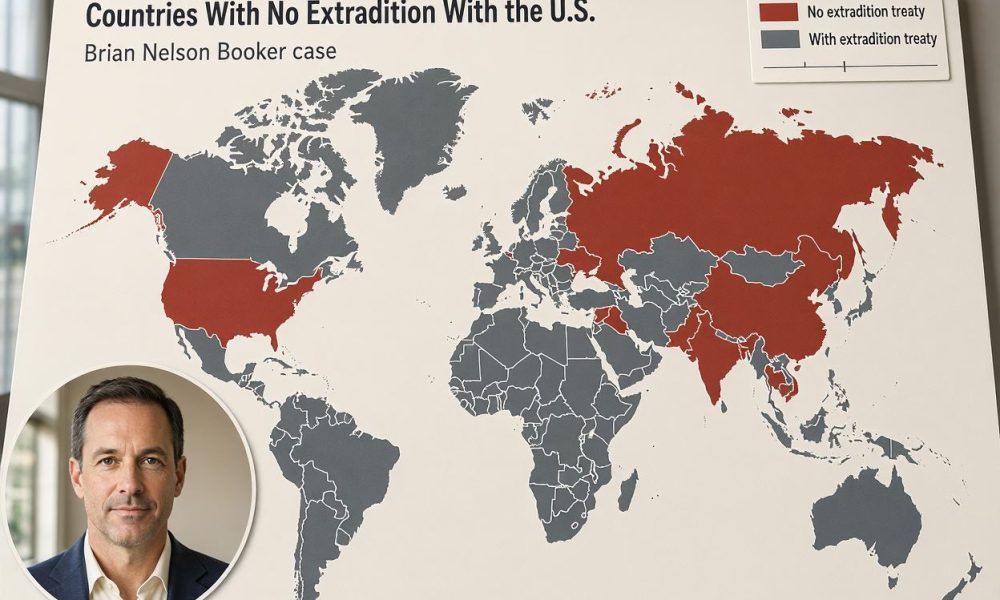
The case moved from foreign detention to federal custody after Belarus ordered his removal in July 2026, ending years beyond American reach and returning a dormant prosecution to an active courtroom in South Florida.
WASHINGTON — Brian Nelson Booker’s return to the United States after Belarus ordered his expulsion transformed a long-running offshore tax prosecution from an unresolved international pursuit into an active federal case, placing the former certified public accountant before an American court nearly a decade after prosecutors say he departed the country.
The decisive development occurred on July 24, 2026, when Booker returned to the United States and was arrested at a Miami airport, following detention in Belarus that began with his arrest there during May 2025 and continued until Belarusian authorities ultimately ordered him removed.
Booker made his first federal court appearance on July 27, according to the Justice Department’s official announcement, which described charges involving unfiled foreign-account reports, false documents submitted to the Internal Revenue Service, and allegedly false statements to the United States.
Although the physical return created a dramatic new chapter, it did not create a new prosecution, because the operative allegations arise from a second superseding indictment returned by a federal grand jury in July 2021 within the Southern District of Florida.
The indictment remains only an accusation; Booker is presumed innocent unless prosecutors prove every charged offense beyond a reasonable doubt, and the government’s description of his movements, financial affairs, professional knowledge, and regulatory filings has not yet been tested through a completed trial.
Expulsion Changed the Case Without Becoming an Extradition
Belarusian expulsion supplied the practical turning point because federal prosecutors could not bring Booker into an American courtroom while he remained abroad, yet the available public record does not characterize the Belarusian action as a completed extradition under a bilateral treaty or judicial surrender order.
That distinction matters because extradition ordinarily concerns one country formally surrendering a wanted person to another through a defined legal process, whereas expulsion describes the removing country’s decision to terminate that person’s presence without necessarily adjudicating the requesting country’s criminal allegations.
The Justice Department has said Booker lived in Russia after leaving the United States and was never ordered extradited from there, while its public account states only that Belarus arrested him, detained him, eventually ordered his expulsion, and preceded his July return.
No publicly released Justice Department narrative identifies the Belarusian statute used, the forum that reviewed his status, the terms of the removal directive, the route of travel, the officials accompanying him, or any diplomatic arrangement behind the transfer.
Responsible reporting therefore stops short of inventing a conventional extradition story, even though the practical outcome resembled surrender in one crucial respect: Booker was again physically available to American authorities, who arrested him when he arrived at the Miami airport.
Specialist coverage from the International Enforcement Law Reporter likewise framed the event as an expulsion followed by a federal appearance, reinforcing why precise terminology is essential when a cross-border removal produces custody without a publicly documented extradition judgment.
A Foreign Detention Became Federal Custody
Booker’s May 2025 arrest in Belarus began a lengthy period of foreign detention whose publicly known details remain limited, but its conclusion altered the government’s enforcement position more dramatically than any new evidentiary development described in the July announcement.
Until his return, the indictment preserved the allegations and allowed the case to remain pending, yet prosecutors still faced the fundamental obstacle that a federal criminal trial generally cannot proceed to a final adjudication while the accused remains unavailable abroad.
Once the expulsion put Booker back on track to return to the United States, the central problem shifted from international access to ordinary federal procedure, including initial appearance, identity confirmation, advisement of charges, representation by counsel, release or detention questions, discovery, motions, and eventual trial preparation.
That procedural shift illustrates why physical jurisdiction can matter as much as the age or complexity of financial evidence, particularly when alleged offenses depend upon banking records, tax submissions, corporate structures, and communications collected years before a defendant is brought before the court.
The July 24 airport arrest also gave the case a clear domestic custody point, allowing prosecutors to reconnect a years-old docket with a living defendant whose presence permits the court to address scheduling, constitutional protections, evidentiary disputes, and the government’s burden.
Nothing about that transition resolves guilt, validates every allegation, or eliminates potential defenses, because a long period outside the country may complicate evidence for both sides and does not reduce the prosecution’s obligation to prove intent and materiality lawfully.
The Indictment Predates the 2026 Return
The second superseding indictment returned in July 2021 charges Booker, formerly a Fort Lauderdale resident, with failing to file Reports of Foreign Bank and Financial Accounts, filing false documents with the Internal Revenue Service, and making false statements, according to the government’s summary.
Prosecutors describe Booker as a former certified public accountant whose business specialized in international trade and who owned Zaandam Trading Company, a cocoa enterprise organized under Panamanian law and allegedly operated from Venezuela, Panama, and his Florida residence.
Those allegations create a cross-border factual setting, but the charged conduct is not based merely upon owning foreign assets or operating internationally, because United States taxpayers may lawfully maintain overseas accounts when they satisfy applicable income-reporting, tax-payment, and information-filing requirements.
Instead, prosecutors claim Booker failed to disclose interests in accounts located in Switzerland, Singapore, and Panama on required annual foreign-account reports covering calendar years 2011 through 2013, while also omitting foreign accounts from individual returns covering tax years 2010 through 2012.
The government must prove the charged statutory elements, including the required mental state for each offense, rather than simply presenting the existence of international accounts as wrongdoing, and Booker retains the right to challenge the evidence, interpretations, witnesses, and inferences offered against him.
Because the 2021 charging document remained pending during Booker’s absence, the July 2026 arrest should be understood as activating courtroom proceedings around an existing accusation, not as prosecutors retroactively criminalizing conduct or announcing an entirely separate tax case.
Why FBAR Allegations Carry Independent Weight
An FBAR is an information report used to disclose qualifying financial interests or authority over foreign accounts when their combined value exceeds the applicable threshold, and its filing obligation exists separately from the annual income-tax return that most taxpayers routinely recognize.
That separation means a taxpayer can face scrutiny over foreign-account reporting even when the underlying money was lawfully earned, just as reporting an account does not automatically resolve all associated income, ownership, control, or tax questions.
In Booker’s case, prosecutors allege failures involving annual reports for three consecutive calendar years, transforming what might appear to outsiders as one continuing financial arrangement into multiple filing events governed by separate deadlines and potentially separate criminal counts.
The government’s theory also depends upon willfulness rather than innocent geography, because maintaining connections with Switzerland, Singapore, Panama, or Venezuela is not itself criminal, while knowingly concealing reportable accounts or deliberately submitting materially false forms can produce substantial federal exposure.
This distinction is especially important for globally mobile entrepreneurs, professional advisers, dual residents, and families using lawful international structures, because accurate citizenship, residency, beneficial-ownership, and tax information must remain consistent across banks, government records, and regulatory submissions.
Amicus International Consulting’s explanation of the compliance function of tax identification numbers emphasizes that cross-border financial access depends upon legally recognized identifiers and regulatory consistency, rather than secrecy claims that misstate a person’s obligations or obscure reportable relationships.
The Streamlined Submission Raises a Different Question
Beyond the annual returns and foreign-account reports, prosecutors accuse Booker of filing a false submission through the Internal Revenue Service Streamlined Domestic Offshore Procedures, a compliance route designed for eligible taxpayers whose earlier reporting failures resulted from non-willful conduct.
The program’s central distinction makes state of mind critical, because taxpayers seeking streamlined treatment certify under penalties of perjury that negligence, inadvertence, mistake, or a good-faith misunderstanding, rather than intentional concealment, explains the historical failures they are correcting.
According to prosecutors, Booker’s submission claimed that his failures to report all income, pay all tax, and provide required information returns, including foreign-account reports, were non-willful, but the indictment alleges that this certification was materially false.
That accusation gives the case importance beyond its underlying account balances, since voluntary-correction systems rely upon truthful narratives from applicants who possess far more direct knowledge of their own communications, professional background, business entities, banking instructions, and prior compliance decisions.
Booker’s former professional status may become relevant to the government’s effort to prove knowledge, yet professional experience cannot substitute for proof of the actual charged intent, and the defense may contest what he understood when particular obligations, forms, and certifications arose.
The trial process, rather than a press release, must determine whether the government can connect documentary evidence and surrounding circumstances to the mental states alleged, while respecting rules governing admissibility, confrontation, materiality, statutory interpretation, and reasonable doubt.
Leaving the United States Became Part of the Narrative
Federal prosecutors allege Booker left the United States during 2016 after learning about the criminal investigation, a chronology they may argue reflects consciousness of exposure, although the ultimate significance and admissibility of any evidence concerning departure will remain matters for litigation.
He subsequently lived in Russia, according to the Justice Department, but no Russian authority ordered his extradition, leaving the American case unresolved while the government preserved its charges and Booker remained beyond the immediate reach of the federal court.
The later move into Belarus changed that equilibrium, because his May 2025 arrest created a new sovereign decision point, followed by detention and an eventual expulsion order that achieved what years of pending charges had not accomplished: his return to American territory.
International mobility can delay a prosecution without extinguishing it, particularly when an indictment remains valid and financial records survive in institutional archives, while border encounters, immigration decisions, and third-country enforcement choices may unexpectedly end an accused person’s period abroad.
For defendants, governments, and advisers, the episode demonstrates why assumptions about permanent safety in any foreign jurisdiction are precarious, because political relationships, immigration status, administrative decisions, travel patterns, and enforcement priorities can change independently of formal extradition arrangements.
Lawful international planning therefore requires more than a passport or residence permission, and Amicus International Consulting’s discussion of second passports and legal identity compliance stresses that citizenship and identity arrangements cannot legitimately erase criminal exposure, financial transparency duties, or reporting requirements.
What the Government Must Prove
The government’s narrative combines offshore accounts, allegedly incomplete filings, a disputed streamlined certification, professional experience, departure from the United States, years in Russia, detention in Belarus, and the eventual Miami arrest, but narrative force alone cannot satisfy the criminal standard.
For the foreign-account counts, prosecutors must establish the applicable reporting duties and the charged willful failures, while the false-document and false-statement allegations require proof tied to the language, materiality, authorship, timing, and state of mind associated with the specific submissions.
Booker may test whether the records prove ownership or authority as alleged, whether the government has accurately interpreted complex financial arrangements, whether statements were materially false, whether any omissions were willful, and whether investigative evidence was lawfully obtained and properly preserved.
The age of the alleged conduct could make those disputes unusually demanding, because witnesses may have faded memories, businesses and financial products may have changed, records may require extensive authentication, and both parties must reconstruct technical transactions across several countries and many years.
Conversely, institutional banking documents, signed tax forms, electronic communications, and government filing systems can preserve evidence long after personal recollections deteriorate, giving prosecutors and defense lawyers durable material from which to build competing accounts of knowledge, control, intent, and disclosure.
Every allegation remains subject to adversarial testing, and neither Booker’s international travel nor Belarus’s expulsion proves the financial charges, just as his return does not prevent him from asserting procedural, factual, constitutional, or statutory defenses in the federal forum.
Potential Penalties Reflect Counts, Not a Predetermined Sentence
The Justice Department states that Booker faces a maximum prison term of five years for each count involving failure to file an FBAR and false statements to the United States, along with three years for each count involving false documents filed with the Internal Revenue Service.
Those figures reflect statutory ceilings rather than a forecast, because any sentence after conviction would depend on the counts sustained, federal sentencing law, advisory guideline calculations, judicial findings, accepted mitigating and aggravating information, and arguments presented by both parties.
Booker could also be acquitted of some or all charges, secure dismissal of particular allegations, reach a negotiated resolution, or pursue appellate review after an adverse judgment, making confident predictions about punishment inappropriate at this preliminary stage.
IRS Criminal Investigation is handling the investigation, Senior Litigation Counsel Sean Beaty is prosecuting the matter, and the Justice Department announcement was made by Assistant Attorney General Colin McDonald of the department’s National Fraud Enforcement Division.
The renewed proceeding will consequently draw attention from tax professionals, international businesses, and compliance advisers because it combines familiar foreign-account obligations with the less common allegation that a taxpayer falsely claimed eligibility for a corrective program based upon non-willful conduct.
Belarus Supplied the Jurisdictional Turning Point
The most consequential fact in the latest chapter is not a new bank record or an additional count, but a sovereign removal decision in Belarus that ended foreign detention and placed Booker within reach of the federal court handling his existing prosecution.
That outcome highlights the operational difference between identifying an accused person abroad and securing a courtroom appearance, since investigators may know where someone is located but lack a legal, political, or practical mechanism to promptly produce physical custody.
Belarus’s order changed that reality without publicly resolving the underlying tax allegations, and the Miami arrest converted an overseas enforcement story into a domestic criminal process governed by federal evidentiary rules, constitutional safeguards, judicial supervision, and the presumption of innocence.
The case will now proceed on the strength of admissible evidence rather than the drama of international movement, with prosecutors bearing the burden of proving the charged offenses and Booker entitled to confront the allegations through counsel in open court.
For observers, the durable lesson is that expulsion, extradition, deportation, and voluntary return are not interchangeable labels, even when each can end with the same practical scene: an accused person entering United States jurisdiction and facing an indictment that remained waiting.
Booker’s July 2026 return closed the international-custody phase but opened the decisive judicial phase, where the years-old allegations concerning foreign accounts, tax returns, information reports, and his streamlined certification will finally encounter formal testing before a federal court.




