
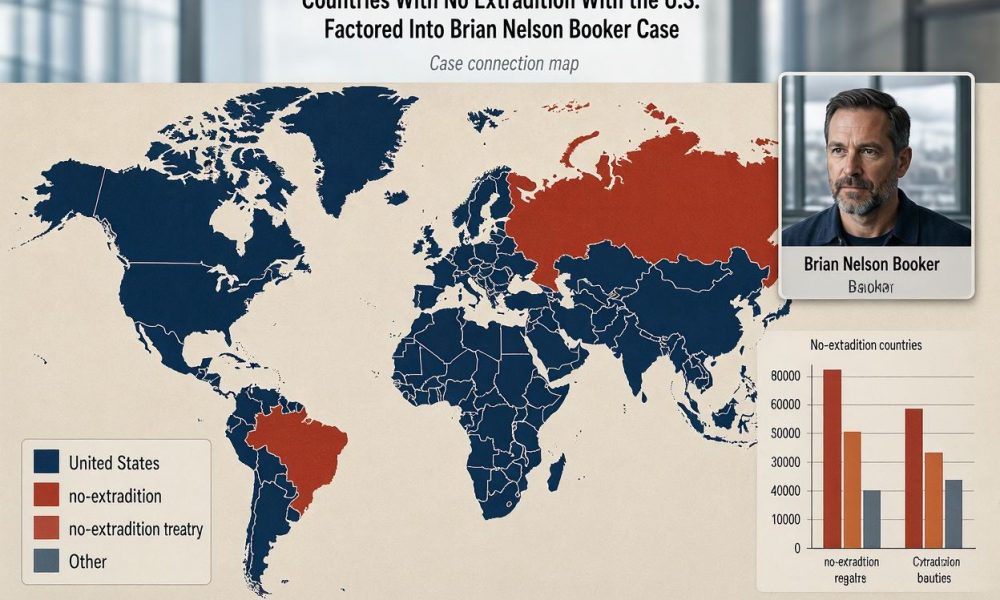
Prosecutors say Russia and Belarus shaped the fugitive timeline before Booker was returned to United States custody, demonstrating how the absence of a conventional extradition route can delay a prosecution without permanently defeating federal jurisdiction.
WASHINGTON — Brian Nelson Booker’s years outside the United States placed countries lacking conventional American extradition arrangements at the center of his federal tax case, yet his eventual return from Belarus showed why treaty status alone cannot guarantee lasting protection from prosecution.
Federal prosecutors say Booker left the United States during 2016 after learning about a criminal investigation, later lived in Russia without being ordered extradited, was arrested in Belarus in May 2025, and returned through Miami on July 24, 2026.
That multinational timeline turned an offshore financial investigation into a prolonged jurisdictional problem: the government could maintain charges and collect evidence while Booker remained abroad, but prosecutors still needed his physical presence before an American criminal trial could meaningfully advance.
The Justice Department’s account of Booker’s return carefully states that Russia never ordered his extradition and Belarus eventually ordered his expulsion, language that distinguishes a treaty-based surrender from other sovereign methods capable of producing federal custody.
Booker’s second superseding indictment contains allegations rather than established facts; he remains presumed innocent unless convicted beyond a reasonable doubt, and neither his residence abroad nor the country he selected independently proves any charged tax or reporting offense.
Russia Supplied the Long Delay
Russia became the most consequential jurisdiction during the extended middle period because prosecutors say Booker lived there after leaving the United States, while American authorities lacked a completed extradition order to place him before the Southern District of Florida court.
The United States and Russia do not maintain a modern bilateral extradition treaty providing the routine legal architecture available between Washington and many allied governments, leaving surrender questions heavily influenced by domestic law, diplomatic relations, political judgment, and sovereign discretion.
Absence of a treaty did not erase the American indictment, cancel federal jurisdiction, invalidate financial records, or create a legal right to remain beyond prosecution, but it complicated the government’s ability to turn an accusation preserved on a docket into an active courtroom case.
For an accused person abroad, that difference can be decisive for years because prosecutors may know the person’s location yet remain unable to secure custody, especially when the host government has no legal obligation or political interest supporting a formal transfer.
Booker’s Russian residence therefore mattered less as geography than as a practical barrier between federal charging authority and physical jurisdiction, demonstrating how a criminal case can remain legally alive while appearing operationally frozen because its defendant stays outside American territory.
The public record does not disclose a Russian extradition hearing, an unsuccessful treaty petition, a surrender order, or a Russian judgment rejecting American evidence, so responsible analysis should not convert the absence of transfer into an invented formal legal defeat.
No Treaty Does Mean No Return
Countries described as having no extradition treaty with the United States are often portrayed as permanent refuges, but that shorthand ignores immigration enforcement, expulsion, deportation, host-country prosecution, voluntary departure, third-country travel, and case-specific diplomatic cooperation.
A treaty supplies procedures, evidentiary requirements, eligible offenses, defenses, and institutional channels for surrender, whereas its absence ordinarily removes a predictable pathway without preventing every lawful mechanism through which a person can leave the host jurisdiction and enter American custody.
Governments retain sovereign authority over admission, residence permissions, visa compliance, national security, public order, and immigration violations, allowing them to remove foreign nationals for reasons distinct from the criminal allegations advanced by prosecutors in another country.
Movement also creates independent risk because a person protected from formal surrender in one jurisdiction may enter another country that maintains stronger American law-enforcement cooperation, recognizes provisional arrest requests, or applies its own statutory basis for extradition or removal.
Changing political relationships can similarly transform practical exposure without amending any treaty, since a government that once tolerated a foreign resident may later reconsider that person’s status after elections, diplomatic disputes, security assessments, immigration reviews, or bilateral negotiations.
Amicus International Consulting’s overview of extradition and international surrender procedures explains the formal distinction between locating a wanted person and completing the legal process required for surrender, a difference vividly reflected throughout Booker’s years outside American custody.
Belarus Changed the Geography and the Outcome
Booker’s appearance in Belarus altered the case’s structure because the Justice Department says he was arrested there in May 2025, detained for an extended period, and eventually ordered expelled before returning to the United States in July 2026.
Belarus, like Russia, is commonly discussed among jurisdictions lacking a conventional bilateral extradition treaty with the United States, yet its authorities did not need to conduct an American-style extradition case before making an independent decision about Booker’s continued presence.
The publicly disclosed result was expulsion rather than treaty extradition, a distinction that preserved Belarusian control over its immigration decision while producing the practical outcome American prosecutors needed: Booker’s physical availability for arrest when he reached the Miami airport.
No public Justice Department statement identifies the Belarusian statute involved, the court or agency reviewing his detention, any appeal, the destination specified in the expulsion order, the travel route, an escort arrangement, or diplomatic terms governing his return.
Those missing details prevent definitive conclusions about whether American authorities requested a particular outcome, whether Belarus selected the United States as the destination, or whether other administrative and logistical decisions shaped the path from foreign detention to Miami custody.
What can be stated confidently is narrower but significant: Russia had not delivered Booker through extradition, Belarus later detained and expelled him, and federal agents arrested him after his July 24 arrival within the territorial jurisdiction of the United States.
Extradition and Expulsion Serve Different Legal Purposes
Formal extradition asks a requested country to surrender someone for prosecution or punishment based upon alleged conduct identified by the requesting government, usually through treaty rules that address documentation, criminality, specialty, timing, and available objections.
Expulsion generally concerns the host country’s determination that a noncitizen must leave its territory, meaning the legal focus may involve immigration status or sovereign authority rather than judicial evaluation of whether the foreign criminal case justifies extradition.
The destination can nevertheless produce consequences resembling extradition when an expelled person travels directly into the requesting country’s reach, even though the removing government may never have adjudicated probable cause, evidentiary sufficiency, or treaty eligibility for the foreign charges.
That functional overlap can create misleading headlines unless journalists preserve the distinction, because saying Belarus extradited Booker would imply a publicly undocumented surrender process, while saying Belarus expelled him accurately tracks the terminology used by federal prosecutors.
Specialist reporting by the International Enforcement Law Reporter similarly described Booker’s return as following Belarusian expulsion, reinforcing that the custody outcome should not rewrite the legal character of the preceding foreign action.
Precision matters beyond semantics because the legal protections, decision-makers, available appeals, documentary burdens, and future precedential value can differ substantially between extradition proceedings and administrative removal, even when both processes ultimately place an accused person before the same court.
The Timeline Began Before Any Indictment Was Active in Court
Prosecutors allege Booker left the United States after learning about the investigation in 2016, while earlier charging documents placed the relocation on or about December 28, giving the government a chronology it may seek to connect with knowledge and intent.
Departure itself is not an offshore-reporting crime, however, and the defense may challenge any inference that travel demonstrates consciousness of guilt by presenting alternative explanations involving business, residence, family, health, personal security, or other circumstances supported by admissible evidence.
The federal docket later moved into fugitive status in 2019, while a grand jury returned the operative second superseding indictment in July 2021, meaning the prosecution continued through successive stages even though Booker remained physically unavailable abroad.
That indictment charges failures to file Reports of Foreign Bank and Financial Accounts, false documents allegedly submitted to the Internal Revenue Service, and false statements, rather than creating a separate criminal offense based simply upon residence in Russia or Belarus.
Prosecutors describe Booker as a former certified public accountant who owned a Panamanian cocoa trading company operated from Venezuela, Panama, and Florida, a business background that placed international activity within the factual narrative long before his years abroad became the enforcement focus.
The government must still prove each charged filing offense through the relevant forms, duties, deadlines, alleged omissions, material statements, and required mental states, without relying on the dramatic international timeline as a substitute for evidence establishing the underlying financial accusations.
Offshore Accounts Created the Original Case
According to prosecutors, Booker failed to disclose interests in financial accounts located in Switzerland, Singapore, and Panama on annual foreign-account reports for calendar years 2011 through 2013, while individual returns covering 2010 through 2012 omitted foreign accounts.
Owning an overseas account, trading internationally, maintaining foreign insurance products, or operating a Panamanian company is not inherently criminal because United States taxpayers may use lawful cross-border structures when they accurately address their income, ownership, authority, and reporting obligations.
The criminal allegations instead depend upon willfulness and falsity, requiring the government to show that particular omissions or representations crossed the line separating mistake, negligence, misunderstanding, and incomplete advice from conduct prohibited by the charged federal statutes.
Booker is also accused of filing a false submission through the Streamlined Domestic Offshore Procedures, which offered eligible taxpayers a route for correcting certain past failures when those failures resulted from non-willful conduct rather than intentional evasion.
Prosecutors allege his streamlined certification falsely attributed failures involving income, taxes, information returns, and foreign-account reports to non-willful conduct, making his description of prior intent a distinct evidentiary issue alongside the original filings themselves.
That allegation may place professional experience, communications with advisers, banking instructions, corporate records, tax returns, and the language of the certification before the court, but Booker can contest the government’s interpretation and require proof beyond a reasonable doubt.
International Mobility Became a Point of Vulnerability
The transition from Russia to Belarus demonstrates why a person’s position can become more precarious when movement replaces stable residence, because every border crossing introduces a new country’s immigration law, law-enforcement relationships, databases, and sovereign choices.
Even neighboring countries with similar political orientations or similarly limited American treaty relationships may reach different decisions about the same traveler, since extradition policy does not automatically determine visa validity, detention authority, expulsion discretion, or willingness to cooperate informally.
Booker’s case does not reveal why he entered Belarus, what travel documents he used, how authorities identified him, whether a notice prompted the arrest, or which agencies communicated, making speculation about tracking technologies or international alerts unsupported by the released record.
The known sequence still illustrates the broader principle that a non-treaty country is not a protective bubble extending beyond its borders, because the practical advantage can disappear once the person travels, loses lawful status, or becomes subject to another sovereign decision.
Amicus International Consulting’s analysis of whether a person can still be returned despite possessing another identity underscores that passports, citizenship documents, aliases, and residence rights do not automatically defeat valid criminal proceedings or cross-border enforcement mechanisms.
For lawful travelers, the same lesson supports consistent documentation and accurate disclosure, while anyone facing charges requires qualified legal counsel rather than assumptions based upon online lists that label entire countries safe, inaccessible, cooperative, or permanently beyond American reach.
Sovereign Discretion Filled the Treaty Gap
The Booker timeline reveals how sovereign discretion can matter more than a static treaty chart, because Russia’s absence of an extradition order prolonged his time abroad, while Belarus’s independent expulsion decision ultimately ended the government’s physical-access problem.
Neither development proves a secret agreement, political exchange, intelligence operation, or informal extradition, and the scarcity of official detail makes it especially important to separate observable results from imagined negotiations occurring behind closed diplomatic or security channels.
Countries without formal treaties may still share information, enforce domestic immigration law, prosecute local offenses, revoke status, deny entry, arrange voluntary departures, or tolerate onward travel, creating multiple outcomes that treaty status alone cannot predict.
Conversely, an extradition treaty does not guarantee surrender because defendants may raise identity, evidence, limitation, double-criminality, political-offense, human-rights, nationality, procedural, or specialty issues, depending on the agreement and the law of the requested country.
The meaningful question is therefore not simply whether a treaty exists, but whether the person is lawfully present, whether the host government will act, what domestic procedures apply, whether travel creates exposure elsewhere, and what outcome current diplomatic conditions support.
Booker’s movement across Russia, Belarus, and the United States offers a concrete example of that layered reality, showing that international custody depends upon intersecting legal systems rather than a single binary label dividing extradition and non-extradition countries.
Return Shifted Attention From Geography to Evidence
Once Booker arrived in Miami and federal agents arrested him, the strategic importance of treaty geography diminished because the Southern District of Florida could proceed through familiar stages involving counsel, discovery, motions, evidentiary challenges, scheduling, and trial preparation.
His first federal appearance followed on July 27, according to the Justice Department, bringing the pending 2021 indictment into an adversarial courtroom governed by constitutional protections and federal procedural rules.
The government may present the departure and foreign timeline as contextual evidence, but it must still establish every element of the charged reporting and false-statement offenses, while the defense can challenge relevance, admissibility, intent, materiality, and the reliability of historical records.
Years of delay may complicate testimony because memories fade and participants become difficult to locate, although bank documents, filed returns, electronic communications, corporate records, and government databases may preserve important evidence more reliably than personal recollection.
The Justice Department states that each charged failure to file an FBAR and each false statement carries a potential maximum of five years, while each charged false document filed with the Internal Revenue Service carries a potential maximum of three years.
Those maximum penalties are not predictions, because any eventual punishment depends on convictions, sentencing law, guideline calculations, judicial findings, mitigation, aggravation, and arguments from both sides, while acquittal or dismissal remains legally possible.
The Case Undercuts the Myth of Permanent Safe Havens
Booker’s extended period abroad shows that countries without United States extradition treaties can significantly delay access, but his eventual arrest shows equally clearly that delay should never be confused with immunity, dismissal, asylum, or permanent defeat of federal charges.
Russia shaped the timeline by providing the setting where he lived without an extradition order, Belarus reshaped it by detaining and expelling him, and Miami completed the jurisdictional transition when American agents took him into custody after arrival.
That sequence offers no basis for declaring every non-treaty jurisdiction cooperative or hostile, because individual outcomes depend upon nationality, immigration status, alleged offenses, evidence, domestic law, political relationships, travel choices, and decisions that governments may reconsider over time.
It also provides no proof of guilt, since international movements and custody decisions cannot establish whether Booker knowingly failed to file required reports, submitted materially false tax documents, or falsely characterized earlier conduct in his streamlined certification.
The decisive phase now concerns proof rather than refuge, requiring prosecutors to translate a complicated multinational narrative into admissible evidence while allowing Booker to confront witnesses, dispute records, present defenses, and invoke the presumption of innocence.
Countries with no conventional extradition arrangements undeniably factored into the Brian Nelson Booker case, but the final lesson is cautionary: borders and treaty gaps can postpone accountability proceedings, while sovereign discretion and later travel can abruptly return them to court.




