
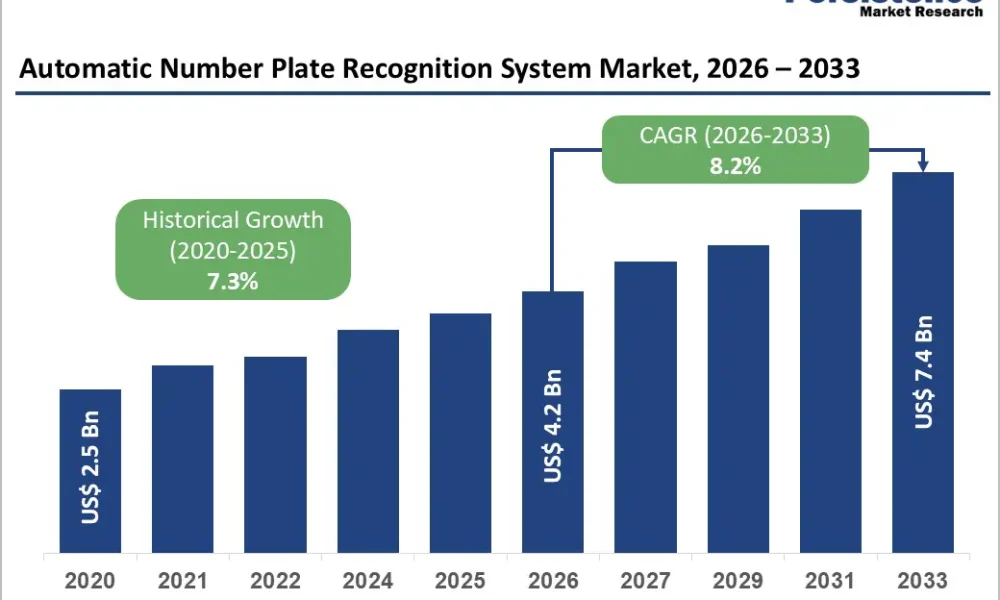
The global Automatic Number Plate Recognition (ANPR) system market is undergoing a transformative phase, driven by the convergence of urbanization, smart mobility, and advanced digital technologies. As cities across the globe grapple with rising traffic congestion, security challenges, and infrastructure demands, ANPR systems have emerged as a critical solution for modern transportation and surveillance ecosystems.
Valued at US$ 4.2 billion in 2026, the ANPR market is projected to reach US$ 7.3 billion by 2033, expanding at a steady CAGR of 8.2% during the forecast period. This growth trajectory reflects the increasing reliance on automated systems for traffic enforcement, vehicle tracking, and smart city integration.
Understanding ANPR Systems and Their Role
Automatic Number Plate Recognition systems use optical character recognition (OCR) technology to detect and read vehicle license plates from images or video streams. These systems combine high-resolution cameras, advanced software algorithms, and centralized databases to deliver real-time vehicle identification.
ANPR technology plays a vital role in:
- Traffic law enforcement
- Toll collection automation
- Crime prevention and investigation
- Parking management systems
- Border and access control
By eliminating manual intervention, ANPR systems improve operational efficiency, accuracy, and scalability across multiple sectors.
Key Market Drivers
Rising Urban Traffic Congestion
One of the most significant factors driving ANPR adoption is the rapid increase in urban traffic congestion. With over 55% of the global population currently living in urban areas—expected to rise to 68% by 2050—cities are under immense pressure to optimize traffic flow.
ANPR systems enable real-time traffic monitoring, automated violation detection, and e-challan generation. Governments in major cities are integrating ANPR into intelligent transportation systems (ITS), allowing authorities to:
- Reduce congestion by up to 30%
- Optimize traffic signal timing
- Improve road safety compliance
Growing Security and Law Enforcement Needs
Vehicle-related crimes, including theft and illegal activities, have increased globally, pushing law enforcement agencies to adopt advanced surveillance technologies. ANPR systems allow authorities to instantly scan license plates and cross-reference them with criminal databases.
Countries like the United States and the United Kingdom have already deployed extensive ANPR networks, capturing millions of vehicle records daily. These systems significantly enhance the ability to:
- Track stolen vehicles
- Identify suspects
- Reconstruct crime scenes
The proven effectiveness of ANPR in crime prevention continues to drive its adoption worldwide.
Government Investments in Smart Cities
Governments are heavily investing in smart city initiatives, where ANPR systems serve as foundational components. These initiatives focus on integrating digital technologies into urban infrastructure to improve efficiency, sustainability, and citizen services.
Regions such as Asia-Pacific are witnessing rapid growth due to large-scale smart city programs in countries like India and China. These projects rely on ANPR for traffic management, surveillance, and public safety.
Market Restraints
Data Privacy and Regulatory Challenges
Despite its benefits, ANPR technology raises significant concerns regarding data privacy and surveillance. License plate data is considered sensitive information, especially in regions with strict regulations.
For instance, the General Data Protection Regulation (GDPR) in Europe imposes strict guidelines on data collection, storage, and usage. Non-compliance can result in heavy penalties, increasing the operational burden on companies.
Privacy advocacy groups have also raised concerns about mass surveillance and potential misuse of data, which may hinder adoption in certain regions.
High Initial Investment and Complexity
The deployment of ANPR systems requires substantial capital investment. Costs include:
- High-performance cameras
- Software licensing
- Infrastructure setup
- Integration with existing systems
Additionally, integrating ANPR with legacy infrastructure can be complex and time-consuming. Continuous software updates and maintenance further add to the total cost of ownership, particularly for smaller municipalities.
Elevate your business strategy with comprehensive market data. Request a sample report now: https://www.persistencemarketresearch.com/samples/19813
Emerging Market Opportunities
Integration with Artificial Intelligence and Machine Learning
The integration of artificial intelligence (AI) and machine learning (ML) is revolutionizing ANPR systems. Modern solutions leverage deep learning algorithms to enhance accuracy and adaptability.
AI-powered ANPR systems can:
- Recognize plates from over 160 countries
- Operate effectively in low-light and adverse weather conditions
- Improve accuracy rates beyond 95%
These advancements are expanding the scope of ANPR applications beyond traditional use cases.
Growth of Smart Parking Solutions
Smart parking is emerging as a high-growth segment within the ANPR market. With increasing vehicle density in urban areas, efficient parking management has become a necessity.
ANPR-enabled parking systems offer:
- Ticketless entry and exit
- Automated billing through license plate recognition
- Real-time parking availability updates
These systems reduce traffic caused by parking searches and enhance user convenience, making them attractive for commercial and residential applications.
Segment Analysis
By Product Type
Fixed ANPR systems dominate the market, accounting for approximately 58% share. These systems are installed at strategic locations such as highways, toll booths, and city entry points.
Their advantages include:
- High accuracy
- Continuous operation
- Robust performance in harsh conditions
By Component
ANPR systems consist of hardware and software components:
- Cameras lead the hardware segment with around 53% share
- Software is the fastest-growing segment, driven by AI, cloud computing, and data analytics
Modern software solutions enable seamless integration, real-time processing, and advanced analytics capabilities.
By Application
Traffic management is the largest application segment, holding about 43% market share. ANPR systems help enforce traffic laws, monitor congestion, and improve road safety.
Other applications include:
- Electronic toll collection
- Parking management
- Border control
- Fleet management
By End-User
Government agencies dominate the market, contributing nearly 55% of total demand. Their investments are primarily focused on:
- Law enforcement
- National security
- Infrastructure development
Private sector adoption is also growing, particularly in industries requiring secure access control.
Regional Insights
North America
North America leads the global ANPR market with approximately 38% share. The region benefits from:
- Advanced infrastructure
- Strong law enforcement adoption
- High government spending
The United States is the largest contributor, with widespread deployment across cities and highways.
Europe
Europe represents a mature market characterized by strict regulatory frameworks and extensive deployment. Countries such as the UK, Germany, and France have implemented large-scale ANPR networks.
However, data privacy regulations like GDPR play a significant role in shaping market dynamics.
Asia-Pacific
Asia-Pacific is the fastest-growing region, with a projected CAGR of 10.8%. Growth is driven by:
- Rapid urbanization
- Increasing vehicle ownership
- Government-led smart city initiatives
India, in particular, presents strong growth potential with its Smart Cities Mission and increasing adoption of digital traffic management systems.
Competitive Landscape
The ANPR market is highly competitive and fragmented, with several global and regional players striving to expand their market presence. Key companies include:
- Kapsch TrafficCom
- Siemens
- Conduent Inc.
- HikVision
- Genetec Inc.
- Axis Communications
- Bosch Security Systems
These companies focus on innovation, strategic partnerships, and mergers & acquisitions to strengthen their capabilities.
Recent developments highlight the industry’s focus on:
- AI-driven solutions
- Cloud-based platforms
- Enhanced recognition accuracy
Future Outlook
The future of the ANPR market is closely tied to the evolution of smart cities, autonomous vehicles, and digital infrastructure. As governments and private organizations continue to invest in intelligent systems, ANPR technology will play a crucial role in shaping modern transportation ecosystems.
Key trends expected to influence the market include:
- Increased adoption of cloud-based ANPR solutions
- Expansion into new applications such as logistics and smart surveillance
- Integration with IoT and big data analytics
- Greater emphasis on data security and compliance
Conclusion
The Automatic Number Plate Recognition system market is poised for steady growth, driven by rising urban challenges, technological advancements, and increasing demand for intelligent solutions. While data privacy concerns and high costs present challenges, ongoing innovation and government support are expected to sustain market expansion.
As cities continue to evolve into smart, connected ecosystems, ANPR systems will remain a cornerstone of efficient traffic management, enhanced security, and seamless urban mobility.
Related Reports:




