
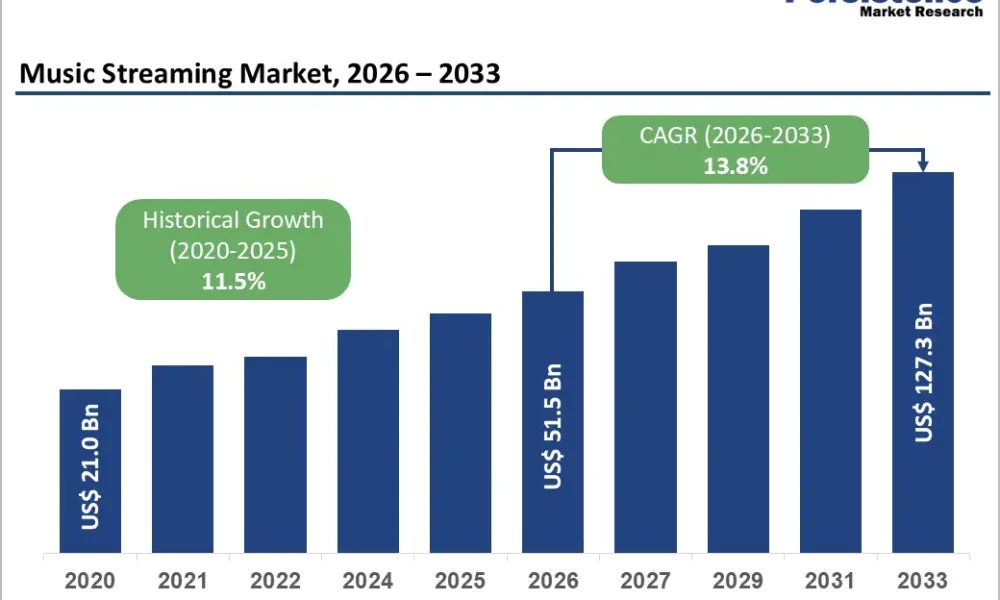
The global music streaming market is experiencing a powerful evolution, reshaping how audiences discover, access, and engage with music. Valued at US$ 51.5 billion in 2026, the market is projected to reach US$ 127.3 billion by 2033, expanding at a CAGR of 13.8%. This growth reflects a fundamental shift from traditional music ownership to on-demand, subscription-based consumption.
Platforms like Spotify, Apple Music, and Amazon Music are redefining the industry by offering personalized, accessible, and high-quality listening experiences. With the proliferation of smartphones and high-speed internet, music streaming has become an integral part of everyday digital life.
Market Overview: The Rise of Streaming as the Dominant Format
Music streaming now dominates the global recorded music industry, accounting for the majority of revenues worldwide. Consumers increasingly prefer access over ownership, valuing convenience, variety, and personalization over physical or downloaded formats.
Key benefits driving adoption include:
- Instant access to millions of songs
- Personalized playlists and recommendations
- Offline listening capabilities
- Multi-device synchronization
- Affordable subscription models
This transformation is not only redefining consumption but also reshaping the broader music ecosystem, including artist monetization, content creation, and distribution strategies.
Key Market Trends Shaping the Industry
- AI-Driven Personalization Enhancing User Experience
Artificial intelligence has become the backbone of modern streaming platforms. Services like Spotify use advanced algorithms to curate personalized playlists such as Discover Weekly and Release Radar, enhancing user engagement and retention.
AI enables platforms to:
- Analyze listening habits and preferences
- Recommend new artists and genres
- Create mood-based and activity-based playlists
- Improve content discovery
This hyper-personalization keeps users engaged and increases subscription conversion rates.
- Rapid Growth of Podcasts and Audio Content
Podcasting is emerging as the fastest-growing segment within the music streaming ecosystem, with growth exceeding 20% CAGR. Platforms are investing heavily in exclusive podcast content to diversify offerings and attract new audiences.
For instance, Spotify has made significant investments in podcast acquisitions and original productions, positioning itself as a leading audio platform rather than just a music service.
This trend reflects changing consumer behavior, with users increasingly consuming spoken-word content during commuting, exercising, and multitasking.
- Expansion of High-Fidelity and Spatial Audio
Premium audio experiences are becoming a key differentiator. Apple Music has introduced lossless and spatial audio features, while platforms like Tidal focus on high-fidelity sound quality.
These innovations cater to audiophiles and premium users willing to pay more for superior listening experiences. As hardware ecosystems improve, demand for immersive audio is expected to rise significantly.
- Integration with Smart Devices and Ecosystems
Music streaming is no longer confined to smartphones. Integration with smart speakers, wearables, connected cars, and home automation systems is expanding usage scenarios.
For example:
- Smart speakers enable voice-controlled playback
- Car infotainment systems provide seamless streaming on the go
- Wearables support fitness-based music experiences
This ecosystem integration enhances accessibility and drives continuous engagement.
Elevate your business strategy with comprehensive market data. Request a sample report now: https://www.persistencemarketresearch.com/samples/24589
Market Drivers: What’s Fueling Growth?
Proliferation of Smartphones and High-Speed Internet
The rapid adoption of smartphones and expansion of 4G/5G networks are the primary drivers of the music streaming market. These technologies enable seamless, high-quality streaming experiences across geographies.
Global streaming revenues have crossed US$ 20 billion, reflecting widespread adoption and increasing reliance on digital platforms for music consumption.
Shift from Ownership to Subscription Models
Consumers are moving away from purchasing albums and downloads toward subscription-based services. This shift is driven by:
- Cost-effectiveness of subscriptions
- Access to vast music libraries
- Convenience and flexibility
The success of Spotify, which reported hundreds of millions of active users, highlights the sustainability of this model.
Growing Youth Population and Digital Engagement
Younger demographics are at the forefront of streaming adoption. Their preference for digital-first experiences, social sharing, and content discovery fuels continuous growth.
Emerging markets with large youth populations, such as India and Indonesia, are particularly important growth drivers.
Market Restraints: Challenges Facing the Industry
Market Saturation in Developed Regions
In mature markets like North America and Europe, growth is slowing due to high penetration rates. Leading players already dominate these regions, leaving limited room for new entrants.
This saturation leads to:
- Intense price competition
- Slower subscriber growth
- Increased customer acquisition costs
Artist Compensation and Royalty Issues
The distribution of streaming revenues remains a contentious issue. Many artists argue that royalty payments are insufficient, particularly for emerging creators.
This has led to:
- Calls for regulatory intervention
- Platform criticism and reputational risks
- Occasional content withdrawal by artists
Balancing profitability with fair compensation remains a key challenge for the industry.
Market Opportunities: Unlocking Future Potential
Expansion into Emerging Markets
Asia-Pacific and Latin America present significant growth opportunities due to:
- Rising smartphone penetration
- Affordable mobile data
- Expanding middle-class populations
Platforms are leveraging localized content, regional pricing, and telecom partnerships to capture these markets.
AI, Creator Economy, and Monetization Tools
The rise of the creator economy is opening new revenue streams. Platforms are introducing tools that enable artists to:
- Monetize directly through subscriptions and tips
- Engage with fans via live sessions
- Access analytics for audience insights
AI-driven tools further enhance content creation and audience targeting.
Immersive and Interactive Experiences
Future growth will be driven by innovations such as:
- Virtual concerts and live streaming events
- Social listening features
- Collaborative playlists
These features enhance user engagement and create new monetization opportunities.
Segment Analysis
By Type: On-Demand Streaming Leads
On-demand streaming dominates the market, accounting for approximately 60–85% of total share. Consumers prefer the flexibility to choose what they want to listen to, when they want.
Platforms like Amazon Music and Apple Music excel in delivering seamless on-demand experiences.
By End User: Residential Segment Dominates
Residential users account for nearly 90% of consumption. Streaming has become a daily activity for entertainment, relaxation, and social interaction.
Family plans, student discounts, and bundled services are driving adoption in this segment.
By Content Type: Audio Remains Core
Audio streaming continues to dominate, holding around 75% market share. However, podcasts and audiobooks are rapidly gaining traction, expanding the scope of streaming platforms beyond music.
Regional Insights
North America: Market Leader
North America holds approximately 35% of the global market, driven by:
- High subscription adoption
- Advanced digital infrastructure
- Strong presence of major players
Despite maturity, innovation in premium features continues to sustain growth.
Europe: Strong and Stable Growth
Europe remains a key market with diverse linguistic and cultural dynamics. Platforms invest heavily in localized content to cater to regional audiences.
Regulatory frameworks also shape market operations, ensuring fair competition and data protection.
Asia-Pacific: Fastest Growing Region
Asia-Pacific is the fastest-growing market, with an estimated CAGR of 18%. Countries like India, China, and South Korea are driving growth through:
- Affordable data plans
- Expanding smartphone usage
- Youth-driven consumption patterns
Local platforms and partnerships play a crucial role in market penetration.
Competitive Landscape
The music streaming market is highly consolidated, with a few dominant players controlling the majority share.
Key Companies:
- Spotify
- Apple (Apple Music)
- Amazon (Amazon Music)
- SoundCloud
- Deezer
- Pandora
- KKBox
Competition is driven by innovation, exclusive content, pricing strategies, and ecosystem integration.
Recent Developments
The industry continues to evolve with strategic initiatives:
- Spotify launched artist-focused programs to support emerging talent
- Apple expanded its global radio offerings with new stations
- Platforms are increasingly investing in podcasts, live audio, and AI-driven features
These developments highlight the shift toward diversified audio ecosystems.
Conclusion: Streaming as the Future of Music
The music streaming market is set for sustained growth, driven by technological innovation, changing consumer behavior, and expanding global access. As platforms continue to integrate AI, enhance audio quality, and explore new content formats, the industry will evolve into a comprehensive digital entertainment ecosystem.
The future of music lies not just in listening—but in personalized, immersive, and interactive experiences. Companies that innovate while addressing challenges such as artist compensation and market saturation will lead the next phase of growth in this dynamic industry.
Related Reports:




