
U.S. Plastic Resin Market Size and Trend Analysis
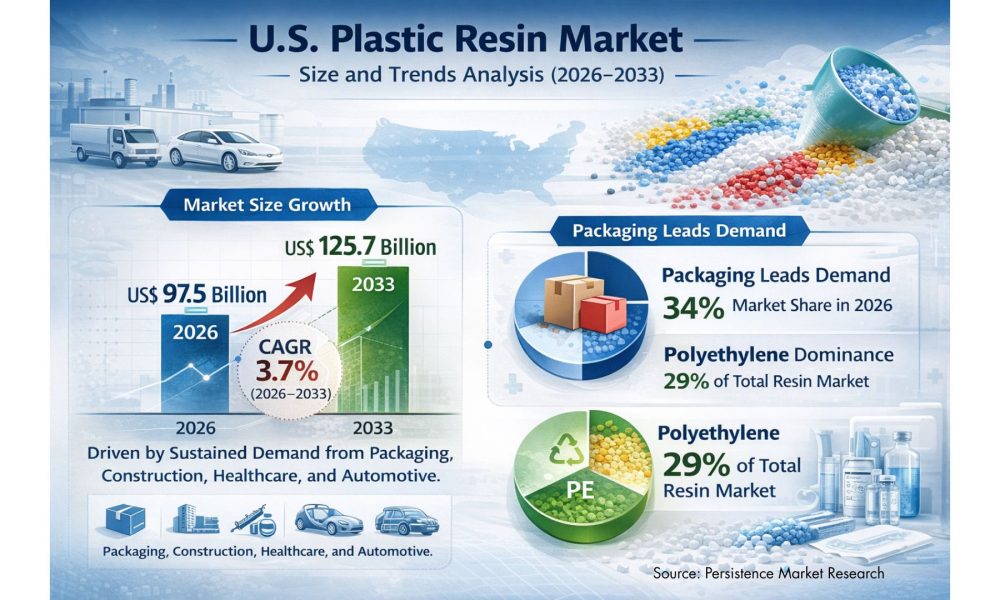
The U.S. plastic resin market represents one of the most mature yet steadily expanding segments within the global chemicals and materials industry. The market is projected to be valued at US$ 97.5 billion in 2026 and is expected to reach approximately US$ 125.7 billion by 2033, growing at a CAGR of 3.7% during the forecast period.
This growth trajectory reflects consistent demand across major end-use industries such as packaging, construction, automotive, healthcare, and consumer goods. The U.S. continues to maintain a strong production base, particularly along the Gulf Coast, supported by access to low-cost feedstock and advanced manufacturing infrastructure. While the market is relatively mature, innovation in sustainable materials and specialty resins is creating new growth avenues.
Get Your FREE Sample Report Instantly – Click Now: https://www.persistencemarketresearch.com/samples/36233
Market Drivers: Packaging and E-commerce Expansion
The packaging sector remains the dominant driver of the U.S. plastic resin market, accounting for approximately 34% of total demand. The increasing penetration of e-commerce has significantly boosted the need for both flexible and rigid packaging materials. Products shipped through online retail channels require enhanced protective packaging, leading to higher consumption of polyethylene (PE), polypropylene (PP), and polyethylene terephthalate (PET).
Additionally, changing consumer lifestyles and rising demand for convenience foods and packaged goods continue to support resin consumption. Plastic resins offer advantages such as lightweight properties, durability, and cost efficiency, making them indispensable in modern packaging solutions.
The structural shift toward online shopping is expected to sustain long-term demand, as packaging intensity per product unit remains high in logistics and delivery systems.
Growing Demand from Automotive and Electric Vehicles
The automotive sector is another key contributor to market growth, driven by the increasing use of lightweight materials. Plastic resins are widely used to replace traditional metals in vehicles, helping reduce overall weight and improve fuel efficiency. Studies suggest that a 10% reduction in vehicle weight can improve fuel economy by 6–8%, reinforcing the importance of polymer-based components.
With the rapid adoption of electric vehicles (EVs), demand for specialty resins is accelerating further. Advanced materials such as polyamide, polycarbonate, and PET are used in battery enclosures, electrical insulation, and thermal management systems. These applications require high-performance polymers, creating new opportunities for innovation and value addition in the market.
Automotive manufacturers are increasingly collaborating with resin producers to develop customized materials that meet stringent performance and safety standards.
Infrastructure Development and Construction Applications
Infrastructure investment is playing a crucial role in driving demand for plastic resins in the U.S. The Infrastructure Investment and Jobs Act, with funding of around US$ 1.2 trillion, is fueling construction activities across transportation, water systems, and energy sectors.
Plastic resins such as polyvinyl chloride (PVC) and polyurethane (PU) are widely used in pipes, insulation, sealants, and structural components. Their durability, corrosion resistance, and cost-effectiveness make them ideal for construction applications.
Residential construction growth, supported by population expansion and housing demand, further contributes to resin consumption. As infrastructure modernization continues, the construction sector is expected to remain a significant demand generator.
Rising Importance of Healthcare and Medical Applications
The healthcare sector is emerging as one of the fastest-growing segments in the U.S. plastic resin market. Increasing healthcare expenditure, aging population, and demand for advanced medical devices are driving the use of high-performance polymers.
Plastic resins are essential in the production of single-use medical devices, surgical instruments, diagnostic equipment, and pharmaceutical packaging. Materials such as PET, polycarbonate, and polyether ether ketone (PEEK) are widely used due to their biocompatibility and sterilization capabilities.
The growing adoption of 3D printing in healthcare, including custom implants and prosthetics, is further expanding the application scope of specialty resins. This segment offers high margins and long-term growth potential due to stringent regulatory requirements and high entry barriers.
Market Segmentation
The U.S. plastic resin market is segmented based on resin type and end-use industries:
By Resin Type
- Thermoplastics
- Polyethylene (PE)
- Polypropylene (PP)
- Polyvinyl Chloride (PVC)
- Polyethylene Terephthalate (PET)
- Polystyrene (PS)
- Engineering Plastics
- Thermosetting Resins
- Epoxy Resins
- Phenolic Resins
- Unsaturated Polyester Resins (UPR)
- Polyurethane (PU) Resins
Among these, polyethylene (PE) dominates the market, accounting for around 29% share, owing to its versatility across packaging, agriculture, and construction applications.
By End-use Industry
- Packaging
- Building & Construction
- Automotive
- Electrical & Electronics
- Consumer Goods
- Healthcare & Medical
- Agriculture
- Textiles & Fibers
Packaging remains the leading segment, while healthcare is the fastest-growing category.
Sustainability Trends and Circular Economy Shift
Sustainability is becoming a central theme in the U.S. plastic resin market. Regulatory pressure and consumer awareness are pushing manufacturers to adopt recycled and bio-based materials. Initiatives such as the U.S. Plastics Pact aim to make 100% of plastic packaging reusable, recyclable, or compostable and increase recycled content to at least 30% by 2030.
This shift is driving investment in post-consumer recycled (PCR) resins and advanced recycling technologies such as chemical recycling. These technologies enable the conversion of plastic waste into high-quality resins comparable to virgin materials.
Companies are also focusing on reducing carbon footprints and improving energy efficiency in production processes. Sustainability is no longer optional but a key competitive factor shaping market dynamics.
Challenges and Market Constraints
Despite steady growth, the market faces several challenges. One of the primary concerns is regulatory pressure on single-use plastics and fossil-based materials. Increasing restrictions and recycling mandates are forcing manufacturers to adapt quickly, often leading to higher compliance costs.
Feedstock price volatility is another significant challenge. Plastic resins are derived from petrochemicals, and fluctuations in crude oil and natural gas prices directly impact production costs and profit margins.
Trade policies and tariffs also introduce uncertainty in supply chains, particularly for imported raw materials. Although the U.S. has strong domestic production capabilities, global trade dynamics continue to influence pricing and availability.
Emerging Opportunities in Advanced Recycling
Advanced recycling technologies present a major growth opportunity for the U.S. plastic resin market. Techniques such as pyrolysis, depolymerization, and solvolysis enable the recycling of complex plastic waste that cannot be processed through traditional mechanical methods.
These technologies support the development of a circular economy by converting waste into high-quality raw materials. With increasing regulatory mandates for recycled content, demand for advanced recycled resins is expected to grow significantly.
Investments in recycling infrastructure and partnerships between chemical companies and technology providers are likely to accelerate innovation and market expansion.
Get a Customized Market View in One Click: https://www.persistencemarketresearch.com/request-customization/36233
Competitive Landscape
The U.S. plastic resin market is highly consolidated, with a few major players dominating production and supply. Key companies include:
- Dow Inc.
- LyondellBasell Industries
- Chevron Phillips Chemical
- Formosa Plastics Corporation
- BASF Corporation
- Eastman Chemical Company
These companies leverage advanced technologies, large-scale production facilities, and extensive distribution networks to maintain competitive advantage. Strategic initiatives such as capacity expansion, product innovation, and sustainability investments are central to their growth strategies.
Future Outlook
The U.S. plastic resin market is expected to maintain steady growth through 2033, supported by strong demand from packaging, automotive, construction, and healthcare sectors. While environmental concerns and regulatory pressures pose challenges, they also create opportunities for innovation in sustainable materials and recycling technologies.
The transition toward a circular economy, combined with advancements in specialty resins, will redefine the competitive landscape. Companies that invest in sustainability, advanced manufacturing, and high-performance materials are likely to lead the market in the coming years.
In conclusion, the U.S. plastic resin market remains a vital component of the industrial ecosystem, balancing maturity with innovation-driven growth and evolving toward a more sustainable future.
About Persistence Market Research:
Persistence Market Research delivers strategic research solutions that drive business growth. Founded in 2012 and registered in England and Wales in 2023 as Persistence Research & Consultancy Services Ltd., we have completed 3,600+ custom and syndicated studies and supported 2,700+ projects for leading research firms. Combining traditional methodologies with modern tools, we provide actionable insights to multinational corporations, consultants, investors, and government bodies, earning strong trust through long-term client relationships.
Contact Us:
Persistence Market Research
Second Floor, 150 Fleet Street,
London, EC4A 2DQ, United Kingdom
USA Phone: +1 646-878-6329
UK Phone: +44 203-837-5656
Email: [email protected]
Web: https://www.persistencemarketresearch.com




