
Refinery Process Chemical Market Size and Trend Analysis
The global refinery process chemical market is experiencing steady expansion, driven by rising demand for cleaner fuels, increasing refining complexity, and the continuous modernization of refineries worldwide. According to industry insights, the market is projected to be valued at approximately US$ 6.3 billion in 2026 and is expected to reach around US$ 9.0 billion by 2033, growing at a CAGR of 5.3% during the forecast period.
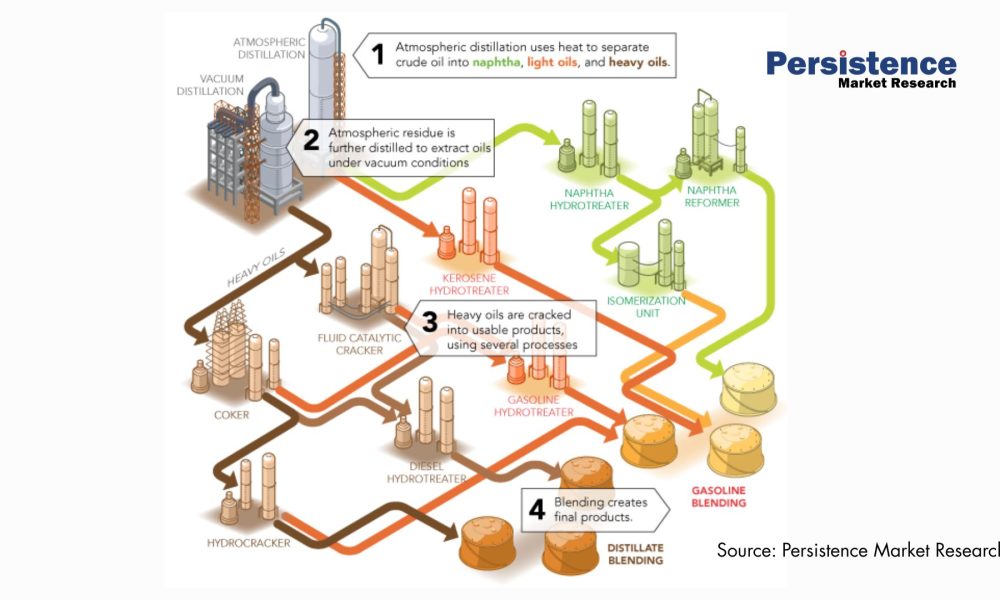
Refinery process chemicals are essential for enhancing operational efficiency, improving fuel quality, and maintaining refinery equipment. These chemicals include catalysts, corrosion inhibitors, demulsifiers, anti-fouling agents, and pH adjusters, all of which play critical roles in refining processes such as crude oil distillation, catalytic cracking, hydrotreating, and isomerization. As refineries process heavier and more complex crude oil feedstocks, the reliance on advanced chemical formulations continues to grow.
Get Your FREE Sample Report Instantly – Click Now: https://www.persistencemarketresearch.com/samples/36122
Key Market Drivers Accelerating Growth
One of the primary drivers of the refinery process chemical market is the implementation of stringent environmental regulations worldwide. Governments and regulatory bodies are enforcing strict fuel quality standards, particularly concerning sulfur content in fuels. For instance, the adoption of ultra-low sulfur fuel standards has significantly increased the demand for hydrotreating catalysts and related chemicals that help refineries meet compliance requirements.
Another major growth factor is the expansion of global refining capacity. Emerging economies, especially in Asia-Pacific and the Middle East, are investing heavily in new refineries and upgrading existing facilities. This expansion is generating substantial demand for process chemicals required to ensure smooth and efficient refinery operations. Additionally, the need to process opportunity crudes—those with higher impurities—has increased the use of corrosion inhibitors and anti-fouling agents.
The growing focus on operational efficiency and cost optimization is also encouraging refineries to adopt high-performance chemical solutions. These chemicals help minimize downtime, enhance yield, and reduce maintenance costs, thereby improving overall profitability.
Expanding Role of Catalysts in Refinery Operations
Catalysts represent the most dominant segment in the refinery process chemical market, accounting for nearly 38% of the total market share. Their importance lies in their ability to accelerate chemical reactions without being consumed, making them indispensable in refining processes such as catalytic cracking and hydroprocessing.
In hydrotreating units, catalysts are used to remove sulfur, nitrogen, and other impurities from crude oil derivatives, ensuring compliance with environmental regulations. In catalytic cracking, they help convert heavy hydrocarbons into lighter, more valuable products like gasoline and diesel.
With the increasing complexity of crude oil feedstocks, there is a growing demand for advanced catalyst technologies that offer higher selectivity, better stability, and improved resistance to contaminants. Continuous innovation in catalyst design is expected to remain a key growth driver in the coming years.
Market Segmentation
The refinery process chemical market can be segmented based on chemical type, application, and end-use industry:
By Chemical Type:
- Catalysts
- pH Adjusters
- Anti-fouling Agents
- Corrosion Inhibitors
- Demulsifiers
Among these, catalysts dominate the market, while anti-fouling agents are emerging as the fastest-growing segment due to increased processing of contaminated crude oil.
By Application:
- Crude Oil Distillation
- Hydrotreating
- Catalytic Cracking
- Alkylation
- Isomerization
Hydrotreating and catalytic cracking are the most significant applications due to their role in producing cleaner fuels.
By End-Use:
- Petroleum Refineries
- Petrochemical Plants
- Chemical Processing Facilities
- Others
Petroleum refineries account for the largest share, driven by the extensive use of process chemicals in refining operations.
Regional Insights and Market Dynamics
North America currently leads the refinery process chemical market, holding around 36% of the global share. This dominance is attributed to the region’s well-established refining infrastructure, strict environmental regulations, and ongoing refinery upgrades.
However, Asia-Pacific is emerging as the fastest-growing region. Countries like China and India are significantly expanding their refining capacities, with India expected to increase its capacity by over 20% by 2028. This rapid industrial growth is driving strong demand for refinery process chemicals.
The Middle East is also witnessing increased demand due to investments in large-scale refining and petrochemical projects. Meanwhile, Europe shows moderate growth, influenced by stringent environmental regulations and a gradual shift toward sustainable energy solutions.
Technological Advancements and Innovation
Technological innovation is a key factor shaping the refinery process chemical market. Companies are investing heavily in research and development to create advanced chemical solutions that improve efficiency and reduce environmental impact.
One notable trend is the development of next-generation catalysts designed to maximize yield while minimizing emissions. These catalysts incorporate advanced materials and proprietary technologies to enhance performance under challenging operating conditions.
Digitalization and process optimization are also gaining traction in the refining industry. The integration of advanced monitoring systems and predictive maintenance tools allows refineries to optimize chemical usage and improve operational efficiency. These innovations are expected to play a crucial role in the future growth of the market.
Challenges Impacting Market Growth
Despite its growth potential, the refinery process chemical market faces several challenges. One of the major constraints is the volatility in refining margins. Fluctuations in crude oil prices and fuel demand can impact refinery operations, leading to reduced consumption of process chemicals during periods of low profitability.
Additionally, the global shift toward renewable energy and electrification of transportation is gradually reducing the demand for traditional fossil fuels. This transition may affect long-term growth prospects for refinery-related industries.
Environmental concerns and regulatory pressures also pose challenges, as chemical manufacturers must develop eco-friendly products while maintaining performance and cost-effectiveness.
Emerging Opportunities in the Market
The refinery process chemical market offers significant growth opportunities, particularly in emerging economies. The construction of new refineries and the modernization of existing facilities in Asia-Pacific and the Middle East are expected to drive demand.
Another key opportunity lies in the development of sustainable and environmentally friendly chemical solutions. As refineries aim to reduce their carbon footprint, there is increasing demand for chemicals that enhance efficiency while minimizing environmental impact.
Advanced catalyst technologies, in particular, present substantial opportunities. Innovations that improve yield, reduce energy consumption, and lower emissions are likely to gain widespread adoption in the coming years.
Get a Customized Market View in One Click: https://www.persistencemarketresearch.com/request-customization/36122
Competitive Landscape
The refinery process chemical market is moderately consolidated, with several global players holding significant market shares. Key companies operating in the market include:
- BASF SE
- Dow Inc.
- Clariant AG
- Honeywell UOP
- Baker Hughes
These companies focus on innovation, strategic partnerships, and expansion into emerging markets to strengthen their competitive position. They are also investing in advanced technologies and integrated solutions to meet the evolving needs of the refining industry.
Future Outlook
The future of the refinery process chemical market appears promising, supported by increasing refining complexity, stringent environmental regulations, and ongoing capacity expansions. While challenges such as fluctuating refining margins and the transition to renewable energy persist, the market is expected to maintain steady growth.
Technological advancements, particularly in catalyst development and process optimization, will play a critical role in shaping the industry’s future. As refineries continue to evolve and adapt to changing market dynamics, the demand for high-performance process chemicals is expected to remain strong through 2033.
About Persistence Market Research:
Persistence Market Research delivers strategic research solutions that drive business growth. Founded in 2012 and registered in England and Wales in 2023 as Persistence Research & Consultancy Services Ltd., we have completed 3,600+ custom and syndicated studies and supported 2,700+ projects for leading research firms. Combining traditional methodologies with modern tools, we provide actionable insights to multinational corporations, consultants, investors, and government bodies, earning strong trust through long-term client relationships.
Contact Us:
Persistence Market Research
Second Floor, 150 Fleet Street,
London, EC4A 2DQ, United Kingdom
USA Phone: +1 646-878-6329
UK Phone: +44 203-837-5656
Email: [email protected]
Web: https://www.persistencemarketresearch.com




