
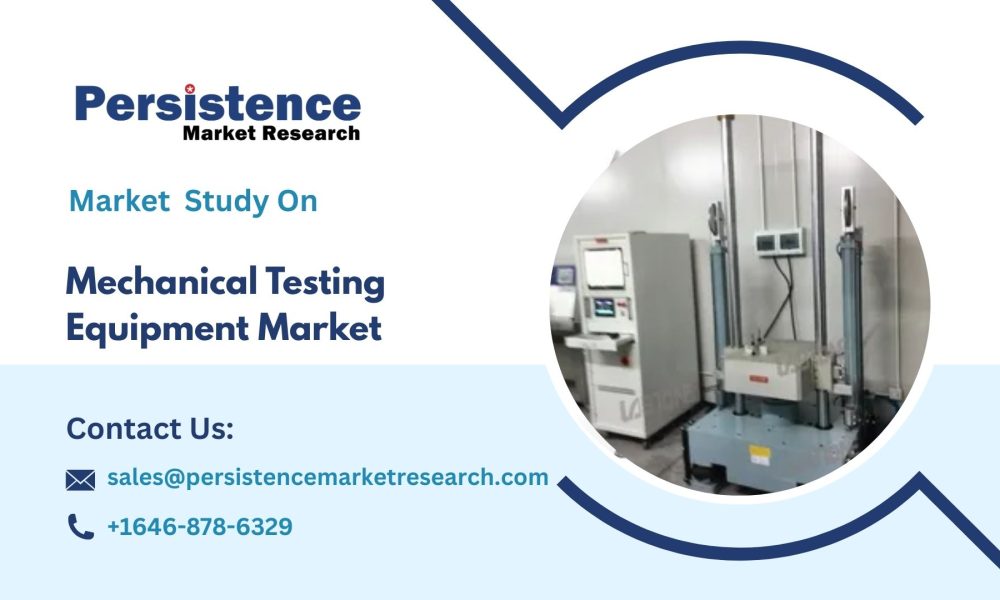
The global mechanical testing equipment market is poised for steady growth as industries worldwide continue to emphasize quality assurance, material validation, and compliance with stringent safety standards. The market is projected to grow from US$ 13.3 billion in 2026 to US$ 17.5 billion by 2033, expanding at a CAGR of 4.0% during the forecast period. Mechanical testing equipment is vital for assessing the physical and mechanical properties of materials, including strength, durability, hardness, and elasticity. These systems play a crucial role in ensuring the reliability and performance of products across aerospace, automotive, construction, and industrial manufacturing sectors.
The growth of the market is fueled by several key factors, including the rising adoption of advanced composites, high-strength alloys, and lightweight materials, which require rigorous testing protocols. The aerospace and automotive industries, in particular, demand precise testing to meet safety regulations and reduce product failures, driving demand for advanced testing equipment. Among segments, universal testing machines dominate due to their versatility and ability to perform multiple tests on a wide range of materials. Geographically, North America leads the market, supported by the presence of major manufacturers, advanced R&D infrastructure, and strong regulatory compliance standards. Asia-Pacific is emerging as a high-growth region due to expanding industrial manufacturing, infrastructure projects, and increasing adoption of quality control measures.
Key Highlights from the Report
• The market is projected to reach US$ 17.5 billion by 2033, growing at a CAGR of 4.0%.
• Increasing demand for quality assurance and material validation is driving growth.
• Universal testing machines dominate due to versatility and multi-material capability.
• Aerospace, automotive, and construction sectors remain key end-users.
• North America leads the market due to advanced R&D and regulatory compliance.
• Asia-Pacific is expected to witness rapid growth driven by industrial expansion and infrastructure development.
𝐆𝐞𝐭 𝐚 𝐒𝐧𝐞𝐚𝐤 𝐏𝐞𝐞𝐤, 𝐒𝐚𝐦𝐩𝐥𝐞 𝐏𝐃𝐅 𝐈𝐧𝐬𝐢𝐝𝐞: https://www.persistencemarketresearch.com/samples/334424
Market Segmentation
The mechanical testing equipment market is segmented based on product type, material type, application, and end-user industry. By product type, the market includes universal testing machines, hardness testers, impact testers, torsion testing equipment, and fatigue testing systems. Universal testing machines hold the largest share due to their capability to perform tensile, compression, and bending tests across various materials. Hardness and impact testers are critical for metals, polymers, and composites to ensure compliance with material standards and durability requirements.
Material-based segmentation covers metals & alloys, polymers & plastics, composites, rubber, ceramics, and other advanced materials. Metals and alloys dominate the market as they are extensively used in automotive, aerospace, and industrial machinery sectors, necessitating rigorous mechanical testing. Composites and high-performance polymers are experiencing increased testing demand as lightweighting initiatives gain traction in automotive and aerospace design.
Application-wise, the market includes quality control, research & development, failure analysis, and production monitoring. Quality control is the largest segment due to the ongoing need to maintain product reliability and minimize recalls or structural failures. End-users include aerospace & defense, automotive, construction & infrastructure, energy & power, electronics, and industrial manufacturing. The aerospace and automotive sectors together contribute significantly to market growth due to their stringent performance requirements and adoption of advanced materials.
Regional Insights
North America holds the leading position in the mechanical testing equipment market, driven by strong aerospace and automotive industries, stringent regulatory standards, and the presence of major equipment manufacturers. The United States is a significant contributor, with high adoption of advanced testing technologies and a focus on research-driven product validation.
Europe also maintains a strong market share due to established industrial infrastructure and compliance with rigorous EU safety and quality regulations. Countries like Germany, France, and the UK are key contributors, supported by investments in advanced manufacturing and materials research.
Asia-Pacific is expected to witness the fastest growth due to rapid industrialization, infrastructure development, and increasing adoption of quality assurance practices in manufacturing hubs such as China, India, and Japan. Rising automotive production, aerospace expansion, and heavy investment in construction and energy projects are key growth drivers. Latin America and the Middle East & Africa are gradually adopting mechanical testing equipment, supported by emerging manufacturing and industrialization efforts.
𝐎𝐧𝐞 𝐂𝐥𝐢𝐜𝐤 → 𝐘𝐨𝐮𝐫 𝐂𝐮𝐬𝐭𝐨𝐦 𝐌𝐚𝐫𝐤𝐞𝐭 𝐕𝐢𝐞𝐰: https://www.persistencemarketresearch.com/request-customization/34424
Market Drivers
The primary driver of the mechanical testing equipment market is the increasing recognition of the importance of material validation and quality assurance in reducing product failures and ensuring safety. Industries such as aerospace, automotive, and construction rely heavily on precise testing to meet regulatory standards and improve operational efficiency. The adoption of advanced materials like composites, high-strength alloys, and polymers requires sophisticated testing systems capable of handling diverse material properties. Additionally, global infrastructure expansion and industrial growth, combined with stricter regulatory emphasis on safety and performance standards, are fueling demand for advanced mechanical testing solutions.
Market Restraints
Despite strong growth prospects, the market faces certain challenges. High initial costs and maintenance expenses for advanced mechanical testing systems can limit adoption, particularly among small and medium-sized enterprises. The complexity of operating sophisticated equipment and the need for skilled technicians can also pose challenges. Furthermore, variations in regional regulatory requirements and long approval processes may delay deployment of new testing systems. Limited awareness of advanced testing technologies in emerging markets may further constrain growth opportunities.
Market Opportunities
The mechanical testing equipment market offers significant opportunities driven by technological advancements and evolving industrial needs. Automation and digitalization of testing equipment, including real-time monitoring, data analytics, and AI integration, are enhancing precision and operational efficiency. Emerging materials such as carbon-fiber composites and high-strength alloys are creating demand for specialized testing solutions. Additionally, the growing focus on sustainable engineering and lightweighting initiatives in automotive and aerospace sectors is opening new avenues for market expansion. Rapid industrialization in Asia-Pacific and infrastructure development in emerging economies are expected to provide substantial growth opportunities.
𝐁𝐮𝐲 𝐍𝐨𝐰 𝐭𝐡𝐞 𝐃𝐞𝐭𝐚𝐢𝐥𝐞𝐝 𝐑𝐞𝐩𝐨𝐫𝐭: https://www.persistencemarketresearch.com/checkout/34424
Company Insights
The mechanical testing equipment market is highly competitive, with major players focusing on innovation, product development, and strategic partnerships to maintain market leadership.
• Instron Corporation
• ZwickRoell GmbH & Co. KG
• MTS Systems Corporation
• Shimadzu Corporation
• Tinius Olsen, Inc.
• ADMET, Inc.
• Ametek, Inc.
• Hegewald & Peschke Meßtechnik GmbH
Recent developments include the launch of advanced universal testing machines with integrated digital control and AI-powered data analytics for predictive maintenance. Additionally, companies are expanding into emerging markets by offering modular and cost-effective testing solutions tailored for industrial and educational applications.
Conclusion
The mechanical testing equipment market is poised for consistent growth driven by increasing demand for quality assurance, material validation, and compliance with stringent safety and performance standards. Advancements in testing technologies, the adoption of sophisticated materials, and the expansion of industrial and infrastructure projects globally are fueling market growth. While challenges such as high costs and technical complexity remain, ongoing innovation, digital integration, and emerging market opportunities are expected to sustain growth. With significant demand from aerospace, automotive, and construction sectors, the mechanical testing equipment market will continue to play a pivotal role in ensuring product safety, reliability, and operational efficiency across industries worldwide.




