
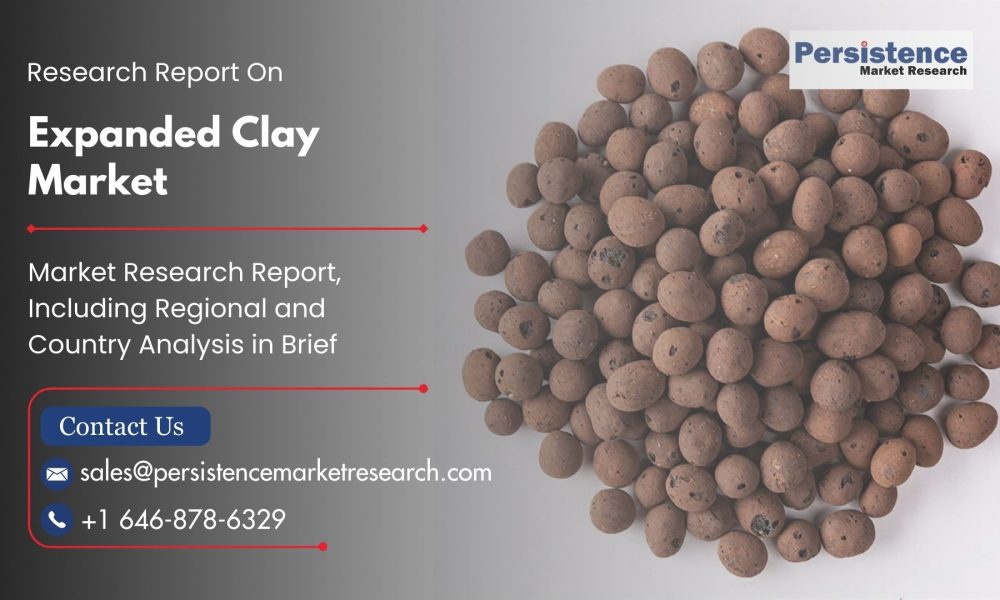
Expanded Clay Market Size and Trend Analysis
The global expanded clay market is witnessing steady growth, driven by increasing demand for lightweight, energy-efficient, and sustainable construction materials. Expanded clay—produced by heating natural clay at high temperatures to form lightweight, porous aggregates—is widely used in construction, horticulture, wastewater treatment, and environmental remediation.
According to industry insights, the global expanded clay market is projected to be valued at US$ 3.3 billion in 2026 and is expected to reach US$ 5.1 billion by 2033, expanding at a CAGR of 6.4% during the forecast period. This growth reflects the rising importance of sustainable building materials and the diversification of applications beyond traditional construction.
Get Your FREE Sample Report Instantly – Click Now: https://www.persistencemarketresearch.com/samples/32495
Key Growth Drivers
Rising Demand for Lightweight Construction Materials
One of the most significant factors fueling the expanded clay market is the growing demand for lightweight construction materials. Expanded clay aggregates are widely used in structural concrete, insulation layers, and geotechnical applications due to their low density and high strength.
Modern infrastructure projects increasingly prioritize materials that reduce structural load without compromising durability. Expanded clay helps lower dead weight by up to 25–40% in large structures, making it ideal for high-rise buildings, bridges, and urban infrastructure.
With global infrastructure investments expected to exceed trillions of dollars in the coming decades, the demand for such efficient materials is expected to rise significantly.
Increasing Focus on Energy Efficiency and Sustainability
Buildings account for a large share of global energy consumption, prompting governments and organizations to adopt energy-efficient construction practices. Expanded clay offers excellent thermal insulation properties, helping reduce heating and cooling requirements in buildings.
The growing adoption of green building certifications such as LEED and BREEAM is further encouraging the use of sustainable materials like expanded clay. Its ability to improve thermal performance and reduce carbon footprints aligns well with global sustainability goals.
Technological advancements in manufacturing processes are also improving energy efficiency and reducing emissions, enhancing the environmental profile of expanded clay products.
Expanding Applications Beyond Construction
While construction remains the dominant application, expanded clay is gaining traction in other sectors such as horticulture, wastewater treatment, and environmental remediation.
In horticulture, expanded clay granules are used as a growing medium due to their excellent water retention and aeration properties. In wastewater treatment, they serve as filtration media and biological support systems due to their high porosity and chemical stability.
These emerging applications are helping diversify the market and reduce dependence on construction cycles, contributing to more stable and long-term demand growth.
Rapid Urbanization and Infrastructure Development
Urbanization is accelerating across emerging economies, particularly in Asia Pacific, creating strong demand for construction materials. Governments are investing heavily in residential housing, transportation networks, and smart city projects.
Expanded clay is increasingly being used in infrastructure projects such as rail embankments, flood management systems, and drainage layers. Its lightweight and durable properties make it suitable for large-scale applications where performance and efficiency are critical.
Asia Pacific is expected to be the fastest-growing regional market, driven by rapid urban expansion and government-backed infrastructure initiatives.
Growth in Controlled Environment Agriculture
The rise of hydroponics, vertical farming, and controlled-environment agriculture is opening new opportunities for expanded clay. These systems require inert, reusable, and efficient growing media, making expanded clay an ideal choice.
Urban farming initiatives in developed economies are increasingly adopting expanded clay granules for crop production. This trend is expected to drive demand from the agricultural sector, particularly in regions facing land and water constraints.
Get a Customized Market View in One Click: https://www.persistencemarketresearch.com/request-customization/32495
Market Segmentation Analysis
By Form
The expanded clay market is segmented into granules, powder, and custom shapes. Among these, granules dominate the market, accounting for approximately 45% of revenue share in 2026 due to their widespread use in construction and horticulture.
Custom shapes are emerging as the fastest-growing segment, driven by demand for specialized applications such as engineered filtration systems and modular construction solutions.
By Production Process
Based on production process, the market is categorized into rotary kiln expansion, fluidized bed expansion, and plasma activation.
- Rotary kiln expansion holds the largest share (around 60%) due to its scalability and reliability.
- Fluidized bed expansion is the fastest-growing process, offering better energy efficiency and lower emissions.
These advancements reflect the industry’s shift toward cleaner and more efficient manufacturing technologies.
By Application
The key application segments include:
- Construction
- Wastewater treatment
- Horticulture
- Environmental remediation
Among these, construction dominates with approximately 40% market share, driven by infrastructure development and demand for lightweight aggregates.
Wastewater treatment is expected to witness the fastest growth due to increasing environmental regulations and investments in water management infrastructure.
Regional Insights
North America
North America leads the expanded clay market, accounting for around 45% of global share in 2026.
The region’s dominance is driven by strong demand for sustainable construction materials, government infrastructure programs, and widespread adoption of green building standards.
Europe
Europe is a significant market, supported by strict environmental regulations and a strong focus on energy-efficient construction. The presence of advanced manufacturing technologies and established industry players further strengthens the region’s position.
Asia Pacific
Asia Pacific is the fastest-growing region, with a projected CAGR of around 6.5% from 2026 to 2033.
Rapid urbanization, increasing construction activities, and government initiatives such as smart cities and infrastructure development are key growth drivers in the region.
Challenges in the Market
High Energy Consumption in Production
Expanded clay production requires high-temperature kilns (often above 1,100°C), making it energy-intensive. Rising energy costs can significantly impact production expenses and profit margins.
Competition from Alternative Materials
The market faces competition from alternative lightweight materials such as perlite, pumice, expanded shale, and synthetic aggregates. These substitutes can be more cost-effective in certain applications, particularly in price-sensitive markets.
Supply Chain and Cost Pressures
Volatility in energy prices and raw material availability can disrupt supply chains and affect market stability. Smaller manufacturers are particularly vulnerable to these fluctuations.
Competitive Landscape
The expanded clay market is moderately competitive, with several global and regional players focusing on innovation, capacity expansion, and sustainability initiatives.
Key companies include:
- LECA International
- Saint-Gobain
- Arcosa Inc.
- Holcim Group
- Argex Group
- Laterlite S.p.A.
These players are investing in advanced production technologies, energy-efficient processes, and customized product offerings to strengthen their market position.
Future Outlook
The future of the expanded clay market appears promising, supported by strong demand from construction, environmental, and agricultural sectors. The integration of sustainable practices and technological advancements will play a crucial role in shaping the market.
Emerging trends such as green construction, urban farming, and water management solutions are expected to create new growth opportunities. Additionally, increasing regulatory focus on sustainability and carbon reduction will further boost the adoption of expanded clay.
For In-Depth Competitive Analysis, Buy Now: https://www.persistencemarketresearch.com/checkout/32495
Conclusion
In conclusion, the expanded clay market is set for steady growth, driven by its versatility, sustainability, and performance advantages. With a projected CAGR of 6.4% and expanding applications across industries, expanded clay is becoming a vital material in modern construction and environmental solutions.
As global demand for energy-efficient and eco-friendly materials continues to rise, the expanded clay market is well-positioned to play a key role in the future of sustainable development.
About Persistence Market Research:
Persistence Market Research delivers strategic research solutions that drive business growth. Founded in 2012 and registered in England and Wales in 2023 as Persistence Research & Consultancy Services Ltd., we have completed 3,600+ custom and syndicated studies and supported 2,700+ projects for leading research firms. Combining traditional methodologies with modern tools, we provide actionable insights to multinational corporations, consultants, investors, and government bodies, earning strong trust through long-term client relationships.
Contact Us:
Persistence Market Research
Second Floor, 150 Fleet Street,
London, EC4A 2DQ, United Kingdom
USA Phone: +1 646-878-6329
UK Phone: +44 203-837-5656
Email: [email protected]
Web: https://www.persistencemarketresearch.com




