
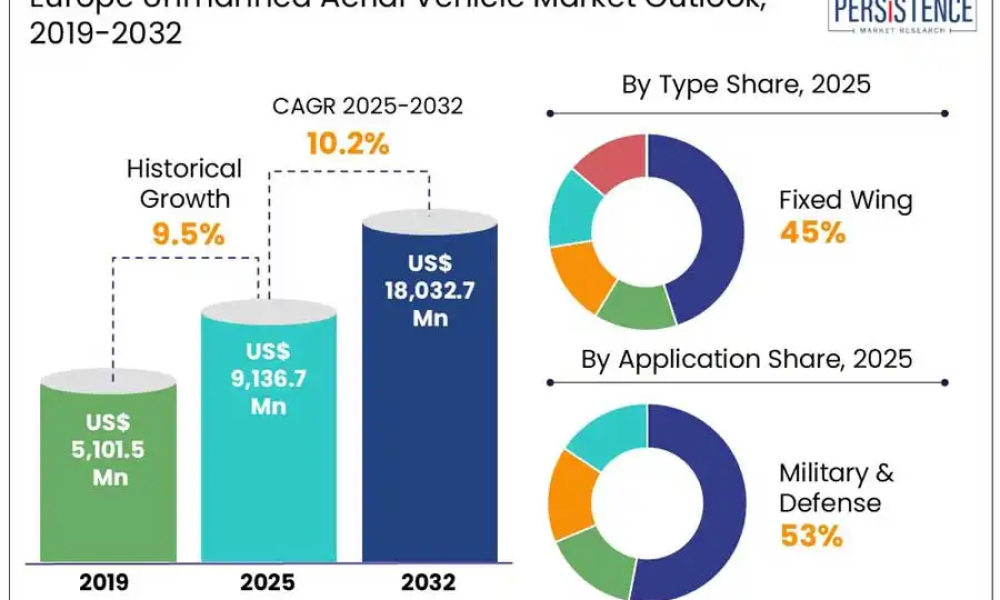
The Europe Unmanned Aerial Vehicle (UAV) market is poised for substantial growth over the coming years, driven by rapid advancements in drone technologies, increasing defense budgets, and expanding commercial applications. The market is anticipated to grow from US$ 9,136.7 Mn in 2025 to US$ 18,032.7 Mn by 2032, registering a compound annual growth rate (CAGR) of 10.2% during the forecast period (2025–2032).
This robust growth trajectory is primarily fueled by the increasing deployment of UAVs across defense, agriculture, logistics, surveillance, and infrastructure inspection sectors. European governments are significantly investing in unmanned systems for border security, intelligence gathering, and combat support, while commercial industries are adopting drones to enhance operational efficiency and reduce costs.
Furthermore, the region’s strong regulatory framework, including initiatives to integrate drones into civilian airspace, is encouraging innovation and commercial adoption. The presence of leading aerospace manufacturers, technological advancements in autonomous navigation, and the integration of artificial intelligence are also accelerating market expansion.
Get Your FREE Sample Report Instantly Click Now: https://www.persistencemarketresearch.com/samples/35256
Key Highlights from the Report
➤ The Europe UAV market is expected to grow from US$ 9,136.7 Mn in 2025 to US$ 18,032.7 Mn by 2032, at a CAGR of 10.2%.
➤ Rising defense expenditure across European nations is significantly boosting UAV procurement and development.
➤ Increasing use of drones in commercial sectors such as agriculture, logistics, and infrastructure inspection.
➤ Growing adoption of AI-powered and autonomous UAV systems for enhanced operational efficiency.
➤ Expansion of favorable regulatory frameworks supporting UAV integration into civilian airspace.
➤ Strong presence of aerospace and defense manufacturers driving innovation and technological advancements.
Segmentation Analysis
By Type
The UAV market in Europe is segmented into fixed-wing UAVs, rotary-wing UAVs, and hybrid UAVs. Fixed-wing UAVs dominate the market due to their long endurance, higher payload capacity, and suitability for military surveillance and long-range missions. These drones are extensively used by defense forces for intelligence, reconnaissance, and border monitoring.
However, rotary-wing UAVs, including quadcopters and multirotor drones, are witnessing the fastest growth, particularly in commercial applications. Their ability to hover, maneuver in confined spaces, and perform vertical take-off and landing makes them ideal for applications such as aerial photography, inspection, and delivery services. Hybrid UAVs are also gaining traction as they combine the benefits of both fixed-wing and rotary-wing designs, offering versatility and improved operational efficiency.
By Vehicle/Product/Service Type
Based on product and application, the market is categorized into defense UAVs and commercial UAVs. The defense segment holds a significant share of the market, driven by increasing military modernization programs and the need for advanced surveillance and combat capabilities. European nations are investing heavily in unmanned systems to strengthen their defense infrastructure and reduce reliance on manned missions.
The commercial UAV segment is expanding rapidly, supported by growing adoption across industries such as agriculture, energy, construction, and logistics. In agriculture, drones are being used for crop monitoring, spraying, and precision farming. In the energy sector, UAVs are deployed for pipeline inspection, wind turbine monitoring, and power line surveillance. Logistics companies are also exploring drone-based delivery systems to improve efficiency and reduce operational costs.
By Propulsion/Technology/Channel
The market is further segmented based on propulsion and technology into electric UAVs, hybrid UAVs, and fuel-powered UAVs. Electric UAVs are gaining popularity due to their lower operating costs, reduced emissions, and suitability for short-range missions. Hybrid and fuel-powered UAVs, on the other hand, are preferred for long-endurance operations, particularly in defense and large-scale commercial applications.
Technological advancements such as AI, IoT, machine learning, and 5G connectivity are playing a critical role in enhancing UAV capabilities. AI-powered drones enable autonomous navigation, obstacle avoidance, and real-time data analysis, while IoT integration facilitates seamless communication between drones and ground control systems. The adoption of 5G technology is expected to further improve data transmission speeds, enabling real-time video streaming and remote operations.
Customize This Report for Your Exact Requirements: https://www.persistencemarketresearch.com/request-customization/35256
Regional Insights
Germany, France, and the United Kingdom are leading the Europe UAV market, driven by strong defense capabilities, advanced technological infrastructure, and significant investments in research and development. These countries are at the forefront of UAV innovation, with well-established aerospace industries and supportive government policies.
Southern and Eastern Europe are emerging as high-growth regions, supported by increasing adoption of drones in agriculture, infrastructure development, and public safety applications. Countries in these regions are gradually enhancing their regulatory frameworks and investing in drone technologies to boost economic growth and operational efficiency.
The fastest-growing region is expected to be Eastern Europe, owing to rising defense modernization efforts, increasing industrialization, and expanding use of UAVs in commercial sectors. Additionally, government initiatives to promote digital transformation and smart infrastructure development are further driving market growth in these regions.
Unique Features and Innovations in the Market
The Europe UAV market is characterized by continuous innovation and technological advancements that are transforming the capabilities of unmanned systems. Modern UAVs are equipped with advanced sensors, high-resolution cameras, and real-time data processing capabilities, enabling them to perform complex tasks with high precision and efficiency.
One of the key differentiators in the market is the integration of artificial intelligence and machine learning, which allows UAVs to operate autonomously, analyze data in real time, and make informed decisions without human intervention. This is particularly beneficial in applications such as surveillance, disaster management, and infrastructure inspection.
Additionally, the adoption of IoT and 5G technologies is enhancing connectivity and communication between UAVs and control systems. This enables seamless data exchange, improved coordination, and real-time monitoring, significantly enhancing operational efficiency. Innovations such as swarm technology, where multiple drones operate collaboratively, are also gaining traction, particularly in defense and large-scale industrial applications.
Market Highlights
The increasing adoption of UAVs across various industries is driven by several key factors, including cost efficiency, operational flexibility, and enhanced safety. Drones offer a cost-effective alternative to traditional methods, reducing the need for manual labor and minimizing risks associated with hazardous operations.
Regulatory developments across Europe are also playing a crucial role in shaping the market. Governments and regulatory bodies are implementing frameworks to ensure safe and efficient integration of UAVs into civilian airspace. These regulations are encouraging innovation while maintaining safety standards, thereby fostering market growth.
Sustainability is another important factor influencing the market, with a growing emphasis on reducing carbon emissions and environmental impact. Electric UAVs and eco-friendly technologies are gaining traction as companies strive to align with environmental goals and regulatory requirements.
Key Players and Competitive Landscape
The Europe UAV market is highly competitive, with the presence of several leading companies focusing on innovation, strategic partnerships, and regional expansion. Key players in the market include:
✦ Airbus SE – A leading aerospace company focusing on advanced UAV systems for defense and commercial applications, with strong investments in R&D and innovation.
✦ BAE Systems plc – Specializing in military UAVs and autonomous systems, leveraging advanced technologies to enhance defense capabilities.
✦ Thales Group – Offering a wide range of UAV solutions with a focus on surveillance, security, and defense applications.
✦ Leonardo S.p.A. – Expanding its UAV portfolio with cutting-edge technologies and strong presence in European defense markets.
✦ Parrot Drones SAS – A prominent player in the commercial drone segment, focusing on compact, high-performance UAVs for enterprise and consumer applications.
✦ Elbit Systems Ltd. – Known for its advanced defense UAV systems, emphasizing long-endurance and high-performance capabilities.
These companies are actively investing in product innovation, partnerships, and mergers to strengthen their market position. They are also focusing on expanding their presence in emerging markets and developing advanced UAV solutions to cater to evolving customer needs.
Ready to Dive Deep? Buy Full Report Today: https://www.persistencemarketresearch.com/checkout/35256
Recent Developments
- Introduction of next-generation autonomous UAV systems with enhanced AI capabilities for defense and industrial applications.
- Expansion of drone delivery pilot programs across European cities, supported by regulatory approvals and technological advancements.
Future Opportunities and Growth Prospects
The Europe UAV market presents significant growth opportunities, particularly in areas such as autonomous systems, smart cities, and advanced logistics solutions. The increasing adoption of drones in urban planning, traffic management, and emergency response is expected to drive demand in the coming years.
Technological advancements in AI, IoT, and connectivity will continue to enhance UAV capabilities, enabling more efficient and reliable operations. The development of fully autonomous drones and swarm technologies is expected to revolutionize the market, offering new possibilities for large-scale applications.
Regulatory developments will also play a crucial role in shaping the future of the market. As governments continue to refine policies and frameworks, the integration of UAVs into civilian airspace is expected to become more streamlined, facilitating broader adoption across industries.
In conclusion, the Europe UAV market is set for dynamic growth, driven by technological innovation, increasing defense investments, and expanding commercial applications. Companies that focus on innovation, regulatory compliance, and sustainability are well-positioned to capitalize on the evolving opportunities in this rapidly growing market.




