
The global CMO and CDMO biotechnology market is experiencing robust growth as pharmaceutical and biopharmaceutical companies increasingly rely on outsourcing for drug development and manufacturing. This trend is fueled by the rising complexity of biologics, biosimilars, and gene therapies, which demand specialized expertise, advanced facilities, and scalable production capabilities. Outsourcing to CMOs and CDMOs allows pharmaceutical companies to reduce operational costs, accelerate time-to-market, and leverage cutting-edge technologies without the need for significant in-house investments. Key innovations such as single-use bioreactors, automated fill-finish systems, and integrated development services are enhancing efficiency and flexibility, positioning CMOs/CDMOs as strategic partners across the drug lifecycle.
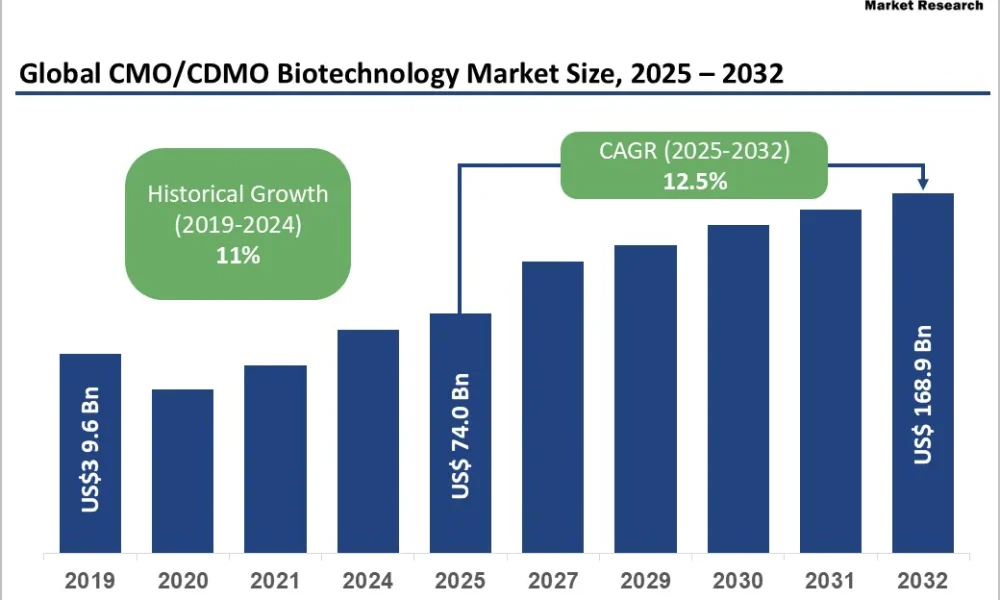
Market statistics indicate that the global CMO/CDMO biotechnology market is projected to reach approximately US$74.0 billion by 2025 and grow to US$168.9 billion by 2032, achieving a CAGR of 12.5% from 2025 to 2032. Monoclonal antibodies (mAbs) dominate the product segment with an estimated 45% market share in 2025, while cell and gene therapies are the fastest-growing segment due to rising demand for personalized medicine. Regionally, North America leads the market with a 42% share, driven by a robust biopharma ecosystem, FDA regulatory support, and a high concentration of innovative biotech hubs. Meanwhile, Asia Pacific is the fastest-growing region, fueled by favorable policy incentives, cost advantages, and increasing R&D investments.
Download Your Free Sample & Explore Key Insights: https://www.persistencemarketresearch.com/samples/32516
Key Highlights from the Report
• Monoclonal antibodies are the leading product type, holding around 45% market share in 2025.
• Cell and gene therapies are the fastest-growing segment, with a CAGR of over 15% through 2032.
• Integrated contract development and manufacturing services are experiencing rapid adoption globally.
• North America commands the largest market share due to innovation hubs and regulatory support.
• Asia Pacific is the fastest-growing regional market, leveraging cost-effectiveness and policy incentives.
• CDMOs are focusing on capacity expansion, digital transformation, and strategic acquisitions.
Market Segmentation
The CMO/CDMO biotechnology market is segmented based on product type, service type, and scale of operation. By product type, monoclonal antibodies represent the largest share due to their clinical maturity, standardized manufacturing platforms, and widespread therapeutic applications. In contrast, cell and gene therapies (CGTs) are growing rapidly, driven by CAR-T therapies, viral vector gene therapies, and rising investments in personalized medicine. Service types are divided into standalone and integrated offerings. Standalone services, including cell-line development, analytical testing, and fill-finish, remain dominant, as they provide flexibility and targeted expertise. Integrated services, which encompass the full development-to-commercial manufacturing lifecycle, are gaining momentum due to pharmaceutical companies’ preference for one-stop outsourcing solutions. Regarding scale, large-scale commercial manufacturing holds the majority of contracts, offering economies of scale and cost advantages, whereas small-scale pilot production is witnessing faster growth to support early-phase clinical trials and personalized therapies.
Regional Insights
North America dominates the CMO/CDMO biotechnology market, accounting for an estimated 42% share in 2025, largely driven by the United States. The region benefits from well-established biotech clusters in Boston, San Francisco, and San Diego, as well as progressive regulatory frameworks from the FDA that encourage outsourcing adoption. CDMOs in North America are early adopters of advanced bioprocess technologies, digital manufacturing, and process optimization, enabling compliance with stringent quality standards. Europe is projected to hold around 25% of the market, with Germany, the U.K., France, and Spain as key contributors. EMA-led regulatory harmonization facilitates cross-border clinical trials and manufacturing, and European CDMOs are investing in digitalization, automation, and bioprocess intensification. Asia Pacific is the fastest-growing region, with China, India, South Korea, and ASEAN countries emerging as major hubs. Cost-effective manufacturing, supportive government policies, growing clinical trial networks, and rising biopharma R&D investments are accelerating market growth in this region.
Get Custom Insights Designed for Your Businecss: https://www.persistencemarketresearch.com/request-customization/32516
Market Drivers
A primary driver of the CMO/CDMO biotechnology market is the escalating demand for complex biologic therapeutics. The global biopharmaceutical pipeline is increasingly populated with monoclonal antibodies, recombinant proteins, and advanced cell and gene therapies, all requiring sophisticated development and manufacturing capabilities. Regulatory approvals from agencies such as the FDA and EMA are increasing, leading to higher outsourcing needs. CDMOs provide scalable, flexible manufacturing solutions that reduce contamination risks and operational costs, allowing pharmaceutical companies to accelerate product launches and manage investment risk. Advances in single-use bioreactors, process automation, and integrated development platforms enhance production efficiency and further drive reliance on outsourced manufacturing services.
Market Restraints
Despite strong growth, the market faces significant restraints due to regulatory compliance challenges and quality assurance costs. CDMOs operate under stringent global standards, including Good Manufacturing Practices (GMP), and must adhere to varying regional regulations for process validation, documentation, and inspections. Non-compliance can result in fines, production delays, and contract losses. High capital requirements for facility upgrades, staff training, and certification renewals disproportionately affect mid-sized and emerging CDMOs, limiting their ability to scale operations. Additionally, regulatory bottlenecks in Investigational New Drug (IND) and New Drug Application (NDA) approvals can extend project timelines, impacting revenue predictability and overall operational efficiency.
Market Opportunities
Digital transformation and Industry 4.0 technologies present significant opportunities for the CMO/CDMO biotechnology market. Adoption of artificial intelligence (AI), machine learning, IoT, and cloud-based analytics enables real-time monitoring, predictive maintenance, and process optimization, improving efficiency and product consistency. Digital twins and continuous manufacturing as a service allow for agile, data-driven production, particularly important for cell and gene therapies with high customization needs. Investments in digital infrastructure, smart biomanufacturing, and workforce upskilling position CDMOs to differentiate themselves in a competitive landscape and capture long-term growth opportunities. Additionally, emerging CDMO hubs in Asia Pacific offer cost advantages, regulatory incentives, and expanding capabilities, creating opportunities for global partnerships and regional expansion.
Checkout Now & Download Complete Market Report: https://www.persistencemarketresearch.com/checkout/32516
Company Insights
• Lonza Group AG
• Thermo Fisher Scientific Inc.
• Samsung Biologics Co., Ltd.
• Boehringer Ingelheim International GmbH
• AGC Biologics, Inc.
• WuXi Biologics
• Patheon N.V.
• Catalent, Inc.
• AbbVie Inc.
• Avid Bioservices, Inc.
• Fujifilm Diosynth Biotechnologies
• Rentschler Biopharma SE
• KBI Biopharma (JSR Corporation)
• Cytovance Biologics
• Xpress Biologic
Recent Developments:
In September 2025, Lotte Biologics signed a contract with a U.S. pharmaceutical company to manufacture a Phase 3 asset, potentially extending into commercial production through 2030. In June 2025, Zydus Lifesciences acquired two U.S. biologics facilities from Agenus Inc., marking its entry into global CDMO operations with advanced manufacturing capabilities for immuno-oncology products.
Conclusion
The CMO/CDMO biotechnology market is poised for substantial growth over the next decade, driven by increasing demand for complex biologics, cell and gene therapies, and integrated development services. The reliance on outsourcing allows pharmaceutical companies to mitigate operational risks, reduce costs, and accelerate time-to-market. North America continues to lead in market share due to a mature biopharma ecosystem, while Asia Pacific emerges as the fastest-growing region thanks to cost efficiencies, regulatory reforms, and expanding R&D investments. Despite challenges from stringent regulatory compliance and high operational costs, opportunities in digital transformation and emerging regional hubs provide avenues for continued expansion. Strategic initiatives by leading CDMOs, including capacity expansions, digital adoption, and global partnerships, will shape a dynamic and competitive market, positioning outsourcing as a critical enabler for biopharmaceutical innovation worldwide.




