
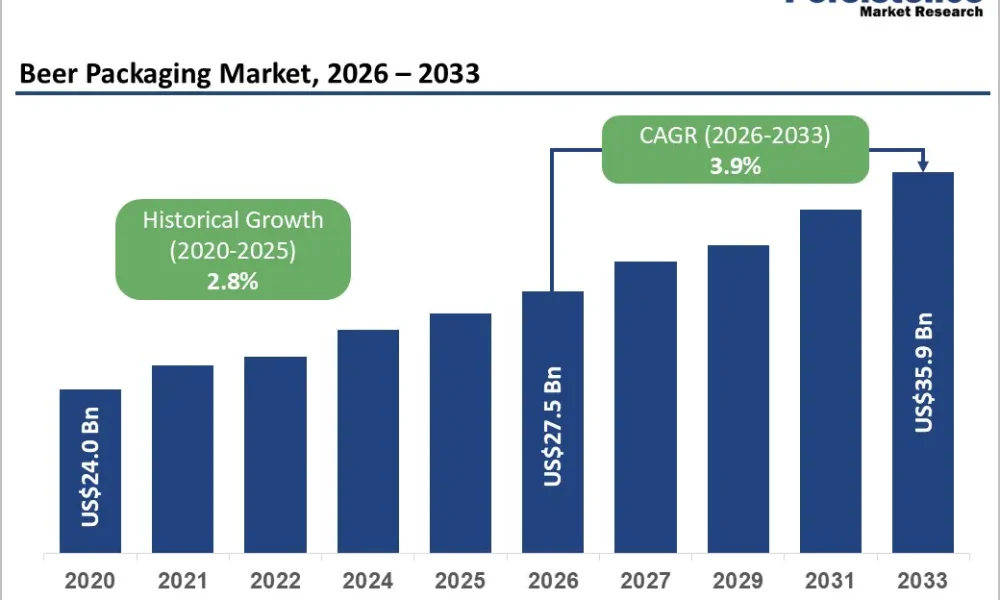
The beer packaging market is experiencing steady growth, fueled by evolving consumer preferences, rising craft beer consumption, and the increasing emphasis on sustainable packaging solutions. Beer packaging encompasses a variety of materials and formats designed to preserve product quality, enhance shelf appeal, and meet regulatory and logistical requirements. Packaging formats include aluminum cans, glass bottles, PET bottles, kegs, and cartons, each offering unique benefits in terms of durability, portability, and recyclability. According to industry estimates, the global beer packaging market is projected to be valued at US$27.5 billion in 2026 and is expected to reach US$35.9 billion by 2033, expanding at a CAGR of 3.9% during the forecast period from 2026 to 2033.
The growth of the beer packaging market is primarily driven by structural shifts toward aluminum cans, sustained demand for premium glass bottles, and the rapid expansion of the craft and specialty beer segment. Aluminum cans are favored for their lightweight nature, recyclability, and ability to preserve flavor, while glass bottles continue to dominate the premium segment due to their perceived quality and brand appeal. Geographically, Europe and North America are leading regions for beer packaging adoption. Europe benefits from a mature beer market with strong premium beer consumption, while North America sees robust growth due to rising craft beer breweries and innovative packaging formats that enhance brand differentiation and consumer engagement.
𝐆𝐞𝐭 𝐚 𝐒𝐧𝐞𝐚𝐤 𝐏𝐞𝐞𝐤, 𝐒𝐚𝐦𝐩𝐥𝐞 𝐏𝐃𝐅 𝐈𝐧𝐬𝐢𝐝𝐞: https://www.persistencemarketresearch.com/samples/36063
Key Highlights from the Report
• The global beer packaging market is projected to reach US$35.9 billion by 2033.
• Aluminum cans are increasingly preferred due to sustainability and cost advantages.
• Premium beer segments continue to rely heavily on glass bottles for brand positioning.
• The rise of craft and specialty beers is fueling demand for small-format and innovative packaging solutions.
• Europe and North America dominate the market, supported by strong beer consumption and packaging innovation.
• Manufacturers are investing in eco-friendly and recyclable materials to meet consumer and regulatory demands.
Market Segmentation
The beer packaging market can be segmented based on material type, packaging format, product type, and end-use industry. In terms of material type, the market primarily includes aluminum, glass, PET, and other materials. Aluminum is rapidly gaining market share due to its lightweight, recyclable, and cost-efficient properties. Glass remains a staple in premium beer offerings, offering superior shelf appeal and perceived quality. PET bottles and other innovative packaging solutions are increasingly being adopted for specific ready-to-drink formats and portable packaging requirements.
Based on packaging format, the market comprises cans, bottles, kegs, and cartons. Cans dominate in mainstream and mass-market beers due to portability, reduced shipping weight, and shelf-life preservation. Bottles, particularly glass, continue to hold significant share in premium and craft beer markets where aesthetics and consumer perception are crucial. Kegs remain essential for bars, restaurants, and draft beer operations, whereas cartons and multipacks are popular in retail and convenience segments.
In terms of product type, the market is segmented into lager, ale, stout, craft beers, and specialty beers. Craft and specialty beers are increasingly driving packaging innovation due to their focus on limited editions, unique flavors, and small-batch production. End-user segmentation includes retail, on-premise (bars, restaurants), and off-premise distribution. Retail accounts for a large portion of sales, while on-premise consumption drives demand for kegs, draught packaging, and branded formats that enhance the drinking experience.
𝐆𝐞𝐭 𝐚 𝐂𝐮𝐬𝐭𝐨𝐦𝐢𝐳𝐞𝐝 𝐌𝐚𝐫𝐤𝐞𝐭 𝐕𝐢𝐞𝐰 𝐢𝐧 𝐎𝐧𝐞 𝐂𝐥𝐢𝐜𝐤 : https://www.persistencemarketresearch.com/request-customization/36063
Regional Insights
Europe remains a dominant region in the beer packaging market due to the strong consumption of both mainstream and premium beers. Countries such as Germany, Belgium, and the United Kingdom are known for their premium beer culture, where glass bottles and specialty packaging remain prevalent. The region also benefits from high recycling rates, regulatory support for sustainable packaging, and widespread adoption of aluminum cans for mass-market beverages.
North America is witnessing robust growth driven by the rise of craft breweries and specialty beer products. The United States and Canada are key markets for innovative packaging formats, including limited-edition cans and eco-friendly solutions. The increasing popularity of ready-to-drink beer cocktails and portable packaging is also contributing to market expansion.
Asia-Pacific represents a growing market for beer packaging due to rising disposable incomes, urbanization, and an increasing number of domestic and international breweries. Countries like China, India, and Japan are investing heavily in modern packaging facilities to cater to a growing middle-class population and evolving consumer preferences.
Latin America and Middle East & Africa are emerging markets where beer consumption is increasing, and breweries are adopting modern packaging solutions to meet growing retail demand. Growth in these regions is fueled by premiumization trends, tourism, and the rising popularity of international beer brands.
Market Drivers
The key drivers of the beer packaging market include the shift toward aluminum cans, which offer lightweight, sustainable, and cost-efficient solutions for breweries. The growth of craft and specialty beers is driving the demand for innovative, small-format, and limited-edition packaging that enhances brand differentiation. In addition, sustained consumer preference for glass bottles in premium beer segments is supporting market growth. Sustainability trends are also driving manufacturers to adopt recyclable materials and eco-friendly packaging processes, which are increasingly favored by environmentally conscious consumers.
Technological advancements in packaging machinery, filling equipment, and protective coatings are further supporting market growth by ensuring product safety, extending shelf life, and maintaining flavor integrity. The rise of on-the-go consumption patterns and direct-to-consumer delivery models is prompting breweries to adopt versatile and durable packaging formats that withstand transportation and handling.
Market Restraints
Despite favorable growth trends, the beer packaging market faces several challenges. One of the primary restraints is the high production cost associated with premium glass bottles and specialized packaging formats, which can limit adoption in price-sensitive markets. Regulatory compliance regarding materials, labeling, and recycling adds additional complexity and cost for manufacturers.
Another challenge is environmental concerns related to single-use packaging, particularly aluminum cans and plastic components. Although recycling rates are improving, consumer and regulatory pressures are prompting breweries to invest in sustainable solutions, which may increase operational costs in the short term. Additionally, fluctuating raw material prices for aluminum, glass, and PET can impact production costs and profitability.
Market Opportunities
The beer packaging market offers significant opportunities driven by sustainability and innovation. The adoption of eco-friendly packaging materials, such as recycled aluminum, biodegradable films, and lightweight glass, provides growth potential while meeting environmental and regulatory standards. Breweries can capitalize on consumer demand for sustainable products by marketing eco-conscious packaging initiatives.
The rise of craft and specialty beers also presents opportunities for packaging differentiation and limited-edition products. Breweries can leverage unique shapes, label designs, and interactive packaging technologies such as QR codes to enhance consumer engagement and brand loyalty.
Another key opportunity lies in emerging markets, particularly in Asia-Pacific and Latin America, where growing urbanization, disposable incomes, and westernization of drinking habits are driving beer consumption. Investment in modern bottling and canning facilities, along with innovative packaging formats, can help breweries capture market share in these high-growth regions.
𝐁𝐮𝐲 𝐍𝐨𝐰 𝐭𝐡𝐞 𝐃𝐞𝐭𝐚𝐢𝐥𝐞𝐝 𝐑𝐞𝐩𝐨𝐫𝐭: https://www.persistencemarketresearch.com/checkout/36063
Company Insights
Key companies operating in the beer packaging market include:
• Ball Corporation
• Crown Holdings, Inc.
• Ardagh Group S.A.
• Amcor plc
• Can-Pack S.A.
• O-I Glass, Inc.
• Silgan Holdings Inc.
• Rexam PLC
• Trivium Packaging
• Berlin Packaging
Recent market developments highlight a strong focus on sustainability and packaging innovation. Several companies have introduced lightweight aluminum cans to reduce material usage and transportation costs while maintaining durability. In addition, breweries are increasingly adopting recyclable and eco-friendly glass bottles and collaborating with packaging technology providers to develop high-barrier solutions that extend beer shelf life and preserve quality.
Conclusion
The beer packaging market is expected to experience steady growth as consumer demand for ready-to-drink, craft, and specialty beers continues to rise globally. With the market projected to reach US$35.9 billion by 2033, the adoption of aluminum cans, premium glass bottles, and innovative packaging solutions is reshaping the industry landscape. Sustainability trends, technological advancements, and the rapid expansion of craft breweries are creating significant opportunities for market players to differentiate their products and appeal to environmentally conscious and quality-focused consumers. While challenges such as raw material cost fluctuations and environmental concerns remain, ongoing investment in packaging innovation and emerging market expansion will continue to drive the growth of the global beer packaging market.




