
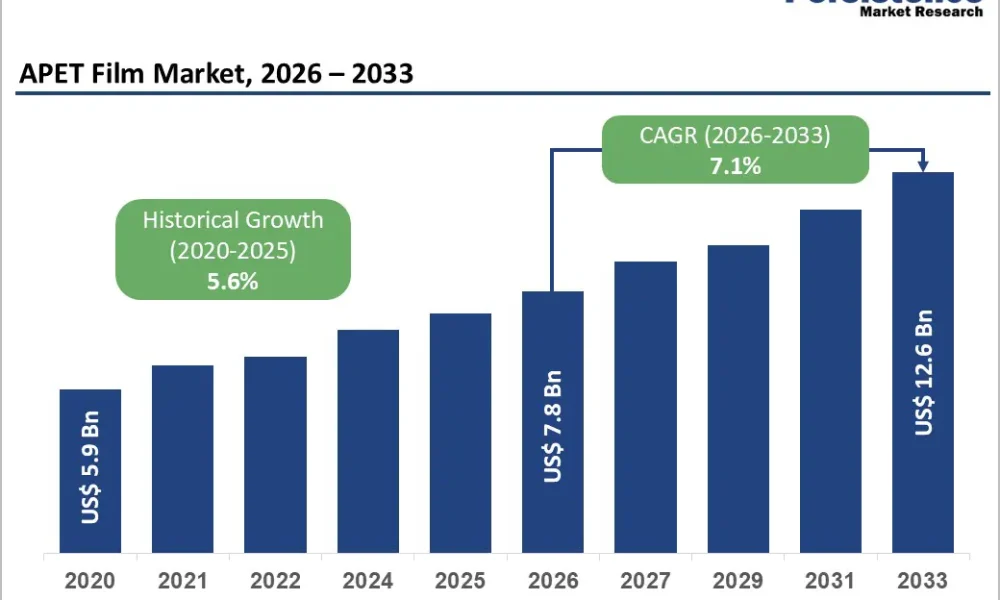
The global APET film market is witnessing substantial growth as industries increasingly adopt lightweight, durable, and recyclable packaging materials. APET films are widely used in food and beverage, consumer goods, pharmaceuticals, and retail packaging due to their clarity, stiffness, and thermoformability. They offer excellent barrier properties, are recyclable, and can be manufactured in specialty functional grades such as anti-fog, high-barrier, and heat-sealable films, making them ideal for modern packaging applications. According to market estimates, the global APET film market size is projected to be valued at US$7.8 billion in 2026 and is expected to reach US$12.6 billion by 2033, growing at a compound annual growth rate (CAGR) of 7.1% between 2026 and 2033. The market is driven by increasing demand in thermoforming applications, particularly in food and beverage packaging, where APET films are replacing heavier materials like glass and metal to reduce weight, improve efficiency, and support sustainable packaging initiatives.
The rising preference for specialty APET films, such as anti-fog and high-barrier grades, is further fueling market growth. These functional grades are increasingly used in retail-ready displays and fresh food packaging to extend shelf life and enhance product visibility. APET films’ recyclability and ability to meet evolving environmental regulations also encourage adoption among manufacturers seeking sustainable alternatives. Geographically, North America currently leads the APET film market, owing to a strong presence of food and beverage companies, increasing demand for convenient retail-ready packaging, and early adoption of lightweight, recyclable packaging solutions. Europe is also a significant market, driven by regulatory pressure on sustainable packaging and increasing consumer preference for recyclable materials. Meanwhile, the Asia-Pacific region is emerging as a high-growth market due to rising industrialization, expanding food and beverage processing sectors, and growing retail distribution networks.
𝐆𝐞𝐭 𝐚 𝐒𝐧𝐞𝐚𝐤 𝐏𝐞𝐞𝐤, 𝐒𝐚𝐦𝐩𝐥𝐞 𝐏𝐃𝐅 𝐈𝐧𝐬𝐢𝐝𝐞: https://www.persistencemarketresearch.com/samples/36101
Key Highlights from the Report
• The APET film market is projected to grow from US$7.8 billion in 2026 to US$12.6 billion by 2033.
• The market is expected to register a CAGR of 7.1% between 2026 and 2033.
• Increasing adoption in food & beverage and consumer goods thermoforming applications is driving growth.
• The shift from heavier packaging materials such as glass and metal to lightweight APET films is expanding market penetration.
• Rising demand for specialty functional grades such as anti-fog and high-barrier films is supporting growth in retail-ready packaging.
• Ongoing investments by leading APET film manufacturers to expand production capacity are further strengthening market trends.
Market Segmentation
The APET film market can be segmented based on product type, application, end-user industry, and packaging format. Each segment reflects evolving consumer requirements, industrial demands, and technological advancements in film production.
From a product perspective, APET films are available in standard, anti-fog, high-barrier, and specialty grades designed for unique applications. Standard APET films are commonly used in general food and beverage packaging, providing transparency and strength for thermoformed trays, containers, and retail-ready packaging. Anti-fog APET films are used extensively in fresh food packaging, particularly for produce, meat, and ready-to-eat meals, as they prevent condensation and improve product visibility. High-barrier APET films are essential in packaging applications that require extended shelf life and protection from oxygen, moisture, and UV exposure. Specialty grades with enhanced functionality, such as metallized or co-extruded films, cater to premium consumer goods and pharmaceutical packaging needs.
In terms of applications, APET films are primarily used in thermoforming, extrusion, and lamination processes. Thermoformed APET trays and containers dominate the market due to their versatility, cost efficiency, and ability to meet retail-ready display requirements. Extruded APET films are often used in flexible packaging formats, shrink films, and protective overwraps for food and beverages. Laminated APET films are increasingly used in multi-layer packaging to provide additional barrier properties for sensitive products.
The end-user industry segmentation highlights food and beverage as the leading sector for APET film adoption. Consumer goods, pharmaceuticals, and electronics also contribute to market growth due to the need for lightweight, durable, and visually appealing packaging. In the food and beverage sector, APET films are widely used in fresh produce trays, ready-to-eat meal containers, bakery trays, and beverage packaging, where transparency, rigidity, and shelf-life extension are critical. Consumer goods manufacturers increasingly utilize APET films for retail-ready packaging, point-of-sale displays, and protective packaging solutions that combine durability with aesthetic appeal.
Packaging format segmentation includes rigid containers, trays, sheets, and flexible rolls. Rigid containers and trays dominate the market due to their widespread use in foodservice and retail packaging. Flexible rolls are primarily used in converting processes for laminated films, shrink wrapping, and other specialized applications where adaptability and cost efficiency are required.
𝐎𝐧𝐞 𝐂𝐥𝐢𝐜𝐤 → 𝐘𝐨𝐮𝐫 𝐂𝐮𝐬𝐭𝐨𝐦 𝐌𝐚𝐫𝐤𝐞𝐭 𝐕𝐢𝐞𝐰: https://www.persistencemarketresearch.com/request-customization/36101
Regional Insights
North America currently leads the APET film market due to its mature food and beverage sector, strong adoption of retail-ready packaging, and regulatory support for recyclable packaging materials. The United States, in particular, has witnessed high adoption of APET films in fresh food trays, bakery packaging, and ready-to-eat meals. The region’s focus on sustainability and lightweight packaging has encouraged manufacturers to shift from glass and metal to APET films, further strengthening market demand.
Europe is another prominent market, driven by stringent environmental regulations and growing consumer awareness regarding sustainable packaging. Countries such as Germany, France, and the United Kingdom have high adoption rates of APET films in fresh food packaging and consumer goods. Functional grades like anti-fog and high-barrier films are increasingly used to meet retail-ready and shelf-life requirements.
The Asia-Pacific region is expected to witness the fastest growth during the forecast period. Rapid urbanization, increasing disposable incomes, and the expansion of modern retail chains in countries like China, India, Japan, and South Korea are driving APET film adoption. Rising industrialization in the food processing sector, coupled with growing consumer demand for fresh, visually appealing packaging, is creating significant opportunities for manufacturers.
Latin America is gradually emerging as a growth market due to increasing investment in modern food processing facilities and retail packaging infrastructure. Brazil and Mexico are leading in terms of APET film adoption for food and beverage applications. Meanwhile, the Middle East and Africa represent a developing market with potential growth opportunities as consumer packaged goods and retail infrastructure expand in the region.
Market Drivers
One of the key drivers of the APET film market is the rising use of APET films in food and beverage thermoforming applications. Manufacturers are increasingly switching from heavier packaging materials such as glass and metal to APET films because they are lightweight, durable, and recyclable. This shift helps reduce transportation costs, enhance sustainability, and improve packaging efficiency.
Another critical driver is the growing demand for specialty functional grades such as anti-fog and high-barrier films. These functional films extend shelf life, maintain product quality, and improve visual appeal, making them highly desirable in retail-ready packaging and fresh food applications.
Furthermore, ongoing investments in production capacity by leading APET film manufacturers are supporting market growth by ensuring a steady supply of high-quality films to meet increasing global demand. Expansion of manufacturing infrastructure and technological advancements in film extrusion and lamination processes are enabling new applications and product innovations.
Market Restraints
Despite its growth prospects, the APET film market faces several challenges. One major restraint is the price volatility of raw materials, particularly PET resin, which can affect production costs and profitability for film manufacturers. Fluctuating resin prices may lead to higher packaging costs for end-users, limiting adoption in cost-sensitive markets.
Another constraint is the competition from alternative packaging materials such as polypropylene (PP), polystyrene (PS), and biodegradable films. These materials may be preferred in certain applications due to cost efficiency or enhanced barrier properties, reducing APET film market penetration.
Additionally, the recycling and collection infrastructure for PET films varies across regions. While North America and Europe have well-established recycling systems, emerging markets may face challenges in managing post-consumer APET film waste, potentially affecting sustainability claims.
Market Opportunities
The APET film market presents several opportunities for expansion, particularly in the development of functional and specialty grades. Anti-fog, high-barrier, metallized, and co-extruded APET films offer higher performance and durability, enabling manufacturers to cater to premium consumer goods and fresh food segments.
Another opportunity lies in the growing adoption of retail-ready and visually appealing packaging. As retailers increasingly emphasize shelf visibility, aesthetic packaging, and point-of-sale differentiation, APET films provide a versatile solution due to their clarity, rigidity, and thermoformability.
The emerging markets in Asia-Pacific, Latin America, and the Middle East also present substantial growth potential. Increasing industrialization, expanding food and beverage processing sectors, and rising disposable income in these regions are expected to drive APET film adoption over the coming years.
Furthermore, investments in sustainable and recyclable packaging solutions offer opportunities for APET film manufacturers to enhance market share and align with global environmental regulations. Innovations in bio-based PET films and circular economy initiatives are likely to accelerate adoption in environmentally conscious markets.
𝐁𝐮𝐲 𝐍𝐨𝐰 𝐭𝐡𝐞 𝐃𝐞𝐭𝐚𝐢𝐥𝐞𝐝 𝐑𝐞𝐩𝐨𝐫𝐭: https://www.persistencemarketresearch.com/checkout/36101
Company Insights
Key players operating in the APET film market are focused on expanding production capacity, investing in specialty film technologies, and meeting the growing demand for sustainable packaging solutions.
• Amcor plc
• Jindal Poly Films Ltd.
• Mitsubishi Chemical Corporation
• Uflex Limited
• DuPont Teijin Films
• Toray Industries, Inc.
• Bemis Company, Inc.
• Polyplex Corporation Ltd.
• SKC Inc.
• Evergreen Packaging LLC
Recent developments highlight the market’s focus on innovation and capacity expansion. Several manufacturers have introduced anti-fog and high-barrier APET film grades for fresh food packaging, enhancing shelf life and consumer appeal. Additionally, leading companies are investing in new production facilities and upgrading extrusion technologies, ensuring higher throughput, consistent quality, and supply to meet increasing global demand.
Conclusion
The global APET film market is poised for robust growth as manufacturers and end-users increasingly adopt lightweight, durable, and functional packaging solutions. With the market projected to expand from US$7.8 billion in 2026 to US$12.6 billion by 2033 at a CAGR of 7.1%, APET films are becoming a preferred choice for food and beverage, consumer goods, and retail-ready packaging applications. Drivers such as the shift from glass and metal to lightweight films, rising demand for specialty functional grades, and ongoing investments in production capacity are supporting market growth. While challenges such as raw material price volatility and competition from alternative materials persist, opportunities in emerging markets, functional film innovation, and sustainable packaging adoption are likely to propel the market forward. As global packaging trends continue to prioritize efficiency, aesthetics, and sustainability, APET films are set to play a central role in shaping the future of packaging solutions.




