
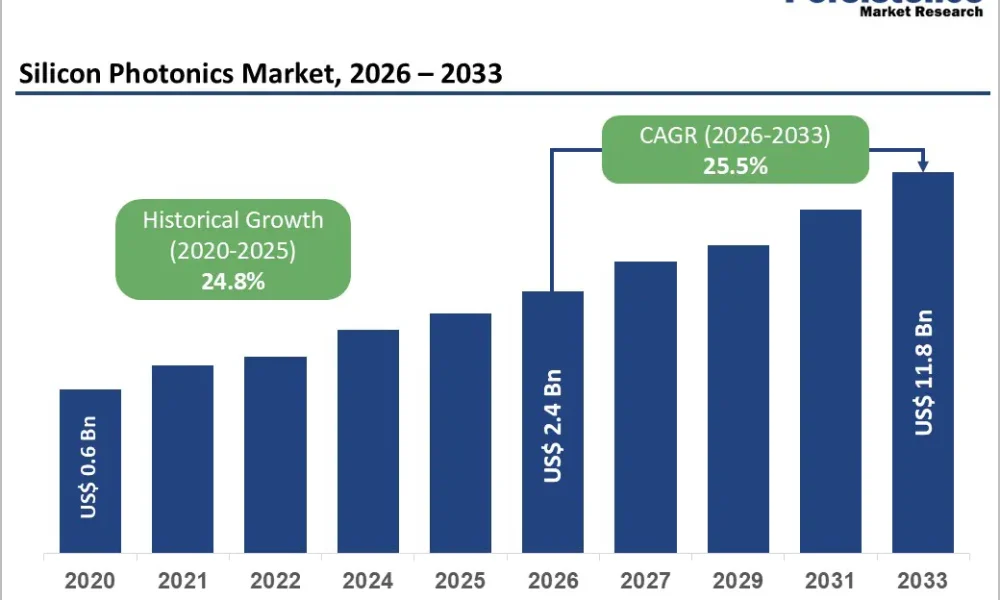
The global silicon photonics market is entering a high-growth phase, projected to increase from US$ 2.4 billion in 2026 to US$ 11.8 billion by 2033, registering a remarkable 25.5% CAGR during the forecast period.
This rapid expansion reflects the explosive growth of AI workloads, hyperscale data centers, and high-performance computing (HPC) architectures. As electrical interconnects approach physical bandwidth and power limits, silicon photonics is emerging as the enabling technology for ultra-fast, energy-efficient optical communication.
Why Silicon Photonics Is Gaining Momentum
Silicon photonics integrates optical components—such as lasers, modulators, and photodetectors—onto silicon chips using CMOS-compatible fabrication. This allows high-volume semiconductor manufacturing techniques to produce optical devices.
The result?
- Higher bandwidth density
- Lower power consumption per bit
- Reduced cooling requirements
- Smaller form factors
- Greater scalability
With AI servers now requiring multiple 800G optical transceivers—and moving toward 1.6T and beyond—traditional copper interconnects are no longer viable at scale.
Market Dynamics
Driver: AI Workloads and Hyperscale Data Centers
The single most powerful growth driver is AI infrastructure expansion.
Modern AI clusters rely on tens of thousands of GPUs interconnected through ultra-high-speed optical links. Every next-generation AI server deployment increases optical I/O density requirements significantly.
Silicon photonics offers:
- Lower energy per transmitted bit
- Reduced latency
- Support for high-radix switch designs
- Scalable bandwidth beyond 800G
Cooling systems typically account for nearly 40% of data-center energy consumption. By lowering power consumption at the interconnect level, silicon photonics directly reduces operational costs and improves sustainability metrics.
Major technology leaders such as Intel Corporation and Cisco Systems are actively advancing silicon-photonics-enabled switch and transceiver platforms targeting AI-ready network fabrics.
Driver: Government Funding and Innovation Ecosystems
Public-private partnerships are strengthening silicon photonics ecosystems globally.
In the United States alone, over US$ 300 million has been committed toward integrated photonics institutes, manufacturing platforms, and advanced packaging research.
Similarly:
- Europe is investing in pilot production lines and quantum communication platforms.
- Asia Pacific governments are strengthening semiconductor self-reliance initiatives.
These programs reduce barriers for fabless designers and encourage standardized CMOS-compatible photonics platforms.
Foundries such as GlobalFoundries and research-driven firms like IBM play critical roles in enabling scalable photonic integrated circuit (PIC) production.
Market Restraints
Fabrication Complexity and Yield Challenges
Despite CMOS compatibility, silicon photonics manufacturing remains technically demanding.
Key challenges include:
- Integration of III-V lasers with silicon substrates
- Managing thermal stability
- Achieving low optical loss coupling
- Packaging precision
Yield variability can impact average selling prices and shipment forecasts. Telecom operators, in particular, require long-term reliability validation before adopting new photonic architectures.
As fabrication processes mature, these bottlenecks are expected to ease—but they currently moderate full-scale commercialization.
Limited Standardization and Interoperability
While organizations like IEEE are standardizing 400G and 800G optical interfaces, inconsistencies remain across:
- Modulation formats
- Thermal tuning mechanisms
- Control electronics
- Packaging methods
This fragmentation increases system-integration complexity and slows economies of scale.
Improved multi-vendor interoperability will be critical to accelerating adoption across telecom and access networks.
Market Opportunities
Co-Packaged Optics (CPO) and Converged Switching
One of the most transformative opportunities lies in co-packaged optics.
Instead of pluggable optical modules, switching silicon and photonic engines are integrated directly into the same package.
Benefits include:
- More than 50% power reduction in 51.2 Tb/s platforms
- Lower signal loss
- Higher port density
- Reduced system footprint
Companies such as Coherent Corp. and InnoLight Technology are already demonstrating 1.6 Tb/s-class silicon photonics transceivers, signaling strong commercial readiness.
As AI mega-data centers scale, co-packaged optics will likely redefine interconnect architecture.
Expansion into LiDAR, Healthcare, and Sensing
Beyond data centers, silicon photonics is unlocking multi-industry growth:
Automotive LiDAR
Enables compact, solid-state sensing for ADAS and autonomous driving.
Healthcare Diagnostics
Supports biosensing, medical imaging, and optical coherence tomography.
Industrial & Environmental Sensing
Provides high-sensitivity detection in compact footprints.
Companies like Hamamatsu Photonics and STMicroelectronics are advancing photonic sensing platforms.
These adjacent markets significantly expand the long-term revenue base beyond telecom and cloud applications.
Elevate your business strategy with comprehensive market data. Request a sample report now: https://www.persistencemarketresearch.com/samples/5930
Category-Wise Analysis
By Component
Lasers and modulators represent the largest revenue share, with lasers contributing nearly 35% of total value.
Their importance lies in:
- Enabling 400G/800G data-center connections
- Supporting coherent telecom systems
- Driving signal integrity in dense optical links
As bandwidth requirements escalate, performance enhancements in these components will remain central to innovation.
By Product
Silicon photonics transceivers dominate, accounting for around 60% of total market revenue.
Their success stems from:
- Proven scalability since the mid-2010s
- High-density optical I/O integration
- Energy efficiency
- Compact footprint
Vendors such as Broadcom Inc. and Marvell Technology are heavily investing in next-generation 800G and 1.6T transceiver platforms.
Transceivers are expected to remain the primary revenue engine through 2033.
By Application
Data Center and HPC account for approximately 40% of global silicon photonics demand.
Key drivers include:
- Hyperscale cloud campus expansion
- AI training clusters
- Edge computing growth
- Government supercomputing upgrades
Compared to telecom or consumer electronics, data centers offer faster refresh cycles and significantly larger deployment volumes, ensuring sustained leadership.
Regional Insights
North America: Market Leader (41.2% Share)
North America remains the dominant region, supported by:
- Strong presence of hyperscale cloud providers
- Leading semiconductor manufacturers
- Federal investment in photonics R&D
- Energy-efficiency regulations
Companies such as Intel Corporation and Juniper Networks are actively integrating silicon photonics into AI and cloud networking platforms.
The region leads in both adoption and innovation.
Europe: Research-Driven Expansion
Europe’s growth is fueled by:
- Advanced photonics research institutes
- Multi-project wafer programs
- EU semiconductor funding initiatives
- Sustainability-focused digital infrastructure policies
Germany, France, the Netherlands, and the U.K. are leading adoption across telecom and quantum communication research.
Energy-efficiency mandates under the European Green Deal further encourage silicon-photonics-based interconnects.
Asia Pacific: Fastest Growing Region (30.7% CAGR)
Asia Pacific is emerging as the fastest-growing market.
Drivers include:
- Strong semiconductor manufacturing base
- AI and 5G investments
- Cloud infrastructure expansion
- Government-backed digital programs
Countries such as China, Japan, South Korea, and Taiwan host advanced foundries and packaging centers.
The region also benefits from strong ecosystem participation by companies such as Infinera Corporation and Synopsys, supporting scalable PIC design and commercialization.
Competitive Landscape
The silicon photonics market is moderately concentrated, featuring a mix of semiconductor giants and specialized photonics innovators.
Key Players Include:
- Intel Corporation
- Cisco Systems
- Broadcom Inc.
- IBM
- GlobalFoundries
- Lumentum Operations
- STMicroelectronics
- Coherent Corp.
Strategic Focus Areas:
- 800G and 1.6T optical interconnects
- Co-packaged optics
- Heterogeneous integration
- Energy-efficient AI networking
- Advanced packaging innovations
Strategic partnerships between foundries, packaging houses, and hyperscale operators are becoming central to competitive advantage.
Future Outlook
Silicon photonics is transitioning from a niche telecom innovation to a foundational AI-era infrastructure technology.
Over the next decade, we can expect:
- Commercialization of 1.6T and multi-terabit optical links
- Widespread co-packaged optics deployment
- Expansion into LiDAR and healthcare sensing
- Improved fabrication yields and cost reduction
- Greater interoperability and industry standardization
As AI clusters scale to unprecedented levels, silicon photonics will become indispensable for delivering bandwidth, density, and energy efficiency at scale.
Conclusion
The global silicon photonics market is on track to grow from US$ 2.4 billion in 2026 to US$ 11.8 billion by 2033, expanding at a powerful 25.5% CAGR.
Driven by AI infrastructure, hyperscale cloud growth, co-packaged optics innovation, and multi-industry sensing applications, silicon photonics is poised to become one of the most critical enabling technologies of the digital economy.
With strong support from North America, rapid acceleration in Asia Pacific, and increasing cross-industry adoption, the market’s growth trajectory remains exceptionally robust through 2033 and beyond.
Related Reports:




