
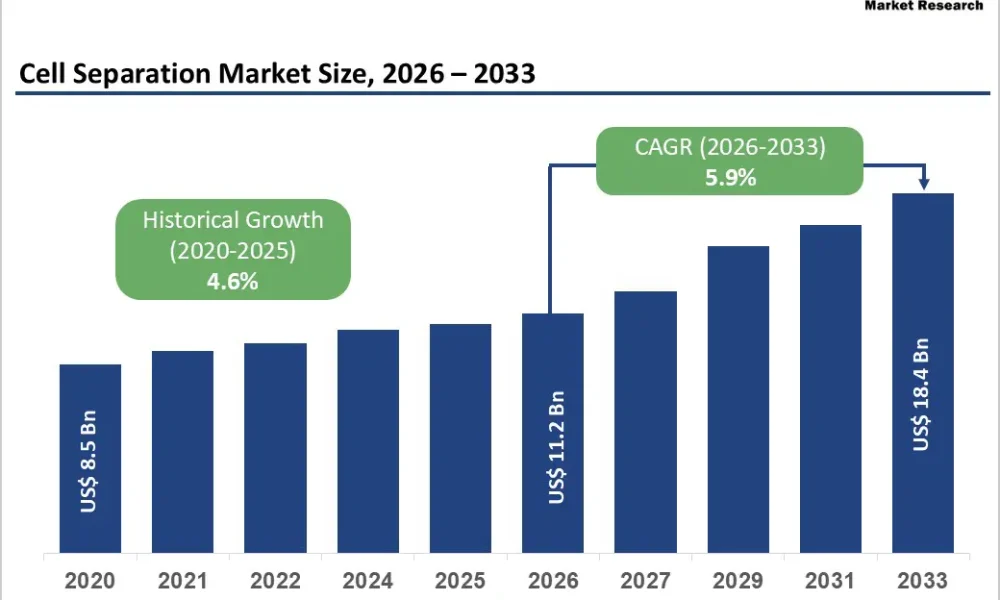
The global cell separation market is witnessing steady growth, driven by the increasing demand for advanced cellular analysis in clinical, research, and biopharmaceutical applications. The market, valued at approximately US$ 11.2 billion in 2026, is projected to reach US$ 18.4 billion by 2033, growing at a compound annual growth rate (CAGR) of 5.9% from 2026 to 2033. Cell separation technologies, including magnetic-activated cell sorting, fluorescence-based separation, and microfluidics, are critical in isolating specific cell populations for diagnostics, biomarker discovery, immunophenotyping, and therapeutic development. Rising prevalence of chronic and life-threatening diseases such as cancer, autoimmune disorders, cardiovascular conditions, and infectious diseases is further expanding the adoption of cell separation solutions across hospitals, diagnostic laboratories, academic institutions, and biopharmaceutical facilities.
North America currently dominates the global cell separation market, accounting for 48.5% of the total share, due to its advanced research infrastructure, strong funding for biomedical research, high prevalence of chronic diseases, and early adoption of innovative technologies. The consumables segment is the leading product type, driven by recurring demand in routine workflows and cell therapy manufacturing. Meanwhile, the Asia-Pacific region is the fastest-growing market, benefiting from expanding biotechnology research, government investments in life sciences, and increasing healthcare access. Human cells remain the largest cell type segment due to their central role in clinical diagnostics, oncology studies, and therapeutic research, while animal cells are growing rapidly in preclinical and drug discovery applications. The market is characterized by continuous technological innovations, including automation, closed systems, and enhanced reagents, which are improving accuracy, throughput, and reproducibility.
Download Your Free Sample & Explore Key Insights: https://www.persistencemarketresearch.com/samples/33252
Key Highlights from the Report
• The global cell separation market is projected to grow from US$ 11.2 billion in 2026 to US$ 18.4 billion by 2033.
• North America holds the largest market share at 48.5%, driven by advanced research infrastructure and early adoption of technology.
• Asia-Pacific is the fastest-growing region, supported by increasing biotechnology investments and healthcare infrastructure expansion.
• Consumables lead the product segment due to their recurring usage and essential role in workflows.
• Human cells dominate the cell type segment, critical for clinical research, diagnostics, and therapeutic development.
• Rapid growth is seen in kits and reagents, fueled by rising demand in oncology, chronic disease care, and home health applications.
Market Segmentation
The global cell separation market is segmented by product type, application, end-user, and cell type. By product type, consumables, including reagents, buffers, beads, and disposable components, dominate the market due to recurring use in laboratories, hospitals, and biopharmaceutical production facilities. Kits and reagents are the fastest-growing segment as targeted therapeutic and diagnostic workflows expand. By application, biomolecule isolation is the leading segment, driven by demand for DNA, RNA, protein, and other cellular component extraction in genomics, proteomics, and precision medicine research. Other applications include immunology, oncology studies, stem cell research, and companion diagnostics. End-user segmentation highlights hospitals as the dominant sector, providing diagnostic testing, oncology treatment, and cell-based therapeutic services. Academic and research institutes, as well as biopharmaceutical companies, contribute to innovation and development-driven demand. Cell type segmentation is primarily divided into human and animal cells, with human cells remaining the largest segment due to their use in clinical research and therapy, while animal cells are increasingly used in preclinical research and drug discovery.
Regional Insights
North America continues to lead the cell separation market globally, driven by the United States’ robust life sciences ecosystem, advanced laboratory infrastructure, and widespread adoption of automated, surface-marker-based separation technologies. High funding levels for biomedical research, oncology, and cell therapy pipelines further reinforce the region’s market dominance. Europe is experiencing steady growth, supported by strong academic research networks, expanding biopharmaceutical manufacturing, and a focus on advanced diagnostics. Countries like Germany, the U.K., France, and Italy are major contributors due to well-developed research facilities and public healthcare systems. The Asia-Pacific region is expected to register the highest CAGR, fueled by increasing investments in biotechnology, pharmaceutical manufacturing, and academic research. Countries including China, India, Japan, and South Korea are expanding healthcare infrastructure, laboratory modernization, and adoption of cell therapy research, contributing to strong market growth. Latin America and the Middle East & Africa are emerging markets, with growth supported by increasing healthcare investments, rising disease prevalence, and expanding research activities.
Get Custom Insights Designed for Your Business: https://www.persistencemarketresearch.com/request-customization/33252
Market Drivers
The rising global burden of chronic and life-threatening diseases, including cancer, autoimmune disorders, infectious diseases, and cardiovascular conditions, is a major driver for the cell separation market. Cell separation is essential for isolating specific cell populations to support disease profiling, biomarker discovery, immunophenotyping, and monitoring treatment efficacy. The increasing adoption of cell-based assays in oncology, immunology, and regenerative medicine further reinforces demand. Technological advancements, including automated platforms, microfluidics, magnetic and fluorescence-based separation, and closed-system workflows, are improving accuracy, throughput, and reproducibility. Integration with downstream analytical tools and data management systems enhances workflow efficiency, reduces contamination risk, and enables regulatory compliance. The expanding pipeline of cell and gene therapies, along with rising adoption of precision medicine and immunotherapy, continues to fuel sustained market growth.
Market Restraints
Despite its rapid growth, the cell separation market faces challenges due to high technology costs and operational complexity. Sophisticated instruments, proprietary consumables, and specialized reagents require significant capital investment, limiting adoption among smaller laboratories and emerging markets. Recurring expenses related to consumables, maintenance, and calibration further increase the total cost of ownership. Operational complexity also poses a barrier, as workflows require skilled personnel, strict adherence to protocols, and controlled environments to ensure high cell purity and viability. Variability in biological samples and stringent regulatory requirements further increase implementation timelines and operational burden. Limited reimbursement for advanced cellular diagnostics in certain regions also constrains broader adoption, causing some institutions to rely on conventional or lower-cost alternatives.
Market Opportunities
The rapid expansion of cell and gene therapy represents a significant growth opportunity. Increasing investments in immunotherapies, stem cell therapies, and regenerative medicine are driving demand for high-purity, scalable, and reproducible cell isolation solutions. Automated, closed-system platforms are gaining traction due to their ability to reduce contamination risks, minimize labor dependency, and improve process consistency. Emerging markets offer additional potential as governments invest in biotechnology infrastructure and research funding, while academic-industry collaborations accelerate technology adoption. Personalized medicine initiatives, rising demand for GMP-compliant manufacturing, and integration with digital process monitoring tools are creating new avenues for long-term market expansion. Overall, the combination of therapeutic innovation, automation, and regional growth is expected to generate significant opportunities for cell separation solution providers.
Checkout Now & Download Complete Market Report: https://www.persistencemarketresearch.com/checkout/33252
Company Insights
• Thermo Fisher Scientific, Inc. – Offers a broad portfolio of cell separation instruments, consumables, and reagents.
• BD – Provides flow cytometry and magnetic-based cell separation solutions for research and clinical applications.
• Danaher – Supplies automated cell sorting systems and consumables across research and manufacturing settings.
• Terumo Corp. – Focuses on clinical and therapeutic applications of cell separation technologies.
• STEMCELL Technologies Inc. – Offers innovative cell separation kits, reagents, and workflow solutions.
• Bio-Rad Laboratories, Inc. – Provides biomolecule isolation solutions and research instruments.
• Merck KGaA – Supplies reagents and consumables for advanced cell separation protocols.
• Agilent Technologies, Inc. – Offers analytical tools and integrated solutions supporting cell separation.
• Corning Inc. – Focuses on laboratory consumables and separation devices for clinical and research use.
• Akadeum Life Sciences – Specializes in buoyancy-based cell separation systems and microbubble technology.
• Miltenyi Biotec – Provides magnetic cell sorting systems and GMP-compliant separation solutions.
Recent Developments:
In September 2025, Cayman Chemical partnered with Akadeum Life Sciences to expand access to next-generation cell isolation solutions for cell and gene therapy development.
In January 2025, Akadeum Life Sciences reported strong results from its early access program for the Alerion™ Microbubble Cell Separation System, demonstrating high-capacity, rapid, and gentle cell isolation for therapeutic applications.
Conclusion
The global cell separation market is poised for robust growth over the next decade, driven by rising chronic disease prevalence, advancements in cell-based research, and expanding cell and gene therapy pipelines. Technological innovations, including automated systems, microfluidics, and surface marker-based separation, are improving efficiency, reproducibility, and scalability, while consumables remain the largest product segment due to recurring usage. North America continues to dominate the market, supported by advanced research infrastructure and high adoption rates, whereas Asia-Pacific represents the fastest-growing region with increasing investment in biotechnology and healthcare infrastructure. Despite challenges posed by high costs and operational complexity, opportunities arising from personalized medicine, automated platforms, and emerging markets are creating significant avenues for growth. With strong competition among key players and ongoing technological advancements, the cell separation market is expected to evolve rapidly, providing critical solutions for clinical diagnostics, research, and therapeutic development.




