
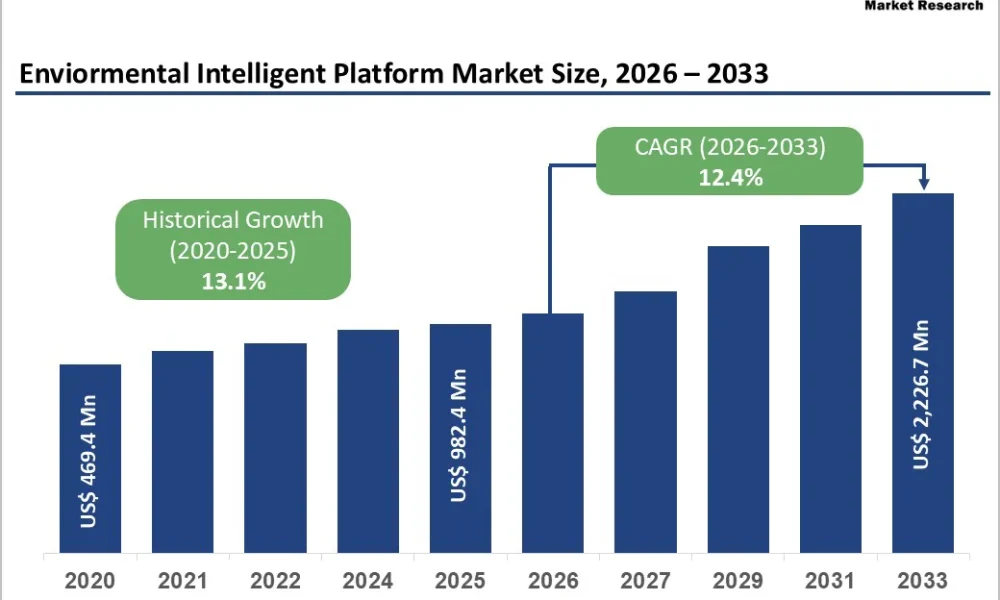
The global environmental intelligent platform market is entering a transformative growth phase as organizations shift from basic compliance reporting to real-time, AI-driven environmental intelligence. The market is projected to grow from US$ 982.4 million in 2026 to US$ 2,226.7 million by 2033, registering a robust CAGR of 12.4% during the forecast period.
This strong expansion is fueled by tightening global environmental regulations, increasing corporate sustainability commitments, and rapid adoption of artificial intelligence (AI), Internet of Things (IoT), and cloud technologies for automated environmental monitoring and reporting.
From carbon accounting to water quality tracking and supply chain emission visibility, environmental intelligent platforms are becoming mission-critical systems across industries.
Market Overview
Environmental intelligent platforms are integrated digital systems that collect, analyze, and report environmental data in real time. These platforms help organizations:
- Monitor Scope 1, 2, and 3 emissions
- Track regulatory compliance
- Optimize energy and resource usage
- Generate ESG and sustainability reports
- Support carbon trading and net-zero strategies
The historical market growth between 2020 and 2025 stood at 13.1% CAGR, indicating sustained momentum that is expected to continue as regulatory frameworks intensify globally.
Key Industry Highlights
- North America Maintains Market Leadership
North America commands approximately 40% of global market share in 2025, supported by:
- Strong regulatory frameworks such as EPA guidelines
- SEC climate disclosure requirements
- Mature IT and cloud infrastructure
- High corporate ESG adoption
The U.S. market continues to lead in enterprise-scale deployment of AI-powered environmental analytics platforms.
- Asia-Pacific Emerges as the Fastest-Growing Region
Asia-Pacific is projected to expand at a CAGR of 16% from 2026 to 2033, driven by:
- China’s carbon market launch
- India’s BRSR reporting framework
- Rapid manufacturing digital transformation
- Government-led environmental initiatives
Countries like China and India are integrating environmental monitoring with smart manufacturing and urban sustainability programs.
- Cloud-Based Platforms Dominate the Market
Cloud-based solutions account for nearly 70% market share in 2025, as organizations prefer:
- Scalable subscription-based pricing
- Faster deployment
- Remote access across multi-site operations
- Seamless integration with ERP and enterprise systems
Cloud-native environmental platforms allow organizations to move from periodic reporting to continuous monitoring.
- Sustainability Management Is the Fastest-Growing Application
While compliance management leads today, sustainability management applications are projected to grow at a 16% CAGR through 2032, as organizations increasingly integrate ESG goals into core strategy.
- Aerospace & Aviation Offer High-Growth Opportunities
The aerospace and aviation segment is forecast to expand at 18% CAGR, driven by:
- EU Emissions Trading System (EU ETS)
- ICAO’s CORSIA framework
- ReFuelEU aviation mandates
Airlines and aerospace manufacturers require advanced emissions tracking and reporting capabilities to meet international climate obligations.
Market Drivers
Stringent Environmental Regulations Driving Demand
Regulatory pressure is the most powerful growth catalyst.
The European Union’s Corporate Sustainability Reporting Directive (CSRD) requires detailed climate disclosures with escalating assurance requirements. India’s Business Responsibility and Sustainability Reporting (BRSR) mandates Scope 3 disclosures for leading listed companies. The SEC climate-related rules further strengthen compliance requirements in the U.S.
Failure to comply can result in:
- Financial penalties
- Regulatory sanctions
- Reputational damage
- Investor withdrawal
This makes environmental intelligent platforms a non-negotiable investment for governance and compliance.
AI, IoT, and Cloud Integration Transforming Environmental Monitoring
Advanced technologies are redefining environmental intelligence:
- Machine learning enables predictive emissions forecasting
- IoT sensors provide real-time data on temperature, air quality, waste, and water usage
- Cloud computing supports centralized monitoring across global operations
Organizations are shifting from reactive reporting to predictive environmental risk management.
Market Restraints
High Implementation Costs
Enterprise-grade environmental platforms require:
- Software licensing fees
- Infrastructure upgrades
- ERP integrations
- Data cleansing and standardization
- Employee training
These costs create adoption barriers, especially for small and mid-sized enterprises.
Cybersecurity and Data Privacy Concerns
Environmental data is increasingly considered strategic corporate information. Sensitive emissions data, supply chain information, and sustainability roadmaps must be protected from:
- Data breaches
- Intellectual property risks
- Regulatory violations
Strict frameworks like GDPR increase compliance complexity for multinational corporations.
Emerging Opportunities
Environmental Health Monitoring in Healthcare & Government
The integration of environmental data with public health initiatives presents a significant opportunity. With telemedicine adoption expanding, environmental monitoring systems that track indoor air quality and exposure risks are gaining importance.
Governments investing in smart city initiatives are embedding environmental intelligence systems for:
- Real-time pollution tracking
- Water management
- Renewable energy integration
- Climate adaptation planning
Precision Agriculture & Agricultural Digitalization
Agriculture is becoming a major growth avenue for environmental intelligent platforms.
By combining satellite imagery, IoT soil sensors, and machine learning, farmers can:
- Optimize irrigation
- Reduce fertilizer usage
- Monitor soil carbon
- Improve yield forecasting
Climate-smart agriculture initiatives in India, China, and ASEAN nations are accelerating adoption.
Elevate your business strategy with comprehensive market data. Request a sample report now: https://www.persistencemarketresearch.com/samples/32995
Category-Wise Analysis
Solution Insights
Cloud-based platforms dominate due to flexibility and cost efficiency. They allow enterprises to scale across regions and ensure centralized compliance management.
On-premises systems remain preferred in highly regulated sectors such as defense and energy, where data sensitivity is critical.
Application Insights
- Regulatory Compliance (45% market share in 2025)
- Sustainability management (fastest growing)
- Carbon accounting
- Risk management
- Resource optimization
The shift from compliance-only platforms to strategic sustainability intelligence systems is reshaping market demand.
Industry Insights
Industrial manufacturing accounts for approximately 35% market share, driven by emissions intensity and regulatory scrutiny.
Aerospace and aviation lead growth due to international carbon frameworks.
Energy, utilities, chemicals, pharmaceuticals, and logistics also represent high-value sectors.
Regional Insights
North America
The U.S. leads adoption due to regulatory mandates and investor-driven ESG accountability. Strong cloud infrastructure and AI innovation further strengthen market dominance.
Canada contributes through national climate commitments and enterprise sustainability initiatives.
Europe
Europe remains a regulatory pioneer. The CSRD framework significantly expands reporting obligations across companies operating within the EU.
Countries such as Germany, the UK, and France are accelerating platform deployment to align with EU Taxonomy and emissions trading regulations.
Asia-Pacific
Asia-Pacific represents the most dynamic expansion zone.
China’s emissions trading system and India’s carbon credit trading scheme are creating structured demand for emissions data management platforms.
Manufacturing digitalization across ASEAN nations further strengthens growth prospects.
Competitive Landscape
The market exhibits moderate consolidation, with major enterprise software vendors competing alongside specialized environmental technology firms.
Leading players include:
- IBM Corporation
- Intelex Technologies
- Enablon
- IsoMetrix
- SAP SE
- Wolters Kluwer
- IFS
These companies differentiate through:
- AI-powered predictive analytics
- Automated compliance reporting
- Industry-specific modules
- ERP integration capabilities
- Managed services offerings
Strategic collaborations and platform expansion remain key competitive strategies.
Key Market Developments
- March 2024: IFS collaborated with PwC to integrate sustainability management modules within its cloud ecosystem.
- June 2024: Intelex enhanced IoT-based monitoring for real-time compliance automation.
- September 2024: Enablon launched enhanced CSRD reporting dashboards with Scope 3 tracking features.
Future Outlook (2026–2033)
The environmental intelligent platform market is transitioning from a compliance-driven segment to a strategic sustainability intelligence ecosystem.
Key future trends include:
- AI-driven climate risk modeling
- Blockchain-based carbon credit verification
- Supply chain emissions transparency
- Industry-specific ESG benchmarking
- Integration with digital twin technologies
By 2033, environmental intelligence will likely become embedded within enterprise digital architecture, similar to ERP and CRM systems.
Organizations that invest early in intelligent environmental data infrastructure will gain competitive advantages in regulatory compliance, investor confidence, operational efficiency, and brand positioning.
Conclusion
The environmental intelligent platform market is poised for significant expansion, growing from US$ 982.4 million in 2026 to US$ 2,226.7 million by 2033 at a CAGR of 12.4%.
Regulatory mandates, technological advancements, sustainability-driven corporate strategies, and regional policy developments are collectively reshaping the environmental data management landscape.
As climate accountability becomes central to corporate governance and financial reporting, environmental intelligent platforms will evolve from operational tools to strategic decision-making engines powering the global sustainability transformation.
Related Reports:




