
The global glycomic therapeutics market is emerging as a dynamic segment within the biotechnology and pharmaceutical landscape. Glycomic therapeutics leverage the complex biology of glycans—carbohydrate molecules attached to proteins and lipids—to create precision-targeted therapies for diseases such as cancer, metabolic disorders, and rare genetic conditions. These therapeutics include glycoproteins, synthetic glycans, glycan analogs, and enzyme-based therapeutics, all designed to influence cellular pathways, immune responses, and metabolic processes.
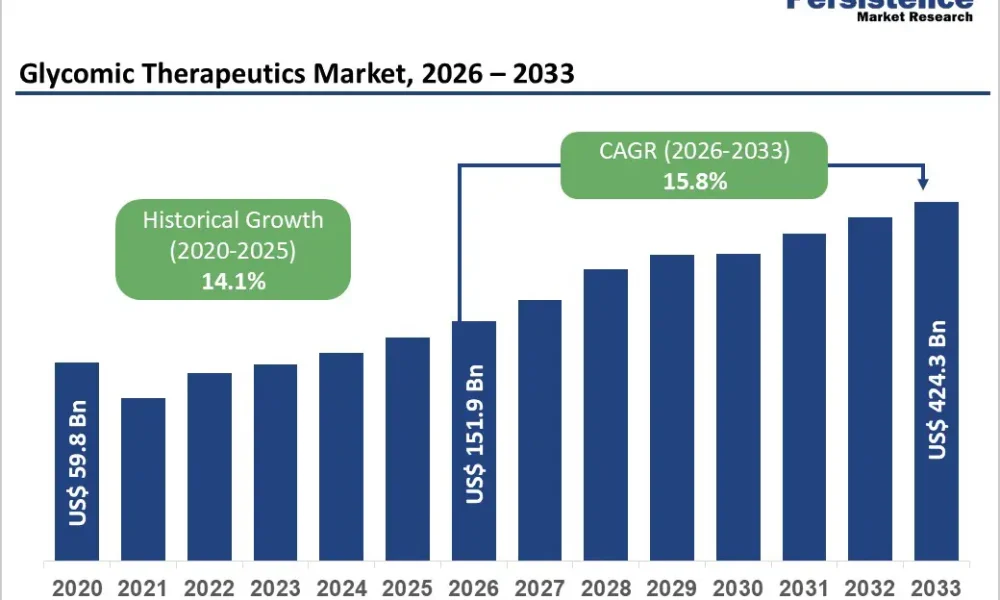
As of 2026, the market is projected to reach US$151.9 billion, with expectations to grow to US$424.3 billion by 2033, reflecting a CAGR of 15.8%. North America leads the market due to strong R&D investment, established clinical trial infrastructure, and regulatory support. Synthetic glycan analogs dominate the product segment, representing about 58.4% of the market, while Asia-Pacific is the fastest-growing region due to expanding research institutes, biotechnology investments, and collaborations with global pharmaceutical companies.
Download Your Free Sample & Explore Key Insights: https://www.persistencemarketresearch.com/samples/33227
Key Highlights from the Glycomic Therapeutics Market
• Synthetic glycan analogs dominate the market, accounting for 58.4% of total revenue.
• North America remains the largest regional market with 39.3% of global revenue.
• Asia-Pacific is the fastest-growing region due to biotechnology investments and clinical trial expansion.
• Rising prevalence of cancer, metabolic disorders, and rare genetic diseases drives demand.
• Development of next-generation glycan-modifying enzymes presents significant market opportunities.
• Increasing R&D collaborations and government support are accelerating therapeutic innovation.
Market Segmentation
The glycomic therapeutics market can be segmented based on product type, therapeutic class, and end-user adoption.
By Product Type: The market primarily includes synthetic glycan analogs, natural glycans, glycoproteins, and glyco-engineered enzymes. Synthetic glycans lead the market due to their structural precision, scalable production, and regulatory acceptance. Natural glycans face challenges because of heterogeneity and manufacturing variability. Glycoproteins are widely used in monoclonal antibodies, enzyme replacement therapies, and recombinant hormones due to established safety and efficacy.
By Therapeutic Class: Applications span oncology, metabolic disorders, rare genetic diseases, and infectious diseases. Oncology therapies are rapidly growing, as glycan-targeted therapeutics can modulate tumor microenvironments and enhance drug delivery specificity. Enzyme replacement and glycan-modifying therapies are critical for metabolic and rare genetic disorders.
By End-User: Hospitals, specialty clinics, and research institutions are the main end-users. Hospitals and clinics adopt these therapies for precision medicine programs, while research institutions drive drug discovery, clinical trials, and preclinical studies. AI-enabled glycomics platforms in research labs accelerate innovation and therapeutic development.
Regional Insights
North America dominates the market, driven by high R&D investment, advanced clinical trial infrastructure, and a supportive regulatory framework. Key biotechnology hubs such as Boston, San Francisco, and San Diego provide world-class laboratories, GMP manufacturing, and skilled workforce, fostering innovation in glycan-based therapies.
Europe is a major development hub, supported by programs like Horizon Europe, which invests heavily in life sciences. Strong academic-industry collaborations, established biomanufacturing clusters, and a robust EMA regulatory framework position Europe as a critical market for glycomic therapeutics.
Asia-Pacific is the fastest-growing region due to rapid expansion of biotechnology research, clinical trials, and biologics manufacturing. China, Japan, India, and South Korea are investing heavily in life sciences infrastructure. Increasing disease burden, growing healthcare investment, and rising adoption of advanced biologics support strong regional growth.
Get Custom Insights Designed for Your Business: https://www.persistencemarketresearch.com/request-customization/33227
Market Drivers
The glycomic therapeutics market is primarily driven by the rising global burden of cancer, metabolic disorders, and rare genetic diseases. Nearly 20 million new cancer cases were reported in 2022, with projections exceeding 30 million by 2040. Diabetes and other metabolic disorders affect over 537 million adults, expected to reach 643 million by 2030. Rare genetic disorders impact an estimated 300 million people worldwide. Glycan-targeted therapies, including synthetic glycans, enzyme-based drugs, and glyco-engineered biologics, offer mechanism-based solutions that traditional therapies cannot achieve, fueling market demand.
Technological advancements, such as chemoenzymatic synthesis and AI-driven glycomics platforms, further boost adoption by enabling precise glycan design, reproducible manufacturing, and regulatory compliance. Pharmaceutical companies increasingly integrate glycoengineering into biologics to improve efficacy, reduce immunogenicity, and enhance serum half-life.
Market Restraints
One of the main challenges for the glycomic therapeutics market is the high complexity of glycan structures and biosynthesis. Glycans are not template-driven like proteins or DNA, and cells generate highly diverse structures through branching, linkages, and chemical modifications. Out of nearly 40,000 cataloged glycans, fewer than 15,000 have fully characterized structures. This complexity increases development timelines, manufacturing costs, and regulatory hurdles. Specialized expertise is required for drug discovery, limiting the number of companies capable of developing glycan-based therapeutics efficiently.
Market Opportunities
Significant growth opportunities exist in next-generation synthetic glycans and glycan analogs. Synthetic glycans provide structural control, reproducibility, and scalable manufacturing while minimizing immunogenicity. FDA-approved synthetic drugs like fondaparinux demonstrate clinical and commercial success. Expanding synthetic glycan libraries, chemoenzymatic pathways, and AI-enabled discovery platforms enable therapeutics for cancer, inflammation, and rare diseases. As precision medicine grows, synthetic glycans offer customizable, mechanistically targeted therapies, representing a major opportunity for market expansion.
Checkout Now & Download Complete Market Report: https://www.persistencemarketresearch.com/checkout/33227
Company Insights
Key companies driving the glycomic therapeutics market focus on glycoengineering, synthetic glycan innovation, and biologic development. They invest in R&D, scalable manufacturing, and strategic partnerships to enhance therapeutic precision and expand pipelines. Leading players include:
• Intellihep Ltd
• Protalix Biotherapeutics
• BioMarin Pharmaceutical Inc.
• Genzyme Corporation (Sanofi)
• Halozyme Therapeutics, Inc.
• Bayer AG
Recent Developments:
In October 2025, Alberta, Canada, invested $2 million to advance glycomics research and strengthen drug development programs.
Global pharmaceutical companies have expanded collaborations with Asia-Pacific institutes to accelerate synthetic glycan discovery and commercialization.
Conclusion
The glycomic therapeutics market is poised for transformative growth, fueled by increasing demand for mechanism-based therapies, technological advancements in synthetic glycan design, and regional adoption in North America and Asia-Pacific. Despite challenges related to structural complexity and regulatory requirements, opportunities in next-generation synthetic glycans, AI-driven discovery, and biomanufacturing expansion offer a promising growth trajectory. With rising prevalence of cancer, metabolic disorders, and rare diseases, glycomic therapeutics will continue to play a pivotal role in precision medicine, reshaping the treatment landscape over the coming decade.




